

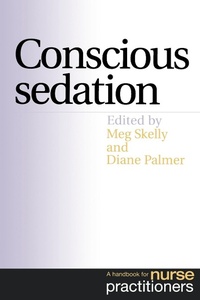
Conscious Sedation
A Handbook for Nurse Practitioners
1st Edition
Published on 15. February 2003
Book
Paperback/Softback
168 pages
978-1-86156-266-1 (ISBN)
Description
In retrospect, the dosage of IV sedatives used in the early days of endoscopy both in the USA and Great Britain was frequently too high. Today we are much more careful in the way we sedate patients being acutely aware of the fact that if the patient becomes unresponsive and verbal contact is lost then, by definition, a general anaesthetic has just been administered with all the clinical and legal implications that this holds. This expertly written book examines all aspects of conscious sedation and will be an essential reference for nurses and other health professionals involved in the clinical care of patients undergoing diagnostic or therapeutic procedures that require conscious sedation. Each chapter covers a particular area of the practice of conscious sedation and the authors come from a wide spectrum of clinical specialities.
More details
Language
English
Place of publication
New York
United States
Target group
Professional and scholarly
Product notice
Paperback (trade)
Unsewn / adhesive bound
Dimensions
Height: 229 mm
Width: 152 mm
Thickness: 9 mm
Weight
254 gr
ISBN-13
978-1-86156-266-1 (9781861562661)
Copyright in bibliographic data and cover images is held by Nielsen Book Services Limited or by the publishers or by their respective licensors: all rights reserved.
Schweitzer Classification
Other editions
Additional editions
E-Book
03/2006
1st Edition
Wiley
€60.99
Available for download
Persons
Meg Skelly is the editor of Conscious Sedation: A Handbook for Nurse Practitioners, published by Wiley.
Diane Palmer is the editor of Conscious Sedation: A Handbook for Nurse Practitioners, published by Wiley.
Diane Palmer is the editor of Conscious Sedation: A Handbook for Nurse Practitioners, published by Wiley.
Content
1. History of Sedation. 2. Physiology and Pharmacology.
3. Patient assessment.
4. Clinical Techniques.
5. Monitoring of The Sedated Patient.
6. Assessment of Sedation Levels.
7. Special Cases and Complications.
8. Professional and Legal Aspects.
3. Patient assessment.
4. Clinical Techniques.
5. Monitoring of The Sedated Patient.
6. Assessment of Sedation Levels.
7. Special Cases and Complications.
8. Professional and Legal Aspects.