

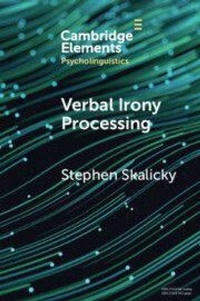
Verbal Irony Processing
Published on 2. February 2023
Book
Paperback/Softback
78 pages
978-1-009-23454-2 (ISBN)
Description
Ironic language is a salient reminder that speakers of all languages do not always mean what they say. While ironic language has captured the attention of theorists and scholars for centuries, it is only since the 1980s that psycholinguistic methods have been employed to investigate how readers and hearers detect, process, and comprehend ironic language. This Element reviews the foundational definitions, theories, and psycholinguistic models of ironic language, covering key questions such as the distinction between literal and ironic meaning, the role of contextual information during irony processing, and the cognitive mechanisms involved. These key questions continue to motivate new studies and methodological innovations, providing ample opportunity for future researchers who wish to continue exploring how ironic language is processed and understood.
More details
Series
Language
English
Place of publication
Cambridge
United Kingdom
Target group
College/higher education
Edition type
New edition
Product notice
Paperback (trade)
Illustrations
Worked examples or Exercises; 4 Tables, black and white
Dimensions
Height: 229 mm
Width: 152 mm
Thickness: 4 mm
Weight
118 gr
ISBN-13
978-1-009-23454-2 (9781009234542)
Copyright in bibliographic data and cover images is held by Nielsen Book Services Limited or by the publishers or by their respective licensors: all rights reserved.
Schweitzer Classification
Other editions
Additional editions
Stephen Skalicky
Verbal Irony Processing
E-Book
01/2023
Cambridge University Press
€22.49
Available for download
Stephen Skalicky
Verbal Irony Processing
E-Book
01/2023
Cambridge University Press
€22.49
Available for download
Person
Content
1. Introduction: Is it Ironic?; 2. Enter Psycholinguistics: Early Studies of Verbal Irony Processing; 3. Broadening the Scope: Later Psycholinguistic Studies; 4. Ears and Minds: Additional Contextual Influences; 5. Future Directions; 6. Conclusion: Isn't it Ironic?; References.