

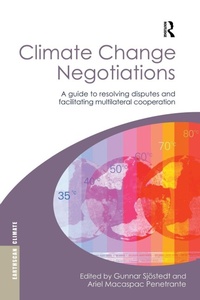
Climate Change Negotiations
A Guide to Resolving Disputes and Facilitating Multilateral Cooperation
1st Edition
Published on 9. June 2015
Book
Paperback/Softback
480 pages
978-1-138-92671-4 (ISBN)
Description
As the Kyoto Protocol limps along without the participation of the US and Australia, on-going climate negotiations are plagued by competing national and business interests that are creating stumbling blocks to success. Climate Change Negotiations: A Guide to Resolving Disputes and Facilitating Multilateral Cooperation asks how these persistent obstacles can be down-scaled, approaching them from five professional perspectives: a top policy-maker, a senior negotiator, a leading scientist, an international lawyer, and a sociologist who is observing the process.
The authors identify the major problems, including great power strategies (the EU, the US and Russia), leadership, the role of NGOs, capacity and knowledge-building, airline industry emissions, insurance and risk transfer instruments, problems of cost benefit analysis, the IPCC in the post-Kyoto situation, and verification and institutional design. A new key concept is introduced: strategic facilitation. 'Strategic facilitation' has a long time frame, a forward-looking orientation and aims to support the overall negotiation process rather than individual actors.
This book is aimed at academics, university students and practitioners who are directly or indirectly engaged in the international climate negotiation as policy makers, diplomats or experts.
The authors identify the major problems, including great power strategies (the EU, the US and Russia), leadership, the role of NGOs, capacity and knowledge-building, airline industry emissions, insurance and risk transfer instruments, problems of cost benefit analysis, the IPCC in the post-Kyoto situation, and verification and institutional design. A new key concept is introduced: strategic facilitation. 'Strategic facilitation' has a long time frame, a forward-looking orientation and aims to support the overall negotiation process rather than individual actors.
This book is aimed at academics, university students and practitioners who are directly or indirectly engaged in the international climate negotiation as policy makers, diplomats or experts.
More details
Language
English
Place of publication
London
United Kingdom
Publishing group
Taylor & Francis Ltd
Target group
College/higher education
Dimensions
Height: 234 mm
Width: 156 mm
Thickness: 26 mm
Weight
723 gr
ISBN-13
978-1-138-92671-4 (9781138926714)
Copyright in bibliographic data and cover images is held by Nielsen Book Services Limited or by the publishers or by their respective licensors: all rights reserved.
Schweitzer Classification
Other editions
Additional editions
Gunnar Sjoestedt | Ariel Macaspac Penetrante
Climate Change Negotiations
A Guide to Resolving Disputes and Facilitating Multilateral Cooperation
E-Book
04/2013
Routledge
€64.49
Available for download
Gunnar Sjoestedt | Ariel Macaspac Penetrante
Climate Change Negotiations
A Guide to Resolving Disputes and Facilitating Multilateral Cooperation
E-Book
04/2013
1st Edition
Routledge
€64.49
Available for download
Gunnar Sjoestedt | Ariel Macaspac Penetrante
Climate Change Negotiations
A Guide to Resolving Disputes and Facilitating Multilateral Cooperation
Book
03/2013
1st Edition
Earthscan Ltd
€233.40
Shipment within 3-4 weeks
Persons
Gunnar Sjoestedt is Director of Studies at the Swedish Institute of International Affairs, Associate Professor of Political Science at the University of Stockholm, and a member of the steering committee of the Processes of International Negotiations Program at IIASA. He has published extensively on international negotiation on environmental and economic affairs.
Ariel Macaspac Penetrante is a research fellow in the Institute for Infrastructure and Resources Management at the University of Leipzig in Germany.
Ariel Macaspac Penetrante is a research fellow in the Institute for Infrastructure and Resources Management at the University of Leipzig in Germany.
Content
Part 1: Introduction Part 2: Professional Perspectives 1. The perspective of a Politician - How Decisions are Made 2. The New Diplomacy from the Perspective of a Diplomat - Facilitation of the Post-Kyoto Climate Talks 3. Costs and Uncertanties in Climate Change Negotiations: A Scientist's Perspective 4. The Observing International Lawyer 5. Climate Talks - The Observing Sociologist Part 3: Stumbling blocks 6. Defining a Politically Feasible Path for Future Climate Negotiations - the EU-USA divide over the Kyoto Protocol 7. Between Two Giants - Lessons from the Russian Policy on Kyoto Protocol 8. Leadership and Climate Talks-Historical Lessons in Agenda Setting 9. GO Participation in the Global Climate Change Decision-making Process - A Key for Facilitating Climate Talks 10. Institutional Capacity to Facilitate Climate Change Negotiations 11. Stumbling Blocks in a Sectoral Approach - Addressing the Global Warming Effect through the Airline Industry 12. Overcoming stumbling blocks: Can the Intergovernmental Panel on Climate Change (IPCC) deliver in Adaptation? 13. Common but Differentiated Responsibilities - The North-South Divide in the Climate Change Negotiations 14. Developing a Legal Toolkit- Institutional Options to Remove Stumbling Blocks in the Climate Change Negotiations 15. Verification as a Precondition for Binding Commitments - Facilitation through Trust 16. Difficulties of Benefit-Cost Analysis in Climate Negotiations: Stumbling Blocks for Reaching an Agreement 17. Proposal for Insurance for Facilitation of Adaptation Part 4: Conclusion: Strategic Facilitation of Climate Talks