

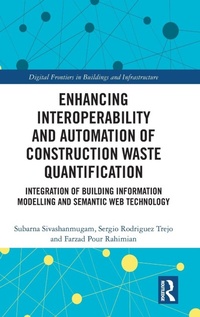
Enhancing Interoperability and Automation of Construction Waste Quantification
Integration of Building Information Modelling and Semantic Web Technology
1st Edition
Published on 28. July 2025
Book
Hardback
192 pages
978-1-032-99854-1 (ISBN)
Description
Enhancing Interoperability and Automation of Construction Waste Quantification outlines the construction waste quantification (CWQ) modelling that supports data-driven decision-making in the built environment. It presents how the functionalities of Building Information Modelling (BIM) and Semantic Web Technology are integrated to enhance the interoperability and automation of the CWQ process.
The research in this book shapes the development of a semantic framework that supports the built environment in quantifying construction waste (CW) and informing optimal material choices from early design stages to minimise the quantity and diversity of waste generation. The book also demonstrates the application of the proposed framework using an ontology (PROduct CIRcularity Ontology) and a BIM-integrated digital tool (Building Waste Tool [BWT]). The PRODCIRO and BWT inform how data, standardisation, consistency, and granularity could streamline and automate the CWQ process. The book also presents the outputs of a test-case building used to validate the adaptability and accuracy of the framework.
This book is a valuable resource for BIM and sustainability practitioners. It provides a comprehensive discussion on the significance of CW, its impacts on sustainability, advancements in CWQ, and data and information gaps within the existing CWQ practices. The solution proposed in the book will help the built environment to shift from reactive to proactive and preventive waste management.
The research in this book shapes the development of a semantic framework that supports the built environment in quantifying construction waste (CW) and informing optimal material choices from early design stages to minimise the quantity and diversity of waste generation. The book also demonstrates the application of the proposed framework using an ontology (PROduct CIRcularity Ontology) and a BIM-integrated digital tool (Building Waste Tool [BWT]). The PRODCIRO and BWT inform how data, standardisation, consistency, and granularity could streamline and automate the CWQ process. The book also presents the outputs of a test-case building used to validate the adaptability and accuracy of the framework.
This book is a valuable resource for BIM and sustainability practitioners. It provides a comprehensive discussion on the significance of CW, its impacts on sustainability, advancements in CWQ, and data and information gaps within the existing CWQ practices. The solution proposed in the book will help the built environment to shift from reactive to proactive and preventive waste management.
More details
Series
Language
English
Place of publication
London
United Kingdom
Publishing group
Taylor & Francis Ltd
Target group
College/higher education
Professional and scholarly
Academic and Postgraduate
Illustrations
4 s/w Zeichnungen, 59 farbige Abbildungen, 59 Farbfotos bzw. farbige Rasterbilder, 4 s/w Abbildungen
4 Line drawings, black and white; 59 Halftones, color; 59 Illustrations, color; 4 Illustrations, black and white
Dimensions
Height: 240 mm
Width: 161 mm
Thickness: 16 mm
Weight
473 gr
ISBN-13
978-1-032-99854-1 (9781032998541)
Copyright in bibliographic data and cover images is held by Nielsen Book Services Limited or by the publishers or by their respective licensors: all rights reserved.
Schweitzer Classification
Other editions
Additional editions
Subarna Sivashanmugam | Sergio Rodriguez Trejo | Farzad Pour Rahimian
Enhancing Interoperability and Automation of Construction Waste Quantification
Integration of Building Information Modelling and Semantic Web Technology
E-Book
07/2025
Routledge
€211.99
Available for download
Subarna Sivashanmugam | Sergio Rodriguez Trejo | Farzad Pour Rahimian
Enhancing Interoperability and Automation of Construction Waste Quantification
Integration of Building Information Modelling and Semantic Web Technology
E-Book
07/2025
Routledge
€211.99
Available for download
Persons
Subarna Sivashanmugam is Research Associate at the School of Computing, Engineering and Digital Technologies, Teesside University, UK.
Sergio Rodriguez-Trejo is Associate Professor of Research at the School of Computing, Engineering and Digital Technologies, Teesside University, UK.
Farzad Rahimian is Professor of Digital Engineering at the School of Computing, Engineering and Digital Technologies, Teesside University, UK
Sergio Rodriguez-Trejo is Associate Professor of Research at the School of Computing, Engineering and Digital Technologies, Teesside University, UK.
Farzad Rahimian is Professor of Digital Engineering at the School of Computing, Engineering and Digital Technologies, Teesside University, UK
Content
Chapter 1: Introduction
Chapter 2: Construction Waste - Definition, Classification, Sources Impacts, Management and Quantification
Chapter 3: Building Information Modelling, Semantic Web Technology, and Life Cycle Assessment
Chapter 4: BIM-based Semantic Construction Waste Quantification Framework
Chapter 5 Product Circularity Ontology - Design, Development and Validation
Chapter 6 Building Waste Tool - Design, Development and Validation
Chapter 7: Potentialities of the Construction Waste Quantification Framework
Chapter 8 Conclusions and Future Directions
Chapter 2: Construction Waste - Definition, Classification, Sources Impacts, Management and Quantification
Chapter 3: Building Information Modelling, Semantic Web Technology, and Life Cycle Assessment
Chapter 4: BIM-based Semantic Construction Waste Quantification Framework
Chapter 5 Product Circularity Ontology - Design, Development and Validation
Chapter 6 Building Waste Tool - Design, Development and Validation
Chapter 7: Potentialities of the Construction Waste Quantification Framework
Chapter 8 Conclusions and Future Directions