

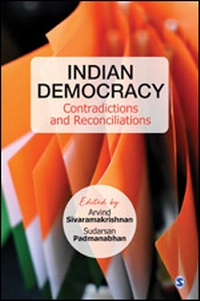
Indian Democracy
Contradictions and Reconciliations
1st Edition
Published on 20. October 2019
Book
Paperback/Softback
380 pages
978-93-5328-983-6 (ISBN)
Description
Indian Democracy: Contradictions and Reconciliations provides a vivid presentation of major facets of democracy in India. It aims to explore how Indian democracy has functioned, with reference to its theoretical foundations, institutional mechanisms and procedures, and political practices.
The book starts with a close analysis of the Constitution of India, which provides the theoretical validation for democratic politics and serves as a reflective and regulative ideal. It highlights the way adherence to democratic principles and nurturing of strong institutions have helped India negotiate and often reconcile contradictions such as caste inequalities, linguistic and ethnic identities, majority-minority divide, gender bias and divergences in the conception of democracy itself. Furthermore, the book delineates significant improvements in the maintenance of accurate electoral registers, enforcement of the Model Code of Conduct and use of electronic voting machines, considerable reductions in violence and intimidation in the recent decades, which have together contributed to strengthening the Indian voter's confidence in democratic processes. This edited book will prove indispensable for all those who are interested in a close understanding of democracy in India.
The book starts with a close analysis of the Constitution of India, which provides the theoretical validation for democratic politics and serves as a reflective and regulative ideal. It highlights the way adherence to democratic principles and nurturing of strong institutions have helped India negotiate and often reconcile contradictions such as caste inequalities, linguistic and ethnic identities, majority-minority divide, gender bias and divergences in the conception of democracy itself. Furthermore, the book delineates significant improvements in the maintenance of accurate electoral registers, enforcement of the Model Code of Conduct and use of electronic voting machines, considerable reductions in violence and intimidation in the recent decades, which have together contributed to strengthening the Indian voter's confidence in democratic processes. This edited book will prove indispensable for all those who are interested in a close understanding of democracy in India.
More details
Language
English
Place of publication
New Delhi
India
Target group
College/higher education
Professional and scholarly
Dimensions
Height: 216 mm
Width: 140 mm
Weight
440 gr
ISBN-13
978-93-5328-983-6 (9789353289836)
Copyright in bibliographic data and cover images is held by Nielsen Book Services Limited or by the publishers or by their respective licensors: all rights reserved.
Schweitzer Classification
Other editions
Additional editions
Book
02/2019
1st Edition
SAGE Publications India Pvt Ltd
€82.00
Article not available for order
Persons
Arvind Sivaramakrishnan is a former Visiting Professor and currently a member of the Guest Faculty, Department of Humanities and Social Sciences, Indian Institute of Technology Madras, Chennai. From 2008 to 2014, he was the Senior Deputy Editor on The Hindu, writing editorials, specialist articles, and book reviews on international politics, public policy, and political theory; he combined his duties with teaching and research as an Associate Professor at the Asian College of Journalism, Chennai. He took his degree, a postgraduate diploma in social administration, and doctorate as well as a professional teaching qualification at the University of Southampton, where he also taught politics. Since then, he has taught at Suffolk College, Ipswich, the Centre for Economic and Social Studies, Hyderabad, Southampton Institute of Higher Education (now Southampton Solent University), and Taunton's College (now Richard Taunton College), Southampton. He has published a range of academic papers in politics, political philosophy, public policy, and related fields, and has conducted research seminars and research training sessions at universities in the European Union and India. His books include Introduction to Political Ideologies (2017), Public Interest Journalism (2014), Public Policy and Citizenship (2012), Short on Democracy (2007), and Through a Glass Wall (2007).
Sudarsan Padmanabhan is Associate Professor in the Department of Humanities and Social Sciences, Indian Institute of Technology Madras, Chennai. He specializes in social and political philosophy, Indian philosophy and culture, and his research focus is on the confluence of law, democracy, and ethics in the public sphere. Sudarsan is the Co-coordinator of an Erasmus+ grant, funded by the European Union (EU) and coordinated by Aarhus University, Denmark. Sudarsan was also the Co-coordinator of Interdisciplinary Bridges for Indo-European Studies (IBIES), a consortium of 19 EU and Indian Higher Education institutions funded by Erasmus Mundus, coordinated by Aarhus University. He was Principal Investigator of the EU-funded Contemporary European Study Centres Project in India during 2010-2011; this research group works on Democracy and Development and Contemporary Global Politics. With Jyotirmaya Tripathy, Sudarsan coedited The Democratic Predicament: Cultural Diversity in Europe and India (2013) and Becoming Minority (2015); with Sonika Gupta, he coedited Politics in the Global Age: Critical Reflections on Sovereignty, Citizenship, Territory and Nationalism (2015).
Sudarsan Padmanabhan is Associate Professor in the Department of Humanities and Social Sciences, Indian Institute of Technology Madras, Chennai. He specializes in social and political philosophy, Indian philosophy and culture, and his research focus is on the confluence of law, democracy, and ethics in the public sphere. Sudarsan is the Co-coordinator of an Erasmus+ grant, funded by the European Union (EU) and coordinated by Aarhus University, Denmark. Sudarsan was also the Co-coordinator of Interdisciplinary Bridges for Indo-European Studies (IBIES), a consortium of 19 EU and Indian Higher Education institutions funded by Erasmus Mundus, coordinated by Aarhus University. He was Principal Investigator of the EU-funded Contemporary European Study Centres Project in India during 2010-2011; this research group works on Democracy and Development and Contemporary Global Politics. With Jyotirmaya Tripathy, Sudarsan coedited The Democratic Predicament: Cultural Diversity in Europe and India (2013) and Becoming Minority (2015); with Sonika Gupta, he coedited Politics in the Global Age: Critical Reflections on Sovereignty, Citizenship, Territory and Nationalism (2015).
Content
Introduction - Arvind Sivaramakrishnan and Sudarsan Padmanabhan
Part I: Democratic Principles and Their Applications in India
Democracy as Antinomy: Procedural versus Substantive - Sudarsan Padmanabhan
Electoral Issues and the Constitution of India - N.L. Rajah
Voter Education: Importance and Impact - S.Y. Quraishi
Proportional Representation - Arvind Sivaramakrishnan and Chris Terry
Part II: Political Processes
The Election Commission of India and General Elections - N. Gopalaswami
India's Democracy: Lost and Regained - M.G. Devasahayam
Reforming Politics and Elections through Legal Changes - Jagdeep Chhokar
Voters and Good Governance - Trilochan Sastry
Part III: The Practice of Democracy
Representing Women: Voting Rights and Women Legislators - Wendy Singer
Democracy as Emancipatory Politics - R. Azhagarasan
Gender Equity in Education among Muslims in India - Josephine Anthony and Sudarsan Padmanabhan
Organic Agriculture and India's Food Security - A.V. Balasubramanian
India's New Intellectual Property Policy: Passive Sovereignty - Chamundeeswari Kuppuswamy
The Practice of Democracy: Chennai Floods, 2015 - Arappor Iyakkam
Index
Part I: Democratic Principles and Their Applications in India
Democracy as Antinomy: Procedural versus Substantive - Sudarsan Padmanabhan
Electoral Issues and the Constitution of India - N.L. Rajah
Voter Education: Importance and Impact - S.Y. Quraishi
Proportional Representation - Arvind Sivaramakrishnan and Chris Terry
Part II: Political Processes
The Election Commission of India and General Elections - N. Gopalaswami
India's Democracy: Lost and Regained - M.G. Devasahayam
Reforming Politics and Elections through Legal Changes - Jagdeep Chhokar
Voters and Good Governance - Trilochan Sastry
Part III: The Practice of Democracy
Representing Women: Voting Rights and Women Legislators - Wendy Singer
Democracy as Emancipatory Politics - R. Azhagarasan
Gender Equity in Education among Muslims in India - Josephine Anthony and Sudarsan Padmanabhan
Organic Agriculture and India's Food Security - A.V. Balasubramanian
India's New Intellectual Property Policy: Passive Sovereignty - Chamundeeswari Kuppuswamy
The Practice of Democracy: Chennai Floods, 2015 - Arappor Iyakkam
Index