

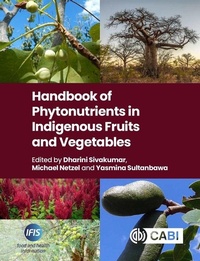
Handbook of Phytonutrients in Indigenous Fruits and Vegetables
Published on 10. November 2022
Book
Hardback
552 pages
978-1-78924-804-3 (ISBN)
Description
The effects of inadequate diets on the population include malnutrition, non-communicable diseases and obesity. 'Hidden hunger', also known as micronutrient deficiencies, leads to various health-related disorders and diseases. Indigenous plants, in the form of indigenous fruits and leafy vegetables are gaining interest as a source of nutrients and bioactive phytochemicals, satisfying both food demand and health needs. Moreover, with the impact of climate change, and the importance of sustainability of food systems, it is essential that we investigate new, forgotten and alternative crops that can thrive in harsh conditions, require low fertilizer input, and are easily harvestable. This book contains chapters on 33 understudied indigenous fruits and vegetables from all around the world, including African nightshade, amaranth, baobab fruit, Indian gooseberry, red bush apple and snake melon. Each chapter provides: An overview of plant botany. An understanding of the phytonutrient constituents and health-promoting properties of bioactive compounds or metabolites. Information on the biological activity of the functional compounds that will improve productivity and increase utilization of indigenous fruits and vegetables to sustain food security. Impacts of postharvest storage, processing, and traditional food preparation methods. Potential for new product development. This is an essential resource for academic researchers and industry professionals in the fields of horticulture, agriculture, crop science, human health and nutrition.
More details
Language
English
Place of publication
Wallingford
United Kingdom
Target group
College/higher education
Professional and scholarly
Dimensions
Height: 178 mm
Width: 250 mm
Thickness: 36 mm
Weight
1526 gr
ISBN-13
978-1-78924-804-3 (9781789248043)
Copyright in bibliographic data and cover images is held by Nielsen Book Services Limited or by the publishers or by their respective licensors: all rights reserved.
Schweitzer Classification
Persons
Dharini Sivakumar (Edited By)
Professor Dharini Sivakumar, Tshwane University of Technology, South Africa, obtained the prestigious South African Research Chair (SARChI) funding from the Department of Science and Innovation (DSI) / National Research Foundation (NRF) for "Phytochemical Food Network to Improve Nutritional Quality for Consumers". Her research programme focuses on establishing links by manipulating agronomic practices to improve phytonutrients; developing processes and methods or packaging to preserve phytonutrients; improving or developing fresh products or agro-processing rich in health-promoting compounds for "lunch boxes"; analysing nutrition and health relationships; gathering information on consumer behaviour and acceptance regarding nutritional quality; and formulating guidelines to improve phytochemical compounds via the farm-to-plate chain. These six steps closely link plant agronomics, food preservation and agro-processing to improve human health, livelihood and well-being. Diversification of crops using indigenous fruit and vegetable species has been identified as an important strategy for a healthy diet among the rural, peri-urban and urban regions of South Africa to alleviate the hidden hunger and to sustain food security. She has established a working programme with the rural African communities to promote cultivation and agro processing of traditional vegetables and fruits in Venda, South Africa which helped to develop entrepreneur skills, creation of employment, income generation and poverty alleviation.
Michael Netzel (Edited By)
Dr Michael Netzel's (The University of Queensland, Australia) main research interests are related to phytochemicals/functional ingredients, their analytical determination, binding characteristics within the plant (food) matrix, structural modifications/degradation during processing and digestion, bioaccessibility as well as bioavailability and metabolism ("from the raw produce to the absorbed and metabolised bioactive compound"). Understanding in vitro bioaccessibility (matrix release and availability for intestinal absorption) as well as the much more complex in vivo bioavailability (including microbial degradation in the gut) of dietary phytochemicals are crucial in understanding and predicting their bioactivity and potential health benefits in humans. Assessing the "nutritional value" of Australian grown (native and non-native) fruits and vegetables in the context of a diverse, sustainable and healthy diet is the current focus of his research.
Yasmina Sultanbawa (Edited By)
Associate Professor Yasmina Sultanbawa, The University of Queensland, Australia, has established a Training Centre funded by the Australian Research Council, that aims to transform the native Food and Agribusiness Sector through development of selected crops, foods and ingredients using an Indigenous governance group to oversee the process of converting Traditional Knowledge into Branded Products. Her research is focused within the agribusiness development framework, specifically in the area of food processing, preservation, food safety and nutrition. Her current research includes the minimisation of post-harvest losses through value addition and the search for natural preservatives to replace current synthetic chemicals. In addition, her research area also includes the challenge of nutrition security, micronutrient deficiency (hidden hunger), lack of diet diversity and nutritional losses in the food supply chain, which are addressed by her work with underutilized Australian plant species and potential new crops. Her work on Australian native plant foods is focused on incorporation of these plants in mainstream agriculture and diet diversification Working with indigenous communities to develop nutritious and sustainable value-added products from native plants for use in the food, feed, cosmetic and health care industries is a key strategy. The creation of employment, economic and social benefits to these remote communities is an anticipated outcome. She has established a Training Centre funded by the Australian Research Council, that aims to transform the native Food and Agribusiness Sector through development of selected crops, foods and ingredients using an Indigenous governance group to oversee the process of converting Traditional Knowledge into Branded Products.
Professor Dharini Sivakumar, Tshwane University of Technology, South Africa, obtained the prestigious South African Research Chair (SARChI) funding from the Department of Science and Innovation (DSI) / National Research Foundation (NRF) for "Phytochemical Food Network to Improve Nutritional Quality for Consumers". Her research programme focuses on establishing links by manipulating agronomic practices to improve phytonutrients; developing processes and methods or packaging to preserve phytonutrients; improving or developing fresh products or agro-processing rich in health-promoting compounds for "lunch boxes"; analysing nutrition and health relationships; gathering information on consumer behaviour and acceptance regarding nutritional quality; and formulating guidelines to improve phytochemical compounds via the farm-to-plate chain. These six steps closely link plant agronomics, food preservation and agro-processing to improve human health, livelihood and well-being. Diversification of crops using indigenous fruit and vegetable species has been identified as an important strategy for a healthy diet among the rural, peri-urban and urban regions of South Africa to alleviate the hidden hunger and to sustain food security. She has established a working programme with the rural African communities to promote cultivation and agro processing of traditional vegetables and fruits in Venda, South Africa which helped to develop entrepreneur skills, creation of employment, income generation and poverty alleviation.
Michael Netzel (Edited By)
Dr Michael Netzel's (The University of Queensland, Australia) main research interests are related to phytochemicals/functional ingredients, their analytical determination, binding characteristics within the plant (food) matrix, structural modifications/degradation during processing and digestion, bioaccessibility as well as bioavailability and metabolism ("from the raw produce to the absorbed and metabolised bioactive compound"). Understanding in vitro bioaccessibility (matrix release and availability for intestinal absorption) as well as the much more complex in vivo bioavailability (including microbial degradation in the gut) of dietary phytochemicals are crucial in understanding and predicting their bioactivity and potential health benefits in humans. Assessing the "nutritional value" of Australian grown (native and non-native) fruits and vegetables in the context of a diverse, sustainable and healthy diet is the current focus of his research.
Yasmina Sultanbawa (Edited By)
Associate Professor Yasmina Sultanbawa, The University of Queensland, Australia, has established a Training Centre funded by the Australian Research Council, that aims to transform the native Food and Agribusiness Sector through development of selected crops, foods and ingredients using an Indigenous governance group to oversee the process of converting Traditional Knowledge into Branded Products. Her research is focused within the agribusiness development framework, specifically in the area of food processing, preservation, food safety and nutrition. Her current research includes the minimisation of post-harvest losses through value addition and the search for natural preservatives to replace current synthetic chemicals. In addition, her research area also includes the challenge of nutrition security, micronutrient deficiency (hidden hunger), lack of diet diversity and nutritional losses in the food supply chain, which are addressed by her work with underutilized Australian plant species and potential new crops. Her work on Australian native plant foods is focused on incorporation of these plants in mainstream agriculture and diet diversification Working with indigenous communities to develop nutritious and sustainable value-added products from native plants for use in the food, feed, cosmetic and health care industries is a key strategy. The creation of employment, economic and social benefits to these remote communities is an anticipated outcome. She has established a Training Centre funded by the Australian Research Council, that aims to transform the native Food and Agribusiness Sector through development of selected crops, foods and ingredients using an Indigenous governance group to oversee the process of converting Traditional Knowledge into Branded Products.
Editor
Tshwane University of Technology, South Africa
The University of Queensland, Australia
The University of Queensland, Australia
Contributions
University of Dhaka, Bangladesh
Tshwane University of Technology, South Africa
The University of Queensland, Australia
University of Dhaka, Bangladesh
North-West University, South Africa
Mangalore Institute of Oncology, India
Manipal Academy of Higher Education (MAHE), India
Content
Chapter 1: Salt bush (Atriplex sp.) Chapter 2: Gumby Gumby (Pittosporum Angustifolium) Chapter 3: Spider Plant (Cleome gynandra) Chapter 4: Amaranth (Genus Amaranthus) Chapter 5: African Pumpkin (Momordica balsamina) Chapter 6: Pumpkin leaves (Cucurbita maxima, Cucurbita moschata and Cucurbita pepo) Chapter 7: African Nightshade (Solanum nigrum complex species) Chapter 8: Moringa (Moringa oleifera) Chapter 9: Sweet Potato (Ipomoea batatas [L.] Lam) Chapter 10: Coral Tree (Erythrina variegata) Chapter 11: Snake Melon (Cucumis melo var. flexuosus) Chapter 12: Kakadu Plum (Terminalia ferdinandiana) Chapter 13: Lillypilly/Riberry (Syzygium spp.) Chapter 14: Australian Green Plum (Buchanania obovata) Chapter 15: Red Bush Apple (Syzygium suborbiculare) Chapter 16: Passion Fruit (Passiflora edulis) Chapter 17: Baobab (Adansonia digitata L.) Chapter 18: Jatoba (Hymenaea courbaril L.) fruit Chapter 19: Ora-pro-nobis (Pereskia aculeata Miller) leaf and fruit Chapter 20: Bacupari Fruit (Garcinia brasiliensis Mart) Chapter 21: Monkey jack (Dewa) (Artocarpus lakoocha) Chapter 22: Black plum (Vitex doniana) Chapter 23: Natal plum (Carissa macrocarpa) Chapter 24: Brazilian Cherry (Eugenia uniflora L.) Chapter 25: Monkey Orange (Strychnos spinosa Lam) Chapter 26: African Star Apple (Chrysophyllum albidum) Chapter 27: Phalsa (Grewia asiatica) Chapter 28: Mexican Plum (Spondias purpurea L.) Chapter 29: Soursop (Annona muricata) Chapter 30: Dabai (Canarium odontophyllum) Chapter 31: Mamey Sapote (Pouteria sapota (Jacq.) Chapter 32: Araca Fruit (Psidium cattleianum Sabine) Chapter 33: Indian Gooseberry (Amla) (Phyllanthus emblica)