

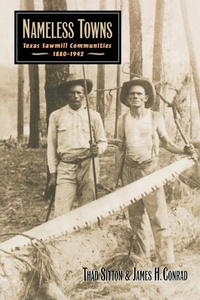
Nameless Towns
Texas Sawmill Communities, 1880-1942
Published on 1. July 1998
Book
Paperback/Softback
271 pages
978-0-292-77726-2 (ISBN)
Description
Winner, T. H. Fehrenbach Award, Texas Historical Commission
Sawmill communities were once the thriving centers of East Texas life. Many sprang up almost overnight in a pine forest clearing, and many disappeared just as quickly after the company "cut out" its last trees. But during their heyday, these company towns made Texas the nation's third-largest lumber producer and created a colorful way of life that lingers in the memories of the remaining former residents and their children and grandchildren.
Drawing on oral history, company records, and other archival sources, Sitton and Conrad recreate the lifeways of the sawmill communities. They describe the companies that ran the mills and the different kinds of jobs involved in logging and milling. They depict the usually rough-hewn towns, with their central mill, unpainted houses, company store, and schools, churches, and community centers. And they characterize the lives of the people, from the hard, awesomely dangerous mill work to the dances, picnics, and other recreations that offered welcome diversions.
Sawmill communities were once the thriving centers of East Texas life. Many sprang up almost overnight in a pine forest clearing, and many disappeared just as quickly after the company "cut out" its last trees. But during their heyday, these company towns made Texas the nation's third-largest lumber producer and created a colorful way of life that lingers in the memories of the remaining former residents and their children and grandchildren.
Drawing on oral history, company records, and other archival sources, Sitton and Conrad recreate the lifeways of the sawmill communities. They describe the companies that ran the mills and the different kinds of jobs involved in logging and milling. They depict the usually rough-hewn towns, with their central mill, unpainted houses, company store, and schools, churches, and community centers. And they characterize the lives of the people, from the hard, awesomely dangerous mill work to the dances, picnics, and other recreations that offered welcome diversions.
Reviews / Votes
"After completing the book, I truly understood life in the sawmill communities, intellectually and emotionally. It was very satisfying. Conrad and Sitton write in such a manner to make one feel the hard life, smell the sawdust, and share the danger of the mills. The book is compelling and stimulating." Robert L. Schaadt, Director-Archivist, Sam Houston Regional Library and Research CenterMore details
Language
English
Place of publication
Austin, TX
United States
Target group
Professional and scholarly
Product notice
Paperback (trade)
Dimensions
Height: 234 mm
Width: 156 mm
Thickness: 15 mm
Weight
418 gr
ISBN-13
978-0-292-77726-2 (9780292777262)
Copyright in bibliographic data and cover images is held by Nielsen Book Services Limited or by the publishers or by their respective licensors: all rights reserved.
Schweitzer Classification
Other editions
Additional editions
E-Book
01/2010
1st Edition
University of Texas Press
from
€32.99
Available for download
Persons
Thad Sitton, of Austin, and James H. Conrad, of Commerce, are historians and writers with extensive experience in collecting oral history.
Content
Preface and Acknowledgments
Chapter One. Introduction
Chapter Two. Panoramas
Chapter Three. Feudal Towns
Chapter Four. The Cornbread Whistle
Chapter Five. Dancing on the Millpond
Chapter Six. Cut and Get Out
Notes
Bibliography
Index
Chapter One. Introduction
Chapter Two. Panoramas
Chapter Three. Feudal Towns
Chapter Four. The Cornbread Whistle
Chapter Five. Dancing on the Millpond
Chapter Six. Cut and Get Out
Notes
Bibliography
Index