

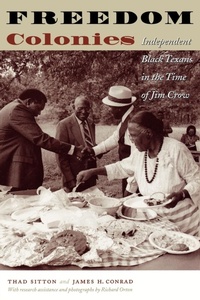
Freedom Colonies
Independent Black Texans in the Time of Jim Crow
Published on 1. March 2005
Book
Paperback/Softback
256 pages
978-0-292-70642-2 (ISBN)
Description
Friends of the Dallas Public Library Award, 2006
Best Book on East Texas, East Texas Historical Association, 2007
In the decades following the Civil War, nearly a quarter of African Americans achieved a remarkable victory-they got their own land. While other ex-slaves and many poor whites became trapped in the exploitative sharecropping system, these independence-seeking individuals settled on pockets of unclaimed land that had been deemed too poor for farming and turned them into successful family farms. In these self-sufficient rural communities, often known as "freedom colonies," African Americans created a refuge from the discrimination and violence that routinely limited the opportunities of blacks in the Jim Crow South.
Freedom Colonies is the first book to tell the story of these independent African American settlements. Thad Sitton and James Conrad focus on communities in Texas, where blacks achieved a higher percentage of land ownership than in any other state of the Deep South. The authors draw on a vast reservoir of ex-slave narratives, oral histories, written memoirs, and public records to describe how the freedom colonies formed and to recreate the lifeways of African Americans who made their living by farming or in skilled trades such as milling and blacksmithing. They also uncover the forces that led to the decline of the communities from the 1930s onward, including economic hard times and the greed of whites who found legal and illegal means of taking black-owned land. And they visit some of the remaining communities to discover how their independent way of life endures into the twenty-first century.
Best Book on East Texas, East Texas Historical Association, 2007
In the decades following the Civil War, nearly a quarter of African Americans achieved a remarkable victory-they got their own land. While other ex-slaves and many poor whites became trapped in the exploitative sharecropping system, these independence-seeking individuals settled on pockets of unclaimed land that had been deemed too poor for farming and turned them into successful family farms. In these self-sufficient rural communities, often known as "freedom colonies," African Americans created a refuge from the discrimination and violence that routinely limited the opportunities of blacks in the Jim Crow South.
Freedom Colonies is the first book to tell the story of these independent African American settlements. Thad Sitton and James Conrad focus on communities in Texas, where blacks achieved a higher percentage of land ownership than in any other state of the Deep South. The authors draw on a vast reservoir of ex-slave narratives, oral histories, written memoirs, and public records to describe how the freedom colonies formed and to recreate the lifeways of African Americans who made their living by farming or in skilled trades such as milling and blacksmithing. They also uncover the forces that led to the decline of the communities from the 1930s onward, including economic hard times and the greed of whites who found legal and illegal means of taking black-owned land. And they visit some of the remaining communities to discover how their independent way of life endures into the twenty-first century.
Reviews / Votes
Thad Sitton and James H. Conrad have made an important contribution to African American and southern history with their study of communities fashioned by freedmen in the years after emancipation. (Journal of American History)More details
Language
English
Place of publication
Austin, TX
United States
Target group
Professional and scholarly
Product notice
Paperback (trade)
Dimensions
Height: 229 mm
Width: 152 mm
Thickness: 15 mm
Weight
424 gr
ISBN-13
978-0-292-70642-2 (9780292706422)
Copyright in bibliographic data and cover images is held by Nielsen Book Services Limited or by the publishers or by their respective licensors: all rights reserved.
Schweitzer Classification
Other editions
Additional editions
E-Book
01/2010
1st Edition
University of Texas Press
from
€32.99
Available for download
Previous edition

Book
03/2005
University of Texas Press
€57.14
Article exhausted; check for reprint
Persons
Thad Sitton is an independent historian and writer in Austin, Texas, who focuses on the social history of rural Texas in the late nineteenth and early twentieth centuries.
James H. Conrad is an oral historian, librarian, and archivist at Texas A&M University-Commerce.
James H. Conrad is an oral historian, librarian, and archivist at Texas A&M University-Commerce.
Content
1. Introduction
2. A Terrible Freedom
3. Making Do, Getting By
4. Saturday Nights and Sunday Mornings
5. School Days
6. Working for the Man
7. Decline and Remembrance
Appendix: Freedmen's Settlements and Other Rural African American Landowner Communities, by County
Notes
Bibliography
Index
2. A Terrible Freedom
3. Making Do, Getting By
4. Saturday Nights and Sunday Mornings
5. School Days
6. Working for the Man
7. Decline and Remembrance
Appendix: Freedmen's Settlements and Other Rural African American Landowner Communities, by County
Notes
Bibliography
Index