

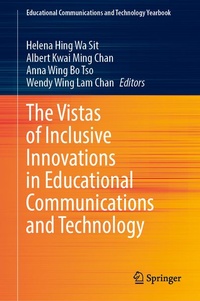
The Vistas of Inclusive Innovations in Educational Communications and Technology
Description
This book examines contemporary developments in educational communications and technology, with particular attention to artificial intelligence (AI), digital pedagogy, and learner-centred innovation. Bringing together international scholars and practitioners, the book explores how emerging technologies are impacting and reshaping teaching, learning, and educational leadership across diverse contexts. Structured around four thematic sections, this book moves from conceptual and policy-oriented discussions of AI and ethics to empirical studies of digital pedagogy, blended learning design, learner voice, and transformative learning experiences. The contributions highlight both opportunities and challenges associated with technology-enhanced education, offering critical insights into curriculum innovation, teacher education, and institutional adoption.
This book provides a practice-informed and insightful perspective on the evolving relationship between technology, communication, pedagogy, and learning in contemporary education. It serves as a valuable resource for researchers, teacher educators, educational leaders, and graduate students, as well as policymakers, curriculum designers, and practitioners engaged in technology-enhanced teaching and learning across diverse educational settings.
More details
Persons
Helena Sit is a teacher educator, Associate Professor, and research supervisor in Education at the University of Newcastle, Australia. She is a recipient of the Research Supervision Excellence Award (2022, 2024). Her research focuses on transformative teaching and learning, internationalisation in education, and innovative language education. She specialises in second language teacher education, educational technology in professional development, and social and cultural perspectives on Artificial Intelligence (AI) in education. She currently serves as Vice-President of the Applied Linguistics Association of Australia (ALAA) (2026- ), and previously as Information Officer (2021-2025). She also serves as International Program Committee Executive (2021 - ) and 2025 Conference Co-Chair of The Hong Kong Association for Educational Communications and Technology (HKAECT).
Albert Chan is an Assistant Educational Development Manager at the Educational Development Centre of The Hong Kong Polytechnic University. His work focuses on quality enhancement in higher education, institutional teaching evaluation, and conducting professional development training for university staff. Dr. Chan specializes in helping faculty integrate emerging learning technologies into the classroom, leveraging learning analytics and digital tools to enhance student engagement and optimize blended learning models. He actively supports institutional strategic initiatives aimed at fostering data-informed and technologically adaptive teaching practices.
Anna Tso is the Department Head and Associate Professor of English at The Hang Seng University of Hong Kong. Interested in children's literature, Shakespeare, and digital literacy, she is the Principal Investigator of the world's first government-funded project on the Children's and Young Adult Shakespeare Corpus. She also holds the position of associate editor for the Digital Culture and Humanities book series (Springer, 2017-present) and serves as the Honorary President of the Hong Kong Association for Educational Communications and Technology (HKAECT).
Wendy Chan received her Ph.D. in Journalism and Communication from Hong Kong Baptist University. She is the current President of The Hong Kong Association for Educational Communications and Technology (HKAECT) and also the programme director at HKUSPACE Po Leung Kuk Stanley Ho Community College. Her research can be seen in journals included in the Social Sciences Citation Index (SSCI), Arts and Humanities Citation Index (AHCI), and the Taiwan Humanities Citation Index (THCI). Her research interests include creativity, media professionalism, and journalistic presentation.
Content
Part One: Reimagining Educational Futures through AI, Ethics, and Policy.- Chapter 1. Revolutionising Personalised Learning: A Visionary AI-driven Approach on Occupational Planning (Fung, Hung, and Cheung).- Chapter 2. Policies for Generative AI in Language Education: Challenges and Choices (Blake).- Chapter 3. Contention of the Schools of Chinese Thought in the Golden Age (To).- Part Two: Digital Pedagogies and Learner Identify in Education.- Chapter 4. EFL Teaching in the RenAIssance: A Study of Thai Pre-service Teachers' Perceptions of Artificial Intelligence (Har and Yordming).- Chapter 5. Exploring the Relationship between Task Type and Learners' Online Interaction / Negotiation of Meaning (Guo and Sit).- Chapter 6.Does Pride Matter for Kids? A Study of Chinese Readers' Attitude towards Gender-Inclusive eBooks for Children (TSO and MA).- Part Three: Technology-Enhanced Learning Design and Blended Models.- Chapter 7. A Study on the Transformation of a Diploma Programme from Full-time Mode to Mixed Mode in a Property Management Company in Hong Kong (Chan, NG, Chiang, and Lam).- Chapter 8. Discussions of a Semi-systematic Literature Review on Adopting Educational Technology in Hong Kong Higher Education (Chiu).- Chapter 9. Student Perspectives on SPOC-based Blended Learning Tasks for Enhancing English Proficiency in Hong Kong Higher Education (LO, Tong, and Chan).- Part Four: Learner Voice and Transformative Learning Experiences.- Chapter 10. Moving from a Score of 2 to 8: A Student's Transformative Journey in AI-supported Writing Instruction (Leung, LO, Zhao, Zhuang, and Xie).- Chapter 11. Literature Reflections on Perceiving an Asynchronous Learning Tool (Chiu).- Chapter 12. Inclusiveness of Shakespeare4All: Promotion of English Language Proficiency among Hong Kong Students (Lau).