

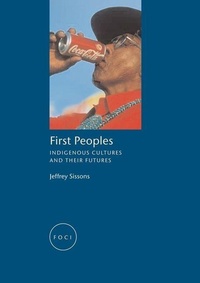
First Peoples
Indigenous Cultures and their Futures
Published on 1. February 2005
Book
Paperback/Softback
176 pages
978-1-86189-241-6 (ISBN)
Description
First Peoples argues, controversially, that far from disappearing in the face of global capitalism, indigenous cultures today are as diverse as they ever were. Rather than being absorbed into a uniform modernity, indigenous peoples are anticipating alternative futures and appropriating global resources for their own, culturally specific needs. For Sissons, however, the traditional and the modern are not mutually exclusive: indigenous cultures and nation-states are aspects of the same contemporary condition, and their apparently opposing position is an expression of the contradictory nature of modernity in the 21st century.
Indigenous peoples often define themselves in terms of their struggle against oppressive exterior forces; by contrast, the metropolitan cultures they struggle against often cling precariously to the surfaces of their new land. But indigenous identities have also been forged through alliances between indigenous peoples at international forums and in other settings. The loose alliances throughout the indigenous world constitute an alternative political order to the global organization of states.
For Inuit, Eskimo and Saami in the northern hemisphere, for Mayan, Maori and Aboriginal Australians in the southern, and for more than a hundred distinct peoples in between, culture has become more than a heritage: it is a project. The numerous cultural renaissances that occurred throughout the indigenous world in the second half of the 20th century were more than passing events. Their momentum has continued into the new millennium, while the challenges they pose to states and their bureaucracies have become increasingly urgent. While the economic and political issues addressed by indigenous groups were and are depressingly similar - racism, loss of land and resources, inadequate health and education services - the solutions have been characterized by enormous cultural diversity.
Indigenous peoples often define themselves in terms of their struggle against oppressive exterior forces; by contrast, the metropolitan cultures they struggle against often cling precariously to the surfaces of their new land. But indigenous identities have also been forged through alliances between indigenous peoples at international forums and in other settings. The loose alliances throughout the indigenous world constitute an alternative political order to the global organization of states.
For Inuit, Eskimo and Saami in the northern hemisphere, for Mayan, Maori and Aboriginal Australians in the southern, and for more than a hundred distinct peoples in between, culture has become more than a heritage: it is a project. The numerous cultural renaissances that occurred throughout the indigenous world in the second half of the 20th century were more than passing events. Their momentum has continued into the new millennium, while the challenges they pose to states and their bureaucracies have become increasingly urgent. While the economic and political issues addressed by indigenous groups were and are depressingly similar - racism, loss of land and resources, inadequate health and education services - the solutions have been characterized by enormous cultural diversity.
Reviews / Votes
Jeffrey Sissons short but lucid book describes what he sees as a major revival of Indigenous culture in the settler nations of the New World . . . He astutely observes the need for reconstructed notions of self-determination that escape the binary of traditional/modern, and offer Indigenous peoples and the non-Indigenous fellow citizens new ways to think about the expanding urban populations and dynamics of Indigenous communities in the New World. * <i>API Review of Books</i>, Australia * An engagement with the profuse spaces, histories, languages and forms of indigenous politics, First Peoples meets these with creativity and care. In moving through and seeking possibilities in processes of urbanization, education, re-workings of knowledges and power, it is a moving argument about indigeneity in the present. * <i>Graduate Journal of Asia-Pacific Studies</i> *More details
Series
Language
English
Place of publication
London
United Kingdom
Illustrations
6 illustrations
Dimensions
Height: 209 mm
Width: 150 mm
Thickness: 15 mm
Weight
345 gr
ISBN-13
978-1-86189-241-6 (9781861892416)
Copyright in bibliographic data and cover images is held by Nielsen Book Services Limited or by the publishers or by their respective licensors: all rights reserved.
Schweitzer Classification
Other editions
Additional editions
E-Book
05/2005
Reaktion Books
€18.49
Available for download
Person
Jeffrey Sissons is Professor in Social Anthropology at the School of Global Studies, Massey University, New Zealand.