

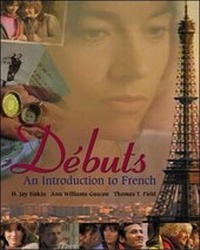
Debuts (Student Edition) + Listening Comprehension Audio CD
Published on 16. April 2002
Book
Hardback
576 pages
978-0-07-250405-7 (ISBN)
Description
An innovative new film-based program designed to motivate and inspire beginning French students. Based on the French film, Le Chemin du retour, Debuts is a completely integrated program for the first year French course. Le Chemin du retour is a two-hour feature-length film, divided into twenty-two episodes and an Epilogue. Each episode includes on-screen pre- and post-viewing activities that make the film accessible to students. Episodes are about fifteen minutes in length and correspond to the chapters in the textbook. Over eight hours of viewing bring the richness of French language and culture to beginning students, while at the same time exposing them to clear and natural French that they CAN understand. Le Chemin du retour is an engaging story about a young French journalist, Camille Leclair, and her pursuit of the truth about her grandfather's past. Through Camille's quest, students are introduced to many facets of today's French and Francophone cultures as well as to important historical events in France. They learn language in the functional context provided by the film, and concepts are reinforced by the on-screen activities that help students verify their comprehension. Debuts, the textbook, is coordinated with the individual episodes of the film and offers students additional pre-and post-viewing activities. Vocabulary and grammar presentations and exercises recycle and expand on dialogue and concepts in the film and also help students to talk about their own lives. Finally, the cultural content of the film is further explored in cultural notes and readings in each chapter.
More details
Edition
Student ed
Language
English
Place of publication
United States
Publishing group
McGraw-Hill Education - Europe
Dimensions
Height: 262 mm
Width: 206 mm
Thickness: 54 mm
Weight
1397 gr
ISBN-13
978-0-07-250405-7 (9780072504057)
Copyright in bibliographic data and cover images is held by Nielsen Book Services Limited or by the publishers or by their respective licensors: all rights reserved.
Schweitzer Classification
Other editions
New editions
H. Jay Siskin | Ann Williams | Tom Field
Debuts (Student Edition) with Bind-In Passcode
Book
12/2005
2nd Edition
McGraw-Hill Professional
€122.75
Article exhausted; check for reprint
Persons
H. Jay Siskin received his Ph.D. from Cornell University in Romance and French linguistics. He is Professor of French and Program Chair of World Languages at Cabrillo College. He is author of five textbooks in French, as well as numerous articles and reviews that have appeared in such publications as The French Review, Foreign Language Annals, and the PMLA. Most recently, he has edited a volume of essays entitled From Thought to Action: Exploring Beliefs and Outcomes in the Foreign Language Program. His book, which explores the cultural context of university-level foreign language teaching, will be published by Yale University Press. Professor Siskin serves as chair of the Modern Language Association's Division of the Teaching of Language and is a member of that association's Committee on Awards and honors, as well as of its Delegate Assembly. He is currently pursuing an advanced degree in Jewish Studies at the Graduate Theological Union in Berkeley, CA.
Ann Williams received her Ph.D. from Northwestern University and also has a Dipli?me d'i?tudes Approfondies from the Universiti? de Lyon II. She is currently professor of French at Metropolitan State College of Denver, where she teaches courses in language, literature, and culture, and she has coauthored three other college-level French textbooks. Dr. Williams received the Chris Wells Memorial Creativity Award in 2008 (Colorado Congress of Foreign Language Teachers).
Thomas T. Field received his Ph.D. in linguistics from Cornell University. He is currently professor of Linguistics and French at the University of Maryland, Baltimore County. Dr. Field's research is focused on Occitan sociolinguistics and the teaching of French and Francophone culture. In 1996, he was named Maryland Professor of the Year by the Carnegie Foundation for the Advancement of Teaching.
Ann Williams received her Ph.D. from Northwestern University and also has a Dipli?me d'i?tudes Approfondies from the Universiti? de Lyon II. She is currently professor of French at Metropolitan State College of Denver, where she teaches courses in language, literature, and culture, and she has coauthored three other college-level French textbooks. Dr. Williams received the Chris Wells Memorial Creativity Award in 2008 (Colorado Congress of Foreign Language Teachers).
Thomas T. Field received his Ph.D. in linguistics from Cornell University. He is currently professor of Linguistics and French at the University of Maryland, Baltimore County. Dr. Field's research is focused on Occitan sociolinguistics and the teaching of French and Francophone culture. In 1996, he was named Maryland Professor of the Year by the Carnegie Foundation for the Advancement of Teaching.
Content
Chapitre Preliminaire Ca tourne ! / Vocabulaire en contexte : Les salutations, Les nombres de 0 a 59, Dans la salle de classe, Les mots apparantes et les faux amis/ Structures : Est-ce ? Qui est-ce ? C'est, Ce sont, Ce n'est pas, Qu'est-ce que c'est ?, Definite and Indefinite ArictlesChapitre 1 Un grand jour / Vocabulaire en contexte : L'alphabet de francais, La rentree, Les lecons, Les etudes, Les cours/ Structures :Subject pronouns and etre, Negation, Yes/No questions with intonation, / Culture : L'ecole dans le monde francophoneChapitre 2 Bonjour! / Vocabulaire en contexte :Pour parler des personnes, Pour exprimer l'accord, le desaccord, Les locaux et les employes de Canal 7/ Structures : Adjective agreement after etre, Regular -er verbs and verb + infinitive, Adjective placement / Lecture : Les Francais aiment la televisionChapitre 3 Le Medaillon / Vocabulaire en contexte : Les environs de Canal 7 et les prepositions de lieu, Les nationalites, les origines regionales et les langues/ Structures : aller, future proche, Yes /No questions with tags, The verb venir / Culture : Communication interculturelleChapitre 4 Une nouvelle vie a Paris / Vocabulaire en contexte : La famille de Bruno Gall, Les nombres a partir de 60, Les jours de la semaine, les mois de l'annee et les dates/ Structures : possessive adjectives, The verb avoir and il y a , questions with inversion / Lecture : France : La famille francaise du XXIe siecleChapter 5 Secrets / Vocabulaire en contexte : La maison, les pieces et les meubles, Quelle heure est-il ? / Structures : The verb faire and faire expressions, Quel interrogatives and the demonstrative adjective ce, quel in exclamations, Nouns : ways of guessing gender, special plurals / Culture : La famille, source de culture : Types of families in different regions of FranceChapitre 6 Bonjour, grand-pere! / Vocabulaire en contexte : La mode, Les couleurs, Structures : The verbs pouvoir, vouloir, verbs with spelling changes / Lecture : La haute couture du millenaireChapitre 7 Preparatifs / Vocabulaire en contexte : Au marche Mouffetard, Les environs de la rue Mouffetard / Structures : Partitive and Definite Article,expressions of quantity, Indirect Object Pronouns, The verbs prendre, mettre, and boire / Culture : La Cuisine du monde francophoneChapitre 8 C'est loin, tout ca / Vocabulaire en contexte : Les repas en France, A table / Structures : The regular -re verbs, Imperative, sortir / Lecture : FamilialeChapitre 9 Inquietudes / Vocabulaire en contexte : Les parties du corps et la sante/ Structures : Direct object pronouns, Reflexive verbs, devoir / Culture : La medecine et la culture : << les medecines douces >> and << le thermalisme de France >>Chapitre 10 Rendez-vous au restaurant /Vocabulaire en contexte : Les distractions en ville / Structures : Passe compose, adverbs of time, verbs like voir, croire, and recevoir / Lecture : La Deuxieme guerre mondiale, les Francais et l'occupation : timeline of WW II in France for the entire period from 1936- 1945Chapitre 11 De quoi as-tu peur? / Vocabulaire en contexte : Les metiers et les professions, Les jours feries et les fetes, Les nombres ordinaux/ Structures : Passe compose with etre and pendant, depuis, Regular -ir verbs / Culture : Les legendes de l'histoire Chapitre 12 C'est a propos de Louise / Vocabulaire en contexte : Les etapes de la vie, , Les medias / Structures : Imparatifs, Adverbs of manner, the verbs dire, lire, ecrire / Lecture : Mon amant de Saint-Jean : Une chanson populaire pendant les annees 40Chapitre 13 Documents / Vocabulaire en contexte : Comment communiquer, Les cours a l'universite/ Structures : Ne...aucun, ne...personne, ne...rien, The verbs connaitre and savoir, Passe compose vs. Imparfait / Culture : Les technologies de la communicationChapitre 14 Une lettre /Vocabulaire en contexte : Pour voyager et circuler a Paris / Structures : Tout as an adjective and a pronoun, The present participle , Prepositions with geographical names / Lecture : Voyages dans les CevennesChapitre 15 Une piste! / Vocabulaire en contexte : La cuisine maghrebine, Specialites du monde entier / Structures : Verbs like ouvrir, y and en, The verbs vivre and suivre, poursuivre / Culture : Immigration et nationaliteChapitre 16 Le Depart / Vocabulaire en contexte : Les loisirs dans les Cevennes, / Structures : The comparative, the superlative, and the interrogative pronouns / Lecture : L'amitie et l'amour Chapitre 17 Je cherche la trace d'un homme / Vocabulaire en contexte : La relief de la France, Demander et donner le chemin / Structures : The future tense, direct and indirect object pronoun placement, c'est vs il/elle est / Culture : L'ecologie et les mouvements de population Chapitre 18 Histoires privees / Vocabulaire en contexte : L'agriculture, L'environnement/ Structures : Relative pronouns, Verbs like conduire, Verb + preposition + infinitive / Lecture : Un conte des CevennesChapitre 19 Un certain Fergus / Vocabulaire en contexte : Un reportage sur la Resistance / Structures : The conditional, Demonstrative pronouns / Culture : Deux iles francaisesChapitre 20 Risques / Vocabulaire en contexte : La ville de Marseille, Le monde du travail et de l'argent / Structures : Impersonal expressions, The subjunctive, Irregular subjunctive forms / Lecture : Un poeme de Louis BrauquierChapitre 21 D'ou vient cette photo ? /Vocabulaire en contexte: Spectacles et manifestations a Marseille / Structures : Use of subjunctive with verbs and expressions of emotion, Subjunctive with verbs and expressions of doubt and uncertainty, Other uses of the subjunctive / Culture : La politique culturelle au QuebecChapitre 22 Secrets devoiles / Vocabulaire en contexte : En voyage a Casablanca / Structures : Possessive pronouns, plus-que-parfait, The indirect discourse / Lecture : Le temoignage d'un survivantEpilogue Le Chemin du retour