

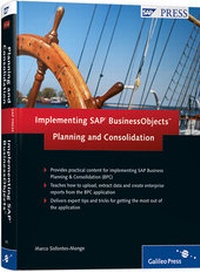
Implementing SAP BusinessObjects Planning and Consolidation
1st Edition
Published on 28. December 2011
Book
Hardback
400 pages
978-1-59229-375-9 (ISBN)
Description
This book provides you with practical, actionable content for all processes and issues relevant to a "typical" SAP BusinessObjects Planning and Consolidation implementation. You are presented with an introduction to SAP BusinessObjects Planning and Consolidation, detailed configuration and implementation guidance, and coverage of other essential topics, including reporting, Business Rules and security considerations.
Highlights:
- Dimensions
- Master Data
- Hierarchies
- Planning
- Budgeting
- Forecasting
- Consolidation
- Data Extraction
- Reporting
- Business Rules
- Script Logic and MDX
- Security
More details
Content
1. Introduction (10 pages)
1.1. Overview of each Chapter
1.2. Welcome to SAP BusinessObjects Planning and Consolidation NW 7.5
1.3. Target audience
1.4. SAP BusinessObjects Planning and Consolidation: Microsoft vs. NetWeaver Architecture Differences
1.5. SAP BusinessObjects Planning and Consolidation Implementation Methodology
1.6. Blueprinting using ASAP Methodology
1.7. SAP BusinessObjects Planning and Consolidation NW 7.5 and SAP BI Cubes
1.8. Implementation Strategies: Development vs. Design
1.9. Legacy Systems and Data Conversion
1.10. Best Implementation Practices: Recommendations Before You Start
2. Dimensions, Master Data and Hierarchies (20 pages)
2.1. Introduction
2.2. The Basic Components of a Planning Application
2.3. Dimension Types and their function
2.4. Member Properties and Application Set Parameters
2.5. Period and Calendar Reporting
2.6. Hierarchies, Aggregation, and Dynamic Hierarchies
2.7. Basic components of a Consolidation Application
2.8. Master Data: traditional SAP vs. BPC
2.9. SAP BusinessObjects Planning and Consolidation Delivered Content (Appset) and its Dimensions
2.10. Summary
3. Data Management and Process Chains (30 pages)
3.1. Introduction
3.2. Package Properties
3.3. Types of Pre-delivered Packages
3.3.1. Financial
3.3.2. System Administration
3.3.3. Import and Export
3.3.4. Application related
3.3.5. Run SAP BW Process Chain
3.4. Working with Data Management Packages
3.4.1. Running a Package
3.4.2. Schedule a Package
3.4.3. Moving and Copying a Package
3.4.4. Deleting a Package
3.5. Working with Data Conversion Files
3.6. Working with Data Transformation Files
3.7. BAdl for Start Routine and End Routine
3.8. Summary
4. SAP BusinessObjects Planning and Consolidation Planning: Budgeting and Forecasting (30 pages)
4.1. Introduction
4.2. General definition of the concept of planning for this book
4.3. General Planning Business Model
4.4. Input Templates and Manually entered data
4.5. Allocations
4.6. Distributions
4.7. Components of Business Planning:
4.7.1. Capital Expenditures (CAPEX)
4.7.2. Operational Expenditures (OPEX)
4.7.3. Production Planning (PROD)
4.7.4. Overhead and Cost Center Planning
4.7.5. Headcount
4.7.6. Balance Sheet and Budget Planning
4.7.7. Revenue Forecast
4.7.8. Rolling Forecast
4.7.9. Planning at the Parent Level(to be reviewed)
4.8. Summary
5. Consolidation Basics (20 pages)
5.1. Introduction
5.2. Definition of SAP BusinessObjects Planning and Consolidation Consolidation for this book
5.3. General Consolidation Business Model
5.3.1. Recommended SAP ECC FI Consolidation Configuration
5.3.2. Table Fields for Legal Consolidation in SAP ECC
5.4. The Five Key Consolidation Processes
5.5. Components of Consolidation Reporting
5.5.1. Balance Sheet
5.5.2. Profit & Loss
5.5.3. Cash Flow
5.5.4. Shareholder's Equity Report
5.5.5. Intercompany Transactions and Elimination
5.5.5.1.1. Using SAP BusinessObjects Planning and Consolidation MS
5.5.5.1.2. Using SAP BusinessObjects Planning and Consolidation NW
5.5.6. Intercompany Matching
5.5.7. Journal Entries and Manual Adjustments (Restatements)
5.6. Summary
6. Consolidation, Working w/ Ownership App (30 pages)
6.1. Introduction
6.2. Joint Ventures, Investments, and Private Equity
6.3. The purpose of the Ownership Application
6.4. Working with the Ownership Application
6.5. Basic Components of the Ownership Application
6.6. Effects of executing the Ownership Application over the Legal Application
6.7. Summary
7. Consolidation: Currency Translation and the Rate Application. (30 pages)
7.1. Introduction
7.2. Currency Translation Adjustments (CTA) and the Rate Application
7.3. IFRS vs. US GAAP
7.4. The Currency Translation Process of SAP BusinessObjects Planning and Consolidation
7.5. The components of the Rate Application
7.6. Updating Currency Exchange Rates
7.7. Handling Multicurrency Reporting
7.8. Summary
8. Data Extraction and Upload into SAP BusinessObjects Planning and Consolidation (30 pages)
8.1. Introduction
8.2. General Framework for data extraction and upload
8.3. Difference between SAP BusinessObjects Planning and Consolidation Microsoft and SAP BusinessObjects Planning and Consolidation NetWeaver
8.4. Data Transformation and Conversion from a Cube
8.5. Data Transformation and Conversion from a Flat File
8.6. Upload a Flat File into the File Storage System
8.7. Creating Data Extraction Package
8.8. Data formats for SAP BusinessObjects Planning and Consolidation
8.9. The Concept of Data Values (Key Figures) in SAP BusinessObjects Planning and Consolidation
8.10. Summary
9. Reporting (40 pages)
9.1. Introduction
9.2. Types of Reporting in SAP BusinessObjects Planning and Consolidation
9.3. Working with SAP BusinessObjects Planning and Consolidation pre delivered Templates
9.4. Working with EVDRE and MS Excel
9.5. Creating your first EVDRE Report
9.6. Creating Drilldown Reports
9.7. Creating Worksheet Formulas
9.8. Creating Member Formulas
9.9. SAP BusinessObjects Planning and Consolidation Reporting using Microsoft PowerPoint
9.10. SAP BusinessObjects Planning and Consolidation Web Reporting
9.11. SAP BusinessObjects Planning and Consolidation System Reports
9.12. Audit Trail Reporting
9.13. Creating BPF and Work Status Reporting
9.14. Summary
10. Business Rules (30 pages)
10.1. Introduction
10.2. SAP BusinessObjects Planning and Consolidation Pre Delivered Programs
10.3. Why Business Rules are Preferred Over Script Logic and MDX
10.4. Working with Dimension Logic and MDX
10.5. Working with Business Rules
10.5.1. Account Transformation
10.5.2. Currency Conversion Setup
10.5.3. Intercompany Booking Setup
10.5.4. Carry-Forward Business Rule
10.5.5. Validation Business Rule
10.5.6. Automatic Adjustment for Legal Consolidation
10.5.7. Intercompany Eliminations
10.6. Summary
11. Script Logic and MDX (20 pages)
11.1. Introduction
11.2. Differences between Script Logic and MDX
11.3. Applicability of MDX and Script Logic
11.4. Script Logic
11.4.1. Overview
11.4.2. Dynamic Parameters to Script Logic
11.4.3. Transferring Data Between Applications
11.4.4. Adding Two Accounts
11.4.5. Calculating a Percentage
11.4.6. Multiplying by a Dynamic Factor
11.4.7. Moving Data Between Two Accounts
11.4.8. Performing Allocations
11.5. Dimension Logic and MDX
11.5.1. Overview
11.5.2. Adding Two Accounts
11.5.3. Calculating a Percentage
11.5.4. Multiplying by a Factor
11.5.5. Movement Calculations
11.5.6. Allocations
11.6. Summary
12. Security in SAP BusinessObjects Planning and Consolidation (30 pages)
12.1. Introduction
12.2. The SAP BusinessObjects Planning and Consolidation Security Architecture
12.3. Task Profiles
12.4. Teams
12.5. User IDs
12.6. Mass Maintenance: Using the End-User Management Tool
12.7. Summary
13. SAP Business Process Flows (BPFs) (20 pages)
13.1. Introduction
13.2. Components of a BPF:
13.2.1. Business Process Flow (BPF)
13.2.2. BPF Template
13.2.3. BPF Instance
13.2.4. BPF Step Region
13.2.5. BPF Identifiers
13.2.6. Owner Property
13.2.7. Reviewer Property
13.2.8. BPF Monitor
13.2.9. My Activities
13.2.10. Action Pane
13.2.11. BPF Action
13.3. Creating a basic Business Process Flow
13.4. BPF Considerations
13.5. Work Status and Security
13.6. Summary
14. Tips and Tricks in SAP BusinessObjects Planning and Consolidation (20 pages)
14.1. Introduction
14.2. Validation
14.3. Transport in SAP BusinessObjects Planning and Consolidation NW
14.4. Transport in SAP BusinessObjects Planning and Consolidation MS
14.5. Creating Custom Measures
14.6. Working with VBA and EVMNU Functions
14.7. Creating Custom Menus
14.8. Summary
15. Performance Tuning and Optimization (30 pages)
15.1. Introduction
15.2. Full and Lite Optimization
15.3. The InApp property
15.4. Creating Partitions in SAP BusinessObjects Planning and Consolidation 7.x MS
15.5. Improving Application Set data upload using Application Set Parameters
15.6. Resolving Concurrency (Send Governor)
15.7. Working with the Project Management Console
15.8. Improving Report Performance using EVDRE
15.9. Worksheet Logic
15.10. SAP BusinessObjects Planning and Consolidation NW 7.5 basic ABAP Profile Parameters
15.11. Summary
16. Conclusions (10 pages)
Index (10 pages)