

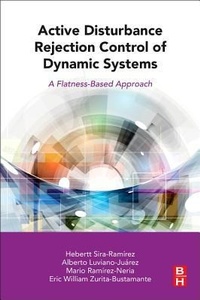
Active Disturbance Rejection Control of Dynamic Systems
A Flatness Based Approach
Published on 12. May 2017
Book
Paperback/Softback
358 pages
978-0-12-849868-2 (ISBN)
Description
Active Disturbance Rejection Control of Dynamic Systems: A Flatness Based Approach describes the linear control of uncertain nonlinear systems. The net result is a practical controller design that is simple and surprisingly robust, one that also guarantees convergence to small neighborhoods of desired equilibria or tracking errors that are as close to zero as desired.
This methodology differs from current robust feedback controllers characterized by either complex matrix manipulations, complex parameter adaptation schemes and, in other cases, induced high frequency noises through the classical chattering phenomenon.
The approach contains many of the cornerstones, or philosophical features, of Model Free Control and ADRC, while exploiting flatness and GPI control in an efficient manner for linear, nonlinear, mono-variable and multivariable systems, including those exhibiting inputs delays.
The book contains successful experimental laboratory case studies of diverse engineering problems, especially those relating to mechanical, electro-mechanical, robotics, mobile robotics and power electronics systems.
This methodology differs from current robust feedback controllers characterized by either complex matrix manipulations, complex parameter adaptation schemes and, in other cases, induced high frequency noises through the classical chattering phenomenon.
The approach contains many of the cornerstones, or philosophical features, of Model Free Control and ADRC, while exploiting flatness and GPI control in an efficient manner for linear, nonlinear, mono-variable and multivariable systems, including those exhibiting inputs delays.
The book contains successful experimental laboratory case studies of diverse engineering problems, especially those relating to mechanical, electro-mechanical, robotics, mobile robotics and power electronics systems.
More details
Language
English
Place of publication
Woburn
United States
Publishing group
Elsevier - Health Sciences Division
Target group
Professional and scholarly
Control engineering professors, Control engineering practitioners, Professionals in the field of Control of Mechatronics systems such as: Robotics, Mobile Robotics, Aerospace Robotics, Mechanical, Electromechanical Systems, Power Electronics Systems.
Product notice
Paperback (trade)
Unsewn / adhesive bound
Dimensions
Height: 229 mm
Width: 152 mm
Thickness: 18 mm
Weight
450 gr
ISBN-13
978-0-12-849868-2 (9780128498682)
Copyright in bibliographic data and cover images is held by Nielsen Book Services Limited or by the publishers or by their respective licensors: all rights reserved.
Schweitzer Classification
Other editions
Additional editions
Hebertt Sira-Ramirez | Alberto Luviano-Juárez | Mario Ramírez-Neria
Active Disturbance Rejection Control of Dynamic Systems
A Flatness Based Approach
E-Book
05/2017
Butterworth-Heinemann
€129.00
Available for download
Persons
He obtained his Electrical Engineering degree in 1970 from the University of Los Andes (Merida, Venezuela). He completed his postgraduate studies at the Massachusetts Institute of Technology (Cambridge, Mass. USA) in 1974 where he held together, the titles of Master of Science in Electrical Engineer and Electrical Engineer. In 1977 he received a Doctorate (PhD) in Electrical Engineering from the Institute. Held the posts of Head of Control Systems from 1978 to 1980, the Administrative Vice Chancellor of University of the Andes during the period 1980-1984 and Head of the Graduate Faculty of Automatic Control Engineering 1992-1993. Alberto Luviano Juarez was born in Mexico City, Mexico, in 1981. He received the B.S. degree in mechatronics engineering from the Instituto Politecnico Nacional, Mexico, in 2003, the M.Sc. degree in automatic control from the Department of Automatic Control, Centro de Investigacion y de Estudios Avanzados (CINVESTAV), Instituto Politecnico Nacional (IPN), in 2006, and the Ph.D. degree in electrical engineering from the Mechatronics section, Departament of Electrical Engineering at CINVESTAV, IPN, in 2011.Since 2011, he has been with the Postgraduate and Research Section at Unidad Profesional Interdisciplinaria en Ingenieria y Tecnologias Avanzadas, IPN. His research interests include robust estimation and control in mechatronic systems, robotics, and algebraic methods in the estimation and control of mechatronic systems. Dr. Alberto Luviano Juarez is the Coordinator of Master's Program in Advanced Technology, since april 2014. M. Ramirez-Neria He received the B.S. degree in Mechatronics Engineering from UPIITA-IPN of the Instituto Politecnico Nacional , Mexico City, Mexico (2008), the M.S. degree in Electrical Engineering from the Mechatronics Section of the Electrical Engineering Department of CINVESTAV-IPN, Mexico City,Mexico (2011), Currently, he is a Ph.D. candidate at Automatic Control Departament of CINVESTAV-IPN. His current research interest are applications of control theory, active disturbance rejection control, mechanical underactuated systems, robotics and mechatronic systems. E.W. Zurita-Bustamante received the B.S.degree in electronic engineering from the Universidad Tecnologica de la Mixteca, Huajuapan de Leon, Oaxaca, Mexico, in 2007, the M.S degree in Electronic and Computer Science from the Universidad Tecnologica de la Mixteca, Huajuapan de Leon, Oaxaca, Mexico, in 2010. Currently, he is a Ph.D. student at Electrical Departament of CINVESTAV-IPN. His research interests include development and implementation of hardware architectures on reconfigurable logic for power electronics, automatic control and mechatronic systems.
Author
Senior Researcher at the Centre for Research and Advanced Studies of IPN (CINVESTAV-IPN, Mexico City, DF, Mexico), with the Researcher category 3-E
Professor, Instituto Politecnico Nacional, Mexico
Departamento de Control Automatico, Mexico
Departamento de Ingenieria Electrica, Seccion de Mecatronica, Ciudad de Mexico, Mexico
Content
1. Introduction
1.1 A Brief Historical Perspective on Active Disturbance Rejection Control
References
2. Generalities of ADRC
2.1 Introduction
2.2 Main Theoretical Issues
2.3 The Need for Flatness-Based ADRC Designs
2.4 Ultralocal Disturbance Models
References
3. Merging Flatness, GPI Observation and GPI Control with ADRC
3.1 Introduction
3.2 GPI Extended State Observer Design
3.3 An Observer-Based Approach to GPI Perturbation Rejection
3.4 The Buck Converter
3.5 Example: A Pendulum System
3.6 Two-Link Robot Manipulator
3.7 Nonholonomic Wheeled Car
3.8 Two-Mass Rectilinear Mechanism
3.9 Remarks
References
4. Extensions of ADRC
4.1 Introduction
4.2 Integral Reconstructors of MIMO Linear Systems
4.3 A Lyapunov Approach for a Class of Nonlinear Multivariable Systems
4.4 Combined Sliding-Mode-ADRC Controllers
4.5 ADRC and Sampled Systems: The Delta Operator Approach
4.6 Control of Time Delay Systems
4.7 Relations With Model-Free Control
4.8 Fractional-Order Systems
References
5. Case Studies
5.1 Introduction
5.2 A Two-Degree-of-Freedom Robotic Arm
5.3 An Omnidirectional Robot
5.4 A Single-Link Manipulator Driven by a Synchronous Motor
5.5 Nonlinear Pendulum System
5.6 The Thomson Ring
5.7 Trajectory Tracking Control of a Delta Robot
5.8 A Time-Delayed Flywheel System
5.9 Control of Robot Manipulators with Delayed Inputs
References
6. The Challenging Case of Underactuated Systems
6.1 Introduction
6.2 Controlling the Pendubot via Tangent Linearization
6.3 A Two-Mass Spring System with an Inverted Pendulum
6.4 Double Inverted Pendulum on a Cart
6.5 The Furuta Pendulum
6.6 The Ball-and-Beam System
6.7 Remarks
References
A. Differential Flatness
A.1 Definition of Flatness
A.2 Illustrative Examples
A.3 About the Advantages and Disadvantages of Flatness
A.4 Differential Flatness and Uncertainty
References
B. Generalized Proportional Integral Control
B.1 Definitions and Generalities
B.2 Generalized Proportional Integral Control and Classical Compensation Networks
B.3 An Illustrative Application Example
B.4 GPI Control for Discrete-Time Systems
B.5 A General Result for Multivariable Linear Systems
References
Index
1.1 A Brief Historical Perspective on Active Disturbance Rejection Control
References
2. Generalities of ADRC
2.1 Introduction
2.2 Main Theoretical Issues
2.3 The Need for Flatness-Based ADRC Designs
2.4 Ultralocal Disturbance Models
References
3. Merging Flatness, GPI Observation and GPI Control with ADRC
3.1 Introduction
3.2 GPI Extended State Observer Design
3.3 An Observer-Based Approach to GPI Perturbation Rejection
3.4 The Buck Converter
3.5 Example: A Pendulum System
3.6 Two-Link Robot Manipulator
3.7 Nonholonomic Wheeled Car
3.8 Two-Mass Rectilinear Mechanism
3.9 Remarks
References
4. Extensions of ADRC
4.1 Introduction
4.2 Integral Reconstructors of MIMO Linear Systems
4.3 A Lyapunov Approach for a Class of Nonlinear Multivariable Systems
4.4 Combined Sliding-Mode-ADRC Controllers
4.5 ADRC and Sampled Systems: The Delta Operator Approach
4.6 Control of Time Delay Systems
4.7 Relations With Model-Free Control
4.8 Fractional-Order Systems
References
5. Case Studies
5.1 Introduction
5.2 A Two-Degree-of-Freedom Robotic Arm
5.3 An Omnidirectional Robot
5.4 A Single-Link Manipulator Driven by a Synchronous Motor
5.5 Nonlinear Pendulum System
5.6 The Thomson Ring
5.7 Trajectory Tracking Control of a Delta Robot
5.8 A Time-Delayed Flywheel System
5.9 Control of Robot Manipulators with Delayed Inputs
References
6. The Challenging Case of Underactuated Systems
6.1 Introduction
6.2 Controlling the Pendubot via Tangent Linearization
6.3 A Two-Mass Spring System with an Inverted Pendulum
6.4 Double Inverted Pendulum on a Cart
6.5 The Furuta Pendulum
6.6 The Ball-and-Beam System
6.7 Remarks
References
A. Differential Flatness
A.1 Definition of Flatness
A.2 Illustrative Examples
A.3 About the Advantages and Disadvantages of Flatness
A.4 Differential Flatness and Uncertainty
References
B. Generalized Proportional Integral Control
B.1 Definitions and Generalities
B.2 Generalized Proportional Integral Control and Classical Compensation Networks
B.3 An Illustrative Application Example
B.4 GPI Control for Discrete-Time Systems
B.5 A General Result for Multivariable Linear Systems
References
Index