

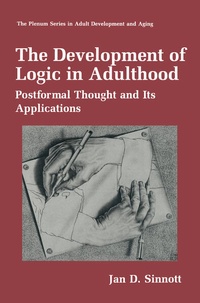
The Development of Logic in Adulthood
Postformal Thought and Its Applications
Published on 6. December 2010
Book
Paperback/Softback
XX, 372 pages
978-1-4419-3286-0 (ISBN)
Description
In this book
Jan D. Sinnott
synthesizes her 20 years of research on lifespan cognitive development to describe the growth of complex (or `postformal') thought in adults. She shows specifically how adults improve mentally over a lifetime and learn to think in more complex and wiser ways. Applications of postformal thought are demonstrated in such diverse areas as - family relations - adult education - personal identity - and spirituality. Chapters examine relations between postformal thought and pertinent variables such as age, health, memory, and vocabulary. Other sections deal with issues in humanistic psychology such as - guided imagery - mind - body medicine - and creative intentionality.
More details
Series
Edition
1st ed. Softcover of orig. ed. 1998
Language
English
Place of publication
New York
United States
Target group
Professional and scholarly
Research
Illustrations
XX, 372 p.
Dimensions
Height: 235 mm
Width: 155 mm
Thickness: 22 mm
Weight
598 gr
ISBN-13
978-1-4419-3286-0 (9781441932860)
DOI
10.1007/978-1-4757-2911-5
Schweitzer Classification
Other editions
Additional editions
E-Book
03/2013
Springer
€96.29
Available for download
Book
03/1998
Kluwer Academic/Plenum Publishers
€106.99
Shipment within 10-15 days
Content
1. Introduction: Creation of a Theory and the Purpose of This Book.- I. The Theory: Description and Development of Complex Postformal Thought.- 2. Limits of Traditional Approaches for Understanding Adult Logical Development.- 3. What Characterizes Postformal Thought?.- 4. Development of Postformal Thought.- 5. New Physics Models Underlying Postformal Thought.- 6. General Systems Theory Underlies Postformal Thought.- 7. Chaos, Complexity, Self-Regulating Systems, and Postformal Thought.- II. Some Research to Support the Theory: Studies of Complex Postformal Thought.- 8. Initial Research: How Do Adults Use Logical Thought?.- 9. Interview and Thinking Aloud Studies: A View of Process.- 10. Age Differences in Processes.- 11. Emotion, Intention, Health, Goal Clarity, and Other Factors in Postformal Thought.- 12. Digging Deeper: A Case Study and Suggestions for Studying Special Subsamples.- III. Applications of the Theory of Postformal Thought at Home and in the "Big Picture".- 13. Applications of the Theory of Postformal Thought to Education.- 14. Reinventing the University to Foster and Serve Postformal Thinkers.- 15. Postformal Thought and Multiperson Groups: The Workplace.- 16. Postformal Thought and Multiperson Groups: Couples and Families.- 17. Development and Yearning: Postformal Thought and Spirituality.- 18. Postformal Thought, Creativity, and Creating the "Self".- 19. Healing Minds, Bodies, Nations, and the Planet: The Value of Postformal Thought.- 20. Some Uses of Postformal Thought in Humanistic Psychology.- IV. The Next Steps: Interventions-Teaching Postformal thinking and Using Postformal Thought to Live in Balance.- 21. Can We Teach Adults To Use Complex Postformal Thought?.- 22. Postformal Thought and Living in Balance.- Appendixes.- A. Measure ofPostformal Thought and Coding and Scoring Guidelines.- Measures.- Coding and Scoring Guidelines.- B. The Narings Liv Project at the Institute for Noetic Sciences...- C. Some Readings in Existential, Humanistic, and Transpersonal Psychology and in Mind-Body Medicine.- References.