

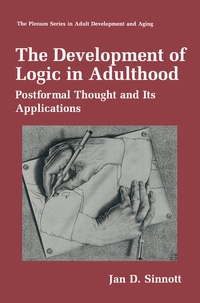
The Development of Logic in Adulthood
Postformal Thought and Its Applications
Published on 31. March 1998
Book
Hardback
XX, 372 pages
978-0-306-45723-4 (ISBN)
Description
In this book
Jan D. Sinnott
synthesizes her 20 years of research on lifespan cognitive development to describe the growth of complex (or `postformal') thought in adults. She shows specifically how adults improve mentally over a lifetime and learn to think in more complex and wiser ways. Applications of postformal thought are demonstrated in such diverse areas as - family relations - adult education - personal identity - and spirituality. Chapters examine relations between postformal thought and pertinent variables such as age, health, memory, and vocabulary. Other sections deal with issues in humanistic psychology such as - guided imagery - mind - body medicine - and creative intentionality.
More details
Series
Edition
1998 ed.
Language
English
Place of publication
New York
United States
Publishing group
Springer Science+Business Media
Target group
Professional and scholarly
Research
Illustrations
XX, 372 p.
Dimensions
Height: 241 mm
Width: 160 mm
Thickness: 26 mm
Weight
758 gr
ISBN-13
978-0-306-45723-4 (9780306457234)
DOI
10.1007/978-1-4757-2911-5
Schweitzer Classification
Other editions
Additional editions
E-Book
03/2013
Springer
€96.29
Available for download
Book
12/2010
Springer
€106.99
Shipment within 15-20 days
Content
1. Introduction: Creation of a Theory and the Purpose of This Book.- I. The Theory: Description and Development of Complex Postformal Thought.- 2. Limits of Traditional Approaches for Understanding Adult Logical Development.- 3. What Characterizes Postformal Thought?.- 4. Development of Postformal Thought.- 5. New Physics Models Underlying Postformal Thought.- 6. General Systems Theory Underlies Postformal Thought.- 7. Chaos, Complexity, Self-Regulating Systems, and Postformal Thought.- II. Some Research to Support the Theory: Studies of Complex Postformal Thought.- 8. Initial Research: How Do Adults Use Logical Thought?.- 9. Interview and Thinking Aloud Studies: A View of Process.- 10. Age Differences in Processes.- 11. Emotion, Intention, Health, Goal Clarity, and Other Factors in Postformal Thought.- 12. Digging Deeper: A Case Study and Suggestions for Studying Special Subsamples.- III. Applications of the Theory of Postformal Thought at Home and in the "Big Picture".- 13. Applications of the Theory of Postformal Thought to Education.- 14. Reinventing the University to Foster and Serve Postformal Thinkers.- 15. Postformal Thought and Multiperson Groups: The Workplace.- 16. Postformal Thought and Multiperson Groups: Couples and Families.- 17. Development and Yearning: Postformal Thought and Spirituality.- 18. Postformal Thought, Creativity, and Creating the "Self".- 19. Healing Minds, Bodies, Nations, and the Planet: The Value of Postformal Thought.- 20. Some Uses of Postformal Thought in Humanistic Psychology.- IV. The Next Steps: Interventions-Teaching Postformal thinking and Using Postformal Thought to Live in Balance.- 21. Can We Teach Adults To Use Complex Postformal Thought?.- 22. Postformal Thought and Living in Balance.- Appendixes.- A. Measure ofPostformal Thought and Coding and Scoring Guidelines.- Measures.- Coding and Scoring Guidelines.- B. The Narings Liv Project at the Institute for Noetic Sciences...- C. Some Readings in Existential, Humanistic, and Transpersonal Psychology and in Mind-Body Medicine.- References.