

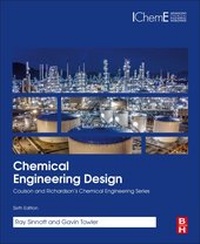
Chemical Engineering Design
SI Edition
6th Edition
Published on 5. June 2019
Book
Paperback/Softback
1294 pages
978-0-08-102599-4 (ISBN)
Description
Chemical Engineering Design: SI Edition is one of the best-known and most widely used textbooks available for students of chemical engineering. The enduring hallmarks of this classic book are its scope and practical emphasis which make it particularly popular with instructors and students who appreciate its relevance and clarity. This new edition provides coverage of the latest aspects of process design, operations, safety, loss prevention, equipment selection, and much more, including updates on plant and equipment costs, regulations and technical standards.
More details
Series
Edition
6th edition
Language
English
Place of publication
Oxford
United Kingdom
Publishing group
Elsevier Science & Technology
Target group
College/higher education
Dimensions
Height: 238 mm
Width: 195 mm
Thickness: 58 mm
Weight
2661 gr
ISBN-13
978-0-08-102599-4 (9780081025994)
Copyright in bibliographic data and cover images is held by Nielsen Book Services Limited or by the publishers or by their respective licensors: all rights reserved.
Schweitzer Classification
Other editions
Additional editions
E-Book
05/2019
6th Edition
Butterworth-Heinemann
€62.99
Available for download
Previous edition
Book
05/2009
5th Edition
Butterworth-Heinemann
€68.09
Article exhausted; check for reprint
Persons
Ray Sinnott's varied career, mainly in design and development, began with several major companies including Dupont and John Brown. The main areas covered within these appointments were: Gas Production and Distribution, Nuclear Energy, Elastomers and Textile fibres. After his career in industry he joined the Chemical Engineering Department, University of Wales Swansea in 1970, specialising in teaching process and plant design, and other engineering practice subjects. The first edition of Chemical Engineering Design (Coulson and Richardson's Vol 6) was published in 1983. Subsequent editions have been published at approximately 5 year intervals.Ray Sinnott retired from full time teaching in 1995 but has maintained close contact with the engineering profession. Gavin Towler Ph.D. is the Vice President and Chief Technology Officer of UOP LLC, a Honeywell company. UOP is a leading supplier of catalysts, process technology, proprietary equipment and services to the oil, gas and petrochemical industries. In this capacity he is responsible for delivering process, catalyst and equipment innovations for UOP's four businesses.Gavin has 20 years of broad experience of process and product design and has 65 US patents. He is co-author of "Chemical Engineering Design?, a textbook on process design, and is an Adjunct Professor at Northwestern University, where he teaches the senior design classes. Gavin has a B.A. and M.Eng. in chemical engineering from Cambridge University and a Ph.D. from U.C. Berkeley. He is a Chartered Engineer and Fellow of the Institute of Chemical Engineers, and is a Fellow of the AIChE.
Content
1. Introduction to design
2. Fundamentals of material balances
3. Fundamentals of energy balances (and energy utilisation)
4. Flow-sheeting
5. Piping and instrumentation
6. Costing and project evaluation
7. Materials of construction
8. Design information and data
9. Safety and loss prevention
10. Equipment selection, specification and design
11. Separation columns (distillation, absorption and extraction)
12. Heat-transfer equipment
13. Mechanical design of process equipment
14. General site considerations
2. Fundamentals of material balances
3. Fundamentals of energy balances (and energy utilisation)
4. Flow-sheeting
5. Piping and instrumentation
6. Costing and project evaluation
7. Materials of construction
8. Design information and data
9. Safety and loss prevention
10. Equipment selection, specification and design
11. Separation columns (distillation, absorption and extraction)
12. Heat-transfer equipment
13. Mechanical design of process equipment
14. General site considerations