

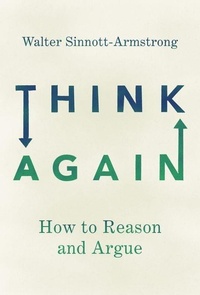
Think Again
How to Reason and Argue
Published on 2. July 2018
Book
Paperback/Softback
256 pages
978-0-19-062712-6 (ISBN)
Description
Our personal and political worlds are rife with arguments and disagreements, some of them petty and vitriolic. The inability to compromise and understand the opposition is epidemic today, from countries refusing to negotiate, to politicians pandering to their base. Social media has produced a virulent world where extreme positions dominate. There is much demonization of the other side, very little progress is made, and the end result is further widening of
positions. How did this happen, and what might be done to address it? Walter Sinnott-Armstrong says there is such a thing as a "good" argument: Reasonable arguments can create more mutual understanding and
respect, and even if neither party is convinced by the other, compromise is still possible.Think Again shows the importance of good arguments and reveals common misunderstandings. Rather than a means to persuade other people or beat them in an intellectual competition, Sinnott-Armstrong sees arguments as an essential tool for constructive interaction with others. After showing how the failure of good arguments has led us to society's current woes, he shows readers
what makes a good argument. In clear, lively, and practical prose, and with plentiful examples from politics, popular culture, and everyday life, Sinnott-Armstrong explains what defines
an argument, identifies the components of good arguments as well as fallacies to avoid, and demonstrates what good arguments can accomplish. Armed with these tools, readers will be able to spot bad reasoning and bad arguments, and to advance their own views in a forceful yet logical way. These skills could even help repair our tattered civic culture.
positions. How did this happen, and what might be done to address it? Walter Sinnott-Armstrong says there is such a thing as a "good" argument: Reasonable arguments can create more mutual understanding and
respect, and even if neither party is convinced by the other, compromise is still possible.Think Again shows the importance of good arguments and reveals common misunderstandings. Rather than a means to persuade other people or beat them in an intellectual competition, Sinnott-Armstrong sees arguments as an essential tool for constructive interaction with others. After showing how the failure of good arguments has led us to society's current woes, he shows readers
what makes a good argument. In clear, lively, and practical prose, and with plentiful examples from politics, popular culture, and everyday life, Sinnott-Armstrong explains what defines
an argument, identifies the components of good arguments as well as fallacies to avoid, and demonstrates what good arguments can accomplish. Armed with these tools, readers will be able to spot bad reasoning and bad arguments, and to advance their own views in a forceful yet logical way. These skills could even help repair our tattered civic culture.
More details
Language
English
Place of publication
New York
United States
Target group
Professional and scholarly
Product notice
Paperback (trade)
Unsewn / adhesive bound
Illustrations
Illustrations, black and white
Dimensions
Height: 212 mm
Width: 144 mm
Thickness: 25 mm
Weight
300 gr
ISBN-13
978-0-19-062712-6 (9780190627126)
Copyright in bibliographic data and cover images is held by Nielsen Book Services Limited or by the publishers or by their respective licensors: all rights reserved.
Schweitzer Classification
Person
Walter Sinnott-Armstrong is Chauncey Stillman Professor of Practical Ethics in the Department of Philosophy and the Kenan Institute for Ethics, Duke University. He is co-instructor of the Coursera online course "Think Again."
Content
Preface: Why I Wrote This Book
Part I: Why to Argue
Intermission: From Why to How
Part II: How to Argue
Part III: How Not to Argue
Conclusion: Rules to Follow
Part I: Why to Argue
Intermission: From Why to How
Part II: How to Argue
Part III: How Not to Argue
Conclusion: Rules to Follow