

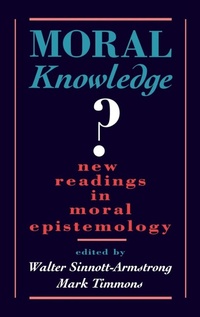
Moral Knowledge?
New Readings in Moral Epistemology
Published on 18. April 1996
Book
Hardback
352 pages
978-0-19-508988-2 (ISBN)
Description
In Moral Knowledge?: New Readings in Moral Epistemology, editors Walter Sinnott-Armstrong and Mark Timmons bring together eleven newly written essays by distinguished moral philosophers exploring the nature and possibility of moral knowledge. Each essay represents a major position within the exciting field of moral epistemology in which a proponent of the position presents and defends his or her view and locates it vis-a-vis competing views.
The first chapter, written by Walter Sinnott-Armstrong, provides a framework for understanding the basic concepts and viewpoints in moral epistemology and presents a limited skeptical challenge to the
justification of moral beliefs. The following essays represent various options in response to moral skepticism. Peter Railton and Simon Blackburn take different stances on moral truth and realism, Robert Audi defends a version of intuitionism, and Geoffrey Sayre-McCord adopts coherentism, while R.M. Hare combines elements of both foundationalism and coherentism. Richard Brandt discusses the relevance of empirical science to moral knowledge, Christopher Morris develops a contractarian account of
moral justification, and David Copp bases moral knowledge on rational choices by societies. Margaret Urban Walker aruges for a feminist perspective on moral knowledge, and Mark Timmons expounds
contextualism in moral epistemology.
The lively and clear selections do not presuppose specialized knowledge of philosophy, and the philosophical vocabulary used throughout the anthology is uniform, in order to facilitate understanding by those not familiar with the field. The first chapter includes a sustained critical discussion of the major views represented in the following chapters, thereby furnishing beginning students with appropriate background to understand the
selections. The volume is further enhanced by an index and an extensive bibliography, which is divided into sections corresponding to the chapters of the book. Moral Knowledge provides the most up-to-date work
on moral knowledge and justification and serves as an excellent text for undergraduate and graduate courses.
The first chapter, written by Walter Sinnott-Armstrong, provides a framework for understanding the basic concepts and viewpoints in moral epistemology and presents a limited skeptical challenge to the
justification of moral beliefs. The following essays represent various options in response to moral skepticism. Peter Railton and Simon Blackburn take different stances on moral truth and realism, Robert Audi defends a version of intuitionism, and Geoffrey Sayre-McCord adopts coherentism, while R.M. Hare combines elements of both foundationalism and coherentism. Richard Brandt discusses the relevance of empirical science to moral knowledge, Christopher Morris develops a contractarian account of
moral justification, and David Copp bases moral knowledge on rational choices by societies. Margaret Urban Walker aruges for a feminist perspective on moral knowledge, and Mark Timmons expounds
contextualism in moral epistemology.
The lively and clear selections do not presuppose specialized knowledge of philosophy, and the philosophical vocabulary used throughout the anthology is uniform, in order to facilitate understanding by those not familiar with the field. The first chapter includes a sustained critical discussion of the major views represented in the following chapters, thereby furnishing beginning students with appropriate background to understand the
selections. The volume is further enhanced by an index and an extensive bibliography, which is divided into sections corresponding to the chapters of the book. Moral Knowledge provides the most up-to-date work
on moral knowledge and justification and serves as an excellent text for undergraduate and graduate courses.
More details
Edition
Annotated edition
Language
English
Place of publication
New York
United States
Target group
College/higher education
Edition type
Annotated edition
Dimensions
Height: 240 mm
Width: 161 mm
Thickness: 24 mm
Weight
696 gr
ISBN-13
978-0-19-508988-2 (9780195089882)
Copyright in bibliographic data and cover images is held by Nielsen Book Services Limited or by the publishers or by their respective licensors: all rights reserved.
Schweitzer Classification
Content
Preface Walter Sinnott-Armstrong: Moral Skepticism and Justification Peter Railton: Moral Realism: Prospects and Problems Simon Blackburn: Securing the Nots: Moral Epistemology for the Quasi-Realist Robert Audi: Intuitionism, Pluralism, and the Foundations of Ethics Geoffrey Sayre-McCord: The Fundamental Appeal of Coherence in Moral Theory R.M. Hare: Foundationalism and Coherentism in Ethics Richard B. Brandt: Science as a Basis for Moral Theory Christopher W. Morris: A Contractarian Account of Moral Justification David Copp: Moral Knowledge in a Society-Centered Moral Theory Margaret Urban Walker: Feminist Skepticism, Authority, and Transparency Mark Timmons: Outline of a Contextualist Moral Epistemology Mitchell R. Haney: An Annotated Bibliography on Moral Epistemology