

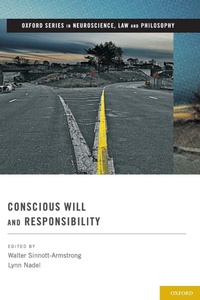
Conscious Will and Responsibility
A Tribute to Benjamin Libet
1st Edition
Published on 23. December 2010
Book
Hardback
288 pages
978-0-19-538164-1 (ISBN)
Description
We all seem to think that we do the acts we do because we consciously choose to do them. This commonsense view is thrown into dispute by Benjamin Libet's eyebrow-raising experiments, which seem to suggest that conscious will occurs not before but after the start of brain activity that produces physical action.
Libet's striking results are often claimed to undermine traditional views of free will and moral responsibility and to have practical implications for criminal justice. His work has also stimulated a flurry of further fascinating scientific research--including findings in psychology by Dan Wegner and in neuroscience by John-Dylan Haynes--that raises novel questions about whether conscious will plays any causal role in action. Critics respond that both commonsense views of action and traditional theories of moral and legal responsibility, as well as free will, can survive the scientific onslaught of Libet and his progeny. To further this lively debate, Walter Sinnott-Armstrong and Lynn Nadel have brought together prominent experts in neuroscience, psychology, philosophy, and law to discuss whether our conscious choices really cause our actions, and what the answers to that question mean for how we view ourselves and how we should treat each other.
Libet's striking results are often claimed to undermine traditional views of free will and moral responsibility and to have practical implications for criminal justice. His work has also stimulated a flurry of further fascinating scientific research--including findings in psychology by Dan Wegner and in neuroscience by John-Dylan Haynes--that raises novel questions about whether conscious will plays any causal role in action. Critics respond that both commonsense views of action and traditional theories of moral and legal responsibility, as well as free will, can survive the scientific onslaught of Libet and his progeny. To further this lively debate, Walter Sinnott-Armstrong and Lynn Nadel have brought together prominent experts in neuroscience, psychology, philosophy, and law to discuss whether our conscious choices really cause our actions, and what the answers to that question mean for how we view ourselves and how we should treat each other.
More details
Language
English
Place of publication
New York
United States
Target group
College/higher education
Neuroscience, psychology
Illustrations
45 s/w Abbildungen
43 B&W Lineart, 2 B&W Combo
Dimensions
Height: 260 mm
Width: 183 mm
Thickness: 20 mm
Weight
723 gr
ISBN-13
978-0-19-538164-1 (9780195381641)
Copyright in bibliographic data and cover images is held by Nielsen Book Services Limited or by the publishers or by their respective licensors: all rights reserved.
Schweitzer Classification
Other editions
Additional editions
E-Book
11/2010
1st Edition
OUP eBook
€72.49
Available for download
E-Book
11/2010
1st Edition
OUP eBook
€72.49
Available for download
Persons
WALTER SINNOTT-ARMSTRONG is Chauncey Stillman Professor in Practical Ethics in the Department of Philosophy and in the Kenan Institute for Ethics at Duke University as well as Co-director of the MacArthur Law and Neuroscience Program. Widely published, his current research focuses on empirical moral psychology, free will and responsibility, and law and neuroscience.
LYNN NADEL is Regent's Professor of Psychology and Cognitive Science at the University of Arizona. Known for his work on the role of the hippocampus in cognitive mapping, and the multiple trace theory of memory, his current research focuses on the cognitive neuroscience of episodic memory and memory reconsolidation.
LYNN NADEL is Regent's Professor of Psychology and Cognitive Science at the University of Arizona. Known for his work on the role of the hippocampus in cognitive mapping, and the multiple trace theory of memory, his current research focuses on the cognitive neuroscience of episodic memory and memory reconsolidation.
Editor
Chauncey Stillman Professor of Practical Ethics in the Philosophy Department and the Kenan Institute for Ethics at Duke University; Co-director of the MacArthur Foundation Law and Neuroscience ProjectChauncey Stillman Professor of Practical Ethics in the Philosophy Department and the Kenan Institute for Ethics at Duke University; Co-director of the MacArthur Foundation Law and Neuroscience Project, Duke University, Durham, NC
Regents Professor of Psychology and Cognitive ScienceRegents Professor of Psychology and Cognitive Science, University of Arizona, Tucson, AZ
Content
Introduction, by Walter Sinnott-Armstrong and Lynn Nadel
1 - Benjamin Libet, "Do We have Free Will?"
2 - Adina L. Roskies, "Why Libet's Studies Don't Pose a Threat to Free Will"
3 - Alfred R. Mele, "Libet on Free Will: Readiness Potentials, Decisions, and Awareness"
4 - Susan Pockett and Suzanne Purdy, "Are Voluntary Movements Initiated Preconsciously? The Relationships between Readiness Potentials, Urges, and Decisions"
5 - William P. Banks and Eve A. Isham, "Do We Really Know What We are Doing? Implications of Reported Time of Decision for Theories of Volition"
6 - Elisabeth Pacherie and Patrick Haggard, "What are Intentions?"
7 - Mark Hallett, "Volition: How Physiology Speaks to the Issue of Responsibility"
8 - John-Dylan Haynes, "Beyond Libet: Long-term Prediction of Free Choices from Neuroimaging Signals"
9 - F. Carota, M. Desmurget, and A. Sirigu, "Forward Modeling Mediates Motor Awareness"
10 - Tashina Graves, Brian Maniscalco, and Hakwan Lau, "Volition and the Function of Consciousness"
11 - Deborah Talmi and Chris D. Frith, "Neuroscience, Free Will, and Responsibility"
12 - Jeffrey P. Ebert and Daniel M. Wegner, "Bending Time to One's Will"
13 - Thalia Wheatley and Christine Looser, "Prospective Codes Fulfilled: A Potential Neural Mechanism of the Will"
14 - Terry Horgan, "The Phenomenology of Agency and the Libet Results"
15 - Thomas Nadelhoffer, "The Threat of Shrinking Agency and Free Will Disillusionism"
16 - Gideon Yaffe, "Libet and the Criminal Law's Voluntary Act Requirement"
17 - Larry Alexander, "Criminal and Moral Responsibility and the Libet Experiments"
18 - Michael S. Moore, "Libet's Challenge(s) to Responsible Agency"
19 - Walter Sinnott-Armstrong, "Lessons from Libet"
1 - Benjamin Libet, "Do We have Free Will?"
2 - Adina L. Roskies, "Why Libet's Studies Don't Pose a Threat to Free Will"
3 - Alfred R. Mele, "Libet on Free Will: Readiness Potentials, Decisions, and Awareness"
4 - Susan Pockett and Suzanne Purdy, "Are Voluntary Movements Initiated Preconsciously? The Relationships between Readiness Potentials, Urges, and Decisions"
5 - William P. Banks and Eve A. Isham, "Do We Really Know What We are Doing? Implications of Reported Time of Decision for Theories of Volition"
6 - Elisabeth Pacherie and Patrick Haggard, "What are Intentions?"
7 - Mark Hallett, "Volition: How Physiology Speaks to the Issue of Responsibility"
8 - John-Dylan Haynes, "Beyond Libet: Long-term Prediction of Free Choices from Neuroimaging Signals"
9 - F. Carota, M. Desmurget, and A. Sirigu, "Forward Modeling Mediates Motor Awareness"
10 - Tashina Graves, Brian Maniscalco, and Hakwan Lau, "Volition and the Function of Consciousness"
11 - Deborah Talmi and Chris D. Frith, "Neuroscience, Free Will, and Responsibility"
12 - Jeffrey P. Ebert and Daniel M. Wegner, "Bending Time to One's Will"
13 - Thalia Wheatley and Christine Looser, "Prospective Codes Fulfilled: A Potential Neural Mechanism of the Will"
14 - Terry Horgan, "The Phenomenology of Agency and the Libet Results"
15 - Thomas Nadelhoffer, "The Threat of Shrinking Agency and Free Will Disillusionism"
16 - Gideon Yaffe, "Libet and the Criminal Law's Voluntary Act Requirement"
17 - Larry Alexander, "Criminal and Moral Responsibility and the Libet Experiments"
18 - Michael S. Moore, "Libet's Challenge(s) to Responsible Agency"
19 - Walter Sinnott-Armstrong, "Lessons from Libet"