

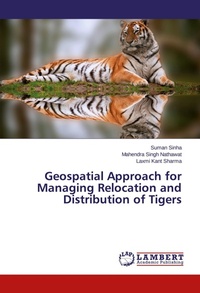
Geospatial Approach for Managing Relocation and Distribution of Tigers
Published on 23. February 2014
Book
Paperback/Softback
204 pages
978-3-659-52104-1 (ISBN)
Description
The Indian tiger (Panthera tigris tigris Linn. 1758), one of the world's most endangered umbrella carnivore species, is now thought to be in the verge of extinction in the wild. Sariska National Park in India is considered to be a highly suitable habitat for the tigers. However, in 2005, due to extensive poaching there were no tigers left in this park. There is some hope of further relocation of tigers from other parts of India in order to conserve them well under the prevailing conditions. The aim of the study is to model the tiger habitat suitability with the current human impacts with integrated Geospatial technology. Our study used topographical and anthropogenic variables to construct a habitat suitability model for tigers in this park. According to our model, there are areas of suitable habitat for tigers within the park. The corresponding weights for the parameters are defined by knowledge-based approach determined by field study and literature survey and thereafter by applying MCDA where AHP (crisp and fuzzy) is applied. The resulting weights imported in GIS mode and the map obtained from MCDA model in GIS shows the optimum location for the site suitability for the tiger.
More details
Language
English
Product notice
Paperback (trade)
Unsewn / adhesive bound
Dimensions
Height: 220 mm
Width: 150 mm
Thickness: 13 mm
Weight
322 gr
ISBN-13
978-3-659-52104-1 (9783659521041)
Copyright in bibliographic data and cover images is held by Nielsen Book Services Limited or by the publishers or by their respective licensors: all rights reserved.
Schweitzer Classification
Persons
He received B.Sc. in Zoology and M.Sc. in Environmental Science, both from University of Calcutta (India) and M.Tech. in Remote Sensing from Birla Institute of Technology,Mesra (India). He is pursuing Ph.D. from Birla Institute of Technology,Mesra as DST INSPIRE Fellow. His field of interest include wildlife, forestry and microwave RS applications.