

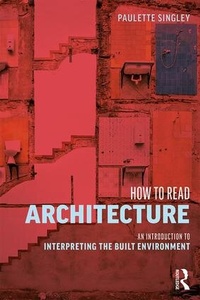
How to Read Architecture
An Introduction to Interpreting the Built Environment
1st Edition
Published on 25. June 2019
Book
Hardback
402 pages
978-0-415-83618-0 (ISBN)
Description
How to Read Architecture is based on the fundamental premise that reading and interpreting architecture is something we already do, and that close observation matters. This book enhances this skill so that given an unfamiliar building, you will have the tools to understand it and to be inspired by it. Author Paulette Singley encourages you to misread, closely read, conventionally read, and unconventionally read architecture to stimulate your creative process.
This book explores three essential ways to help you understand architecture: reading a building from the outside-in, from the inside-out, and from the position of out-and-out, or formal, architecture. This book erodes boundaries between the frequently compartmentalized fields of interior design, landscape design, and building design with chapters exploring concepts of terroir, scenography, criticality, atmosphere, tectonics, inhabitation, type, form, and enclosure. Using examples and case studies that span a wide range of historical and global precedents, Singley addresses the complex interaction among the ways a building engages its context, addresses its performative exigencies, and operates as an autonomous aesthetic object.
Including over 300 images, this book is an essential read for both undergraduate and postgraduate students of architecture with a global focus on the interpretation of buildings in their context.
This book explores three essential ways to help you understand architecture: reading a building from the outside-in, from the inside-out, and from the position of out-and-out, or formal, architecture. This book erodes boundaries between the frequently compartmentalized fields of interior design, landscape design, and building design with chapters exploring concepts of terroir, scenography, criticality, atmosphere, tectonics, inhabitation, type, form, and enclosure. Using examples and case studies that span a wide range of historical and global precedents, Singley addresses the complex interaction among the ways a building engages its context, addresses its performative exigencies, and operates as an autonomous aesthetic object.
Including over 300 images, this book is an essential read for both undergraduate and postgraduate students of architecture with a global focus on the interpretation of buildings in their context.
Reviews / Votes
"Beautifully written, Paulette Singley's How to Read Architecture is a call to action to return to reading buildings closely. If contemporary architecture is increasingly designed for Instagram, Singley's work is a vividly uncovers the meaning embodied in great works of architecture. This book has many uses: it will be a joyous read for sophisticated lovers of architecture, a rich manual as well as a manifesto for practicing architects, and a thorough introduction for those new to the field. Read it and start reading buildings."Kazys Varnelis, Director of the Network Architecture Lab and co-founder of AUDC
"Paulette Singley's How to Read Architecture is an elegant guide to those without a guide book. It raises the use of the prepositions of 'within', 'without', and 'with' to an organising principle that promotes the relational aspect of architecture and its situatedness."
Polly Gould, Author of Antarctica, Art and Archive (2010), reviewed for Site-Reading Writing Quarterly
More details
Language
English
Place of publication
London
United Kingdom
Publishing group
Taylor & Francis Ltd
Target group
College/higher education
Illustrations
261 s/w Photographien bzw. Rasterbilder, 42 s/w Zeichnungen
42 Line drawings, black and white; 261 Halftones, black and white
Dimensions
Height: 229 mm
Width: 152 mm
Weight
920 gr
ISBN-13
978-0-415-83618-0 (9780415836180)
Copyright in bibliographic data and cover images is held by Nielsen Book Services Limited or by the publishers or by their respective licensors: all rights reserved.
Schweitzer Classification
Other editions
Additional editions
Book
07/2019
1st Edition
Routledge
€67.03
Shipment within 15-20 days
E-Book
06/2019
1st Edition
Routledge
€52.49
Available for download
E-Book
06/2019
1st Edition
Routledge
€52.49
Available for download
Person
Paulette Singley is a widely read architectural historian and theorist whose work expands the disciplinary limits of architecture across diverse subject matter such as food, film, and fashion. She is a Professor of Architecture at Woodbury University in Los Angeles, California. She received a Ph.D. from Princeton University, an M.A. from Cornell University, and a B.Arch. from the University of Southern California. She co-edited Eating Architecture, the first book to explore the intersections of architecture and the culinary arts. She also co-edited Architecture: In Fashion and has published chapters in several anthologies as well as essays in architecture journals such as Log and Assemblage.
Content
Introduction: Ground Rules
Part 1 Reading Between the Lines
Chapter 1 Engraving
Chapter 2 Inscription
Part 2 Outside-In Architecture
Chapter 3 Terroir
Chapter 4 Scenography
Chapter 5 Criticality
Part 3 Inside-Out Architecture
Chapter 6 Atmosphere
Chapter 7 Tectonics
Chapter 8 Inhabitation
Part 4 Out-and-Out Architecture
Chapter 9 Type
Chapter 10 Form
Chapter 11 Enclosure
Part 1 Reading Between the Lines
Chapter 1 Engraving
Chapter 2 Inscription
Part 2 Outside-In Architecture
Chapter 3 Terroir
Chapter 4 Scenography
Chapter 5 Criticality
Part 3 Inside-Out Architecture
Chapter 6 Atmosphere
Chapter 7 Tectonics
Chapter 8 Inhabitation
Part 4 Out-and-Out Architecture
Chapter 9 Type
Chapter 10 Form
Chapter 11 Enclosure