

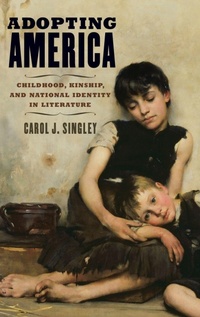
Adopting America
Childhood, Kinship, and National Identity in Literature
Published on 26. May 2011
Book
Hardback
236 pages
978-0-19-977939-0 (ISBN)
Description
American literature abounds with orphans who experience adoption or placements that resemble adoption. These stories do more than recount adventures of children living away from home. They tell an American story of family and national identity. In narratives from the seventeenth to the early twentieth century, adoption functions as narrative event and trope that describes the American migratory experience, the impact of Calvinist faith, and the growth of democratic individualism.
The roots of literary adoption appear in the discourse of Puritan settlers, who ambivalently took leave of their birth parent country and portrayed themselves as abandoned children. Believing they were chosen children of God, they also prayed for spiritual adoption and emulated God's grace by extending adoption to others. Nineteenth-century adoption literature develops from this notion of adoption as salvation and from simultaneous attachments to the Old World and the New. In domestic fiction of the mid-nineteenth century, adoption also reflects a focus on nurture in childrearing, increased mobility in the nation, and middle-class concerns over immigration and urbanization, assuaged when the orphan finds a proper, loving home. Adoption signals fresh starts and the opportunity for success without genealogical constraints, especially for white males, but inflected by gender and racial biases, it often entails dependency for girls and children of color.
A complex signifier of difference, adoption gives voice to sometimes contradictory calls to origins and fresh beginning; to feelings of worthiness and unworthiness. In writings from Cotton Mather to Edith Wharton, it both replicates and offers an alternative to the genealogical norm, evoking ambivalence as it shapes national mythologies.
The roots of literary adoption appear in the discourse of Puritan settlers, who ambivalently took leave of their birth parent country and portrayed themselves as abandoned children. Believing they were chosen children of God, they also prayed for spiritual adoption and emulated God's grace by extending adoption to others. Nineteenth-century adoption literature develops from this notion of adoption as salvation and from simultaneous attachments to the Old World and the New. In domestic fiction of the mid-nineteenth century, adoption also reflects a focus on nurture in childrearing, increased mobility in the nation, and middle-class concerns over immigration and urbanization, assuaged when the orphan finds a proper, loving home. Adoption signals fresh starts and the opportunity for success without genealogical constraints, especially for white males, but inflected by gender and racial biases, it often entails dependency for girls and children of color.
A complex signifier of difference, adoption gives voice to sometimes contradictory calls to origins and fresh beginning; to feelings of worthiness and unworthiness. In writings from Cotton Mather to Edith Wharton, it both replicates and offers an alternative to the genealogical norm, evoking ambivalence as it shapes national mythologies.
Reviews / Votes
Singley's very timely and original re-reading of many classic texts proves once more that we students of the canon never exhaust it. Such rich books as The Scarlet Letter and Our Nig, Little Women, Summer, and others spring to new life under Singley's careful (and historically informed) analysis. An excellent addition to the burgeoning scholarship on childhood and American literature. * Linda Wagner-Martin, University of North Carolina * Singley has produced an impressive piece of scholarship that shows the centrality of adoption issues to American literature. Adopting America should appeal not only to scholars of literature, but also to anyone interested in adoption in relation to history, sociology, psychology, or their own lives. * Marianne Novy, University of Pittsburgh * Adopting America presents an excellent and thoroughly researched overview of a timely topic--the relation of familial constructs to forms of adoption in the literature of the United States. With readings of works by writers ranging from Ben Franklin to Edith Wharton, Singley has crafted a book that will attract scholars of American literature and culture for years to come. * Shirley Samuels, Cornell University * Wide ranging, clearly written, and well informed, Adopting America provides detailed readings of canonical and little known adoption texts against the backdrop of Americans' changing attitudes toward child rearing and nation from Puritan times through the First World War. Carol Singley's new book is a valuable contribution to adoption studies. * Claudia Nelson, Texas A&M University * This book succeeds admirably...through deep historical contextualization and close literary analysis of theme and form. * New England Quarterly *More details
Language
English
Place of publication
New York
United States
Target group
College/higher education
Product notice
Unsewn / adhesive bound
Paper over boards
With dust jacket
Dimensions
Height: 245 mm
Width: 164 mm
Thickness: 24 mm
Weight
496 gr
ISBN-13
978-0-19-977939-0 (9780199779390)
Copyright in bibliographic data and cover images is held by Nielsen Book Services Limited or by the publishers or by their respective licensors: all rights reserved.
Schweitzer Classification
Other editions
Additional editions
E-Book
01/2012
1st Edition
OUP eBook
€16.49
Available for download
E-Book
04/2011
1st Edition
OUP eBook
€17.49
Available for download
Person
Carol J. Singley is Associate Professor of English at Rutgers University, Camden. She is the author of Edith Wharton: Matters of Mind and Spirit (Cambridge, 1995) and the editor of The American Child: A Cultural Studies Reader (Rutgers UP, 2003), Edith Wharton's The House of Mirth: A Casebook (OUP, 2003) and A Historical Guide to Edith Wharton (OUP, 2003).
Content
INTRODUCTION; INDEX