

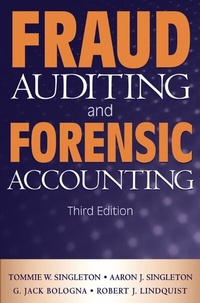
Fraud Auditing and Forensic Accounting
3rd Edition
Published on 1. August 2006
Book
Hardback
336 pages
978-0-471-78591-0 (ISBN)
Description
Get the latest tools in fraud auditing and get rid of fraud in your organization
With the responsibility of detecting and preventing fraud placed directly on the accounting profession, you are responsible for recognizing fraud and learning the tools and strategies necessary to stop it. Fraud Auditing and Forensic Accounting, Third Edition shows you how to develop an investigative eye toward both internal and external fraud and provides crucial information on how to deal with it when discovered.
This authoritative, timely book equips auditors, investigators, corporate attorneys, and accountants to identify the signs of financial fraud and successfully investigate it. This new edition will enable you to:
* Recognize the characteristics of organizations in which fraud is likely to occur
* Detect and deter accounting fraud, using the most recently developed techniques
* Conduct an efficient, systematic fraud investigation
* Use the latest methods for documenting fraud and preparing evidence--and much more
PRAISE FOR Fraud Auditing and Forensic Accounting, Third Edition
"An excellent primer for developing and implementing an antifraud program as part of a SOX 404, fraud prevention and detection process. A clear and concise history of fraud and the methods needed to deter it now and for the future. It is like having a professor on call and in your office when you need one. Well written with easy-to-understand definitions and examples, this is a must-read for anyone who is putting a financial investigation unit in place."
--George Mullins, CFE, HealthSouthInternal Audit Manager and Project Manager, Antifraud Program
"The book is an excellent anti-fraud resource for those professionals charged with the responsibility of detecting, investigating, and preventing fraud. I also highly recommend it to educators as a prospective textbook for a semester-long course in macro fraud examination."
--Thomas Buckhoff, PhD, CPA, CFE, Associate Professor of Forensic Accounting, Georgia Southern University, and Principal, FraudWise, LLC
"This book, better than any other in print, hits the subject areas I cover in my fraud examination and forensic accounting class. The authors have done a great job of presenting complicated terms and techniques in a manner for students to understand. I particularly like the presentation of a fraud's endgame, namely the court case that recovers assets and puts these creeps in jail."
--Douglas E. Ziegenfuss, Professor and Chair, Department of Accounting,Old Dominion University
With the responsibility of detecting and preventing fraud placed directly on the accounting profession, you are responsible for recognizing fraud and learning the tools and strategies necessary to stop it. Fraud Auditing and Forensic Accounting, Third Edition shows you how to develop an investigative eye toward both internal and external fraud and provides crucial information on how to deal with it when discovered.
This authoritative, timely book equips auditors, investigators, corporate attorneys, and accountants to identify the signs of financial fraud and successfully investigate it. This new edition will enable you to:
* Recognize the characteristics of organizations in which fraud is likely to occur
* Detect and deter accounting fraud, using the most recently developed techniques
* Conduct an efficient, systematic fraud investigation
* Use the latest methods for documenting fraud and preparing evidence--and much more
PRAISE FOR Fraud Auditing and Forensic Accounting, Third Edition
"An excellent primer for developing and implementing an antifraud program as part of a SOX 404, fraud prevention and detection process. A clear and concise history of fraud and the methods needed to deter it now and for the future. It is like having a professor on call and in your office when you need one. Well written with easy-to-understand definitions and examples, this is a must-read for anyone who is putting a financial investigation unit in place."
--George Mullins, CFE, HealthSouthInternal Audit Manager and Project Manager, Antifraud Program
"The book is an excellent anti-fraud resource for those professionals charged with the responsibility of detecting, investigating, and preventing fraud. I also highly recommend it to educators as a prospective textbook for a semester-long course in macro fraud examination."
--Thomas Buckhoff, PhD, CPA, CFE, Associate Professor of Forensic Accounting, Georgia Southern University, and Principal, FraudWise, LLC
"This book, better than any other in print, hits the subject areas I cover in my fraud examination and forensic accounting class. The authors have done a great job of presenting complicated terms and techniques in a manner for students to understand. I particularly like the presentation of a fraud's endgame, namely the court case that recovers assets and puts these creeps in jail."
--Douglas E. Ziegenfuss, Professor and Chair, Department of Accounting,Old Dominion University
Reviews / Votes
"...look at the expanded scope that fraud and other white collar crimes have taken on in the business landscape, attributed in part to the pervasiveness of computerized accounting systems, the World Wide Web, the occurrence of large-scale frauds such as Enron and WorldCom, which requires financial accountants to provide a new level of assertion as to the veracity of a company's financial records." (Strategic Finance, April 2009)More details
Edition
3., Auflage
Language
English
Place of publication
New York
United States
Publishing group
John Wiley and Sons Ltd
Target group
Professional and scholarly
Edition type
Revised edition
Dimensions
Height: 22.9 cm
Width: 16.3 cm
Thickness: 26 mm
Weight
625 gr
ISBN-13
978-0-471-78591-0 (9780471785910)
Schweitzer Classification
Other editions
New editions
Tommie W. Singleton | Aaron J. Singleton
Fraud Auditing and Forensic Accounting
Book
09/2010
4th Edition
Wiley
€97.50
Shipment within 10-20 days
Additional editions
Tommie W. Singleton | Aaron J. Singleton | G. Jack Bologna
Fraud Auditing and Forensic Accounting
E-Book
08/2006
3rd Edition
Wiley
€57.99
Available for download
Persons
TOMMIE W. SINGLETON, CPA, CMA, CISA, CITP, is Marshall IS Scholar and coordinator of the Forensic Accounting Program at the University of Alabama at Birmingham. He is a member of the American Institute of Certified Public Accountants, the Association of Certified Fraud Examiners, the Institute of Internal Auditors, the Information Systems Audit and Control Association, and the Institute of Management Accountants, among other organizations. He has published numerous articles and is coauthor of Managing the Audit Function: A Corporate Audit Department Procedures Guide, Third Edition (Wiley).
AARON J. SINGLETON acquired his master's of accountancy at Bowling Green State University. He is an IT auditor with PricewaterhouseCoopers (PWC). His articles have been published in the Journal of Corporate Accounting and Finance and Bank Accounting and Finance.
G. JACK BOLOGNA, BBA, JD, CFE, is former president of Computer Protection Systems, Inc., and Associate Professor of Management at Siena Heights University, Michigan. Among his numerous publications are The Accountant's Handbook of Fraud and Commercial Crime (Wiley), Forensic Accounting Handbook, and Handbook on Corporate Fraud.
ROBERT J. LINDQUIST, BComm, CA, CFE, is CEO of Lindquist, Avey, Macdonald, Baskerville, Inc., a leading North American forensic and investigative accounting firm. Previously, he was partner and national director of the forensic accounting services division of a "Big Six" accounting firm.
AARON J. SINGLETON acquired his master's of accountancy at Bowling Green State University. He is an IT auditor with PricewaterhouseCoopers (PWC). His articles have been published in the Journal of Corporate Accounting and Finance and Bank Accounting and Finance.
G. JACK BOLOGNA, BBA, JD, CFE, is former president of Computer Protection Systems, Inc., and Associate Professor of Management at Siena Heights University, Michigan. Among his numerous publications are The Accountant's Handbook of Fraud and Commercial Crime (Wiley), Forensic Accounting Handbook, and Handbook on Corporate Fraud.
ROBERT J. LINDQUIST, BComm, CA, CFE, is CEO of Lindquist, Avey, Macdonald, Baskerville, Inc., a leading North American forensic and investigative accounting firm. Previously, he was partner and national director of the forensic accounting services division of a "Big Six" accounting firm.
Content
Preface.
Acknowledgments.
Chapter 1: Fraud Definitions, Models, and Taxonomies.
Introduction.
Classic Fraud Research.
Fraud Triangle.
Scope of Fraud.
Profile of Fraudsters.
Who Is Victimized by Fraud Most Often?
Fraud Taxonomies.
Evolution of a Typical Fraud.
Chapter 2: Fundamentals of Fraud Auditing and Forensic Accounting.
Introduction.
Brief History of Fraud and the Antifraud Profession.
Review of Technical Literature.
Auditor's Mind-Set.
What Is Forensic Accounting?
Steps in Fraud Investigation.
What Is Fraud Auditing?
Antifraud Professional Organizations and Certifications.
Summary.
Chapter 3: Auditor Liability for Detecting Fraud.
Introduction.
Recent Developments in Auditor Liability.
Summary.
Chapter 4: Fraud Schemes.
Introduction.
ACFE Fraud Tree.
Financial Statement Schemes.
Corruption Schemes.
Asset Misappropriation Schemes.
Summary.
Chapter 5: Red Flags and Fraud Detection.
Introduction.
Professional Standards.
Common Red Flags.
Common Detection Methods.
Specific Red Flags and Detection Methods.
Corruption Schemes.
Asset Misappropriation Schemes.
Fraud Detection Model.
Summary.
Chapter 6: Fraud and CAATs.
Introduction.
Benefits of CAATs.
Fraud and CAAT Issues.
Need for Computer Tools.
Sample Tools/CAATs.
CAAT Methodology.
Summary.
Chapter 7: Fraud Prevention and Control.
Introduction.
Perception of Detection.
Classic Approaches.
Prevention Environment.
Prevention Measures.
Accounting Cycles.
Summary.
Chapter 8: Fraud Risk Assessment.
Introduction.
Risk Assessment Process and Documentation.
Risk Management Checklists and Documentation.
Special Cases.
Summary.
Chapter 9: Fraud and the Accounting Information System.
Introduction.
Accounting Concepts.
Expenditures Cycle (Purchases and Disbursements).
Bank Reconciliation.
General Ledger.
Cash Path.
Segregation of Duties.
Computerized Accounting Systems.
Key Personnel.
Computer Hardware.
Computer Software.
Media Storage.
New Forms of Media.
Paper and Microfilm.
Audit Trail Concept.
Chapter 10: Computer-Related Fraud.
Introduction.
History and Evolution of Computer-Related Crimes.
Computer-Related Fraud Theories and Principles.
Characteristics of the Computer Environment.
Information Security (InfoSec).
Profiling Internet Fraudsters.
Summary.
Chapter 11: Forensic Accountant as an Expert Witness.
Introduction.
Role of a Forensic Accountant as a Witness in Court.
Forensic Accountant as an Expert Witness.
Qualification and Admissibility of Accounting Evidence.
Expert's Role in the Litigation Team.
Pretestimony Activities.
Trial and Testimony.
Summary.
Appendix 11A.
Chapter 12: General Criteria and Standards for Evaluating an Expert's Qualifications.
Introduction.
Credentials.
Personal Qualities of the Expert.
Sources for Locating Expert Witnesses.
Distinguishing the Actual Area of Competence.
Summary.
Chapter 13: Gathering Evidence.
Introduction.
Rules of Evidence.
Hearsay Exceptions.
Other Rules of Evidence.
Index.
Acknowledgments.
Chapter 1: Fraud Definitions, Models, and Taxonomies.
Introduction.
Classic Fraud Research.
Fraud Triangle.
Scope of Fraud.
Profile of Fraudsters.
Who Is Victimized by Fraud Most Often?
Fraud Taxonomies.
Evolution of a Typical Fraud.
Chapter 2: Fundamentals of Fraud Auditing and Forensic Accounting.
Introduction.
Brief History of Fraud and the Antifraud Profession.
Review of Technical Literature.
Auditor's Mind-Set.
What Is Forensic Accounting?
Steps in Fraud Investigation.
What Is Fraud Auditing?
Antifraud Professional Organizations and Certifications.
Summary.
Chapter 3: Auditor Liability for Detecting Fraud.
Introduction.
Recent Developments in Auditor Liability.
Summary.
Chapter 4: Fraud Schemes.
Introduction.
ACFE Fraud Tree.
Financial Statement Schemes.
Corruption Schemes.
Asset Misappropriation Schemes.
Summary.
Chapter 5: Red Flags and Fraud Detection.
Introduction.
Professional Standards.
Common Red Flags.
Common Detection Methods.
Specific Red Flags and Detection Methods.
Corruption Schemes.
Asset Misappropriation Schemes.
Fraud Detection Model.
Summary.
Chapter 6: Fraud and CAATs.
Introduction.
Benefits of CAATs.
Fraud and CAAT Issues.
Need for Computer Tools.
Sample Tools/CAATs.
CAAT Methodology.
Summary.
Chapter 7: Fraud Prevention and Control.
Introduction.
Perception of Detection.
Classic Approaches.
Prevention Environment.
Prevention Measures.
Accounting Cycles.
Summary.
Chapter 8: Fraud Risk Assessment.
Introduction.
Risk Assessment Process and Documentation.
Risk Management Checklists and Documentation.
Special Cases.
Summary.
Chapter 9: Fraud and the Accounting Information System.
Introduction.
Accounting Concepts.
Expenditures Cycle (Purchases and Disbursements).
Bank Reconciliation.
General Ledger.
Cash Path.
Segregation of Duties.
Computerized Accounting Systems.
Key Personnel.
Computer Hardware.
Computer Software.
Media Storage.
New Forms of Media.
Paper and Microfilm.
Audit Trail Concept.
Chapter 10: Computer-Related Fraud.
Introduction.
History and Evolution of Computer-Related Crimes.
Computer-Related Fraud Theories and Principles.
Characteristics of the Computer Environment.
Information Security (InfoSec).
Profiling Internet Fraudsters.
Summary.
Chapter 11: Forensic Accountant as an Expert Witness.
Introduction.
Role of a Forensic Accountant as a Witness in Court.
Forensic Accountant as an Expert Witness.
Qualification and Admissibility of Accounting Evidence.
Expert's Role in the Litigation Team.
Pretestimony Activities.
Trial and Testimony.
Summary.
Appendix 11A.
Chapter 12: General Criteria and Standards for Evaluating an Expert's Qualifications.
Introduction.
Credentials.
Personal Qualities of the Expert.
Sources for Locating Expert Witnesses.
Distinguishing the Actual Area of Competence.
Summary.
Chapter 13: Gathering Evidence.
Introduction.
Rules of Evidence.
Hearsay Exceptions.
Other Rules of Evidence.
Index.