

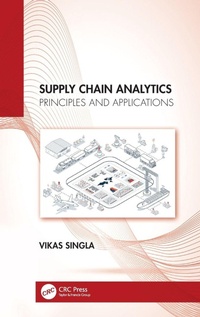
Supply Chain Analytics
Principles and Applications
1st Edition
Published on 2. December 2025
Book
Hardback
386 pages
978-1-032-60314-8 (ISBN)
Description
This reference text resolves problems of physical products, information, and financial transactions by using mathematical and statistical tools to provide robust and validated solutions to real-world problems of the supply chain. It further discusses important concepts such as supply chain segmentation, constrained and unconstrained optimization, time series analysis, double exponential smoothing, and demand probability distributions.
This book:
Discusses inventory replenishment models including economic order quantity (EOQ), and economic production quantity (EPQ).
Explains different mathematical and analytical models applied frequently depending on the supply chain problem.
Covers important topics such as linear, integer, and mixed integer programming.
Demonstrates how the variation in demand with time follows certain patterns which can be seasonal, cyclical, trend, and random.
Highlights forecasting methods, namely, cumulative, naive, moving averages, and exponential smoothing.
It is primarily written for senior undergraduate, graduate students, and academic researchers in the fields of manufacturing engineering, industrial engineering, supply chain management, mechanical engineering, and production engineering.
This book:
Discusses inventory replenishment models including economic order quantity (EOQ), and economic production quantity (EPQ).
Explains different mathematical and analytical models applied frequently depending on the supply chain problem.
Covers important topics such as linear, integer, and mixed integer programming.
Demonstrates how the variation in demand with time follows certain patterns which can be seasonal, cyclical, trend, and random.
Highlights forecasting methods, namely, cumulative, naive, moving averages, and exponential smoothing.
It is primarily written for senior undergraduate, graduate students, and academic researchers in the fields of manufacturing engineering, industrial engineering, supply chain management, mechanical engineering, and production engineering.
More details
Language
English
Place of publication
London
United Kingdom
Publishing group
Taylor & Francis Ltd
Target group
College/higher education
Professional and scholarly
Academic, Postgraduate, and Undergraduate Advanced
Illustrations
58 s/w Tabellen, 105 s/w Zeichnungen, 105 s/w Abbildungen
58 Tables, black and white; 105 Line drawings, black and white; 105 Illustrations, black and white
Dimensions
Height: 240 mm
Width: 161 mm
Thickness: 26 mm
Weight
763 gr
ISBN-13
978-1-032-60314-8 (9781032603148)
Copyright in bibliographic data and cover images is held by Nielsen Book Services Limited or by the publishers or by their respective licensors: all rights reserved.
Schweitzer Classification
Other editions
Additional editions
E-Book
12/2025
1st Edition
CRC Press
€73.99
Available for download
E-Book
12/2025
1st Edition
CRC Press
€73.99
Available for download
Person
Vikas Singla is an associate professor at the department of Management Studies of Punjabi University Patiala, Punjab since 2006. He earned his bachelor's in mechanical engineering from Thapar Institute of Engineering and Technology and pursued his MBA and PhD from Punjabi University. During the course of his profession, he has been involved in publications in the field of Lean manufacturing and branding. He has also published papers and two books in areas of Operations Research and Supply Chain Analytics. Dr Singla has also coordinated and developed content for Operations Management under National Mission on Education through ICT (NME-ICT), Ministry of Human Resource Development (MHRD). He has also partnered with industries such as Polyplast India Ltd and Federal Mogul, Bahadurgarh for problem-solving related with operations by extensive application of quantitative techniques.
Content
1. Supply Chain Management. 2. Deterministic Models. 3. Predictive Models. 4. Forecasting. 5. Inventory Management. 6. Inventory Management: Stochastic Demand. 7. Freight Transportation.