

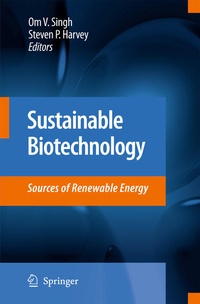
Sustainable Biotechnology
Sources of Renewable Energy
Published on 9. December 2009
Book
Hardback
XVII, 323 pages
978-90-481-3294-2 (ISBN)
Description
Sustainable Biotechnology; Sources of Renewable Energy draws on the vast body of knowledge about renewable resources for biofuel research, with the aim to bridge the technology gap and focus on critical aspects of lignocellulosic biomolecules and the respective mechanisms regulating their bioconversion to liquid fuels and other value-added products. This book is a collection of outstanding research reports and reviews elucidating several broad-ranging areas of progress and challenges in the utilization of sustainable resources of renewable energy, especially in biofuels.
More details
Edition
2010 ed.
Language
English
Place of publication
Dordrecht
Netherlands
Target group
Professional and scholarly
Research
Illustrations
XVII, 323 p.
Dimensions
Height: 241 mm
Width: 160 mm
Thickness: 26 mm
Weight
745 gr
ISBN-13
978-90-481-3294-2 (9789048132942)
DOI
10.1007/978-90-481-3295-9
Schweitzer Classification
Other editions
Additional editions
Book
11/2014
Springer
€213.99
Shipment within 15-20 days
E-Book
11/2009
1st Edition
Springer
€213.99
Available for download
Content
Heat and Mass Transport in Processing of Lignocellulosic Biomass for Fuels and Chemicals.- Biofuels from Lignocellulosic Biomass.- Environmentally Sustainable Biofuels - The Case for Biodiesel, Biobutanol and Cellulosic Ethanol.- Biotechnological Applications of Hemicellulosic Derived Sugars: State-of-the-Art.- Tactical Garbage to Energy Refinery (TGER).- Production of Methane Biogas as Fuel Through Anaerobic Digestion.- Waste to Renewable Energy: A Sustainable and Green Approach Towards Production of Biohydrogen by Acidogenic Fermentation.- Bacterial Communities in Various Conditions of the Composting Reactor Revealed by 16S rDNA Clone Analysis and DGGE.- Perspectives on Bioenergy and Biofuels.- Perspectives on Chemicals from Renewable Resources.- Microbial Lactic Acid Production from Renewable Resources.- Microbial Production of Potent Phenolic-Antioxidants Through Solid State Fermentation.- Photoautotrophic Production of Astaxanthin by the Microalga Haematococcus pluvialis.- Enzymatic Synthesis of Heparin.- Extremophiles: Sustainable Resource of Natural Compounds-Extremolytes.