

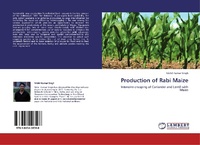
Production of Rabi Maize
Intensive cropping of Coriander and Lentil with Maize
Published on 12. August 2011
Book
Paperback/Softback
88 pages
978-3-8454-2859-8 (ISBN)
Description
Sustainable crop production from limited land resource is the key concern of this millennium. With the shrinking of par-capita land availability, the only option available is to enhance production by crop intensification for increasing the input use efficiency. Intercropping is the one among the various approaches which provides an opportunity to increase the production & productivity of the cereals, particularly of Maize. This system involves growing two or more crops simultaneously with distinct row arrangement for complementary use of natural resources to enhance the productivity. Intercropping system provides substantial yield advantage over solo crop due to temporal and spatial complementarities and minimizes inter/intra specific competition. The objective to adopt such cropping practice is to reduce the risk of main crop failure due to uncertain factors and to have variation of produce for food and to feed the requirement of the farmers, family and animals besides meeting the cash requirement.
More details
Language
English
Place of publication
Germany
Target group
Children/juvenile
Product notice
Paperback (trade)
Unsewn / adhesive bound
Dimensions
Height: 220 mm
Width: 150 mm
Thickness: 6 mm
Weight
149 gr
ISBN-13
978-3-8454-2859-8 (9783845428598)
Copyright in bibliographic data and cover images is held by Nielsen Book Services Limited or by the publishers or by their respective licensors: all rights reserved.
Schweitzer Classification
Person
Nikhil Kumar Singh has obtained his Msc (Agriculture) degree in Agronomy in 2007. Currently, he is a Research Scholar in BHU, India, and working on 'Resource Conservation Technology in Rice-Wheat System in Indo-Gangetic Plains'. He has published several research papers and participated/presented papers in National and International seminars.