

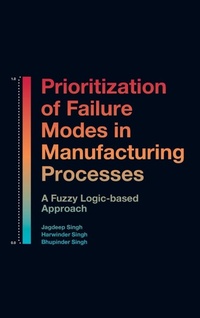
Prioritization of Failure Modes in Manufacturing Processes
A Fuzzy Logic-based Approach
Published on 21. May 2020
Book
Hardback
224 pages
978-1-83982-143-1 (ISBN)
Description
In the contemporary automotive manufacturing industry, service providers are continuously working to improve system optimization in order to remain competitive in the market and deliver quality products to satisfy their customers. With this comes the possibility of failure, rejection and reworking of the components or services in the system, which can incur high costs and impact the reputation of an organization. This book uses Failure Mode and Effect Analysis (FMEA) to assess, investigate and predict the Risk Priority Number (RPN) of potential failures for three companies within the manufacturing industry:
A metal component supplier in the automotive sector
Part manufacturer for the automobile and engineering industries
Manufacturer of suspension components for commercial vehicles
Integrating human expertise and artificial intelligence on a single platform, the authors use fuzzy logic as a tool to overcome the vagueness associated with traditional methods of assessing potential failures. The book also details the procedure and scales of how to conduct FMEA, offering guidance on how to input and rank each risk within manufacturing processes across a range of sectors's. Each of the three real-world cases offer suggested improvements for the companies themselves, alongside takeaways for researchers and professionals within the fields of manufacturing and supply chain management.
A metal component supplier in the automotive sector
Part manufacturer for the automobile and engineering industries
Manufacturer of suspension components for commercial vehicles
Integrating human expertise and artificial intelligence on a single platform, the authors use fuzzy logic as a tool to overcome the vagueness associated with traditional methods of assessing potential failures. The book also details the procedure and scales of how to conduct FMEA, offering guidance on how to input and rank each risk within manufacturing processes across a range of sectors's. Each of the three real-world cases offer suggested improvements for the companies themselves, alongside takeaways for researchers and professionals within the fields of manufacturing and supply chain management.
More details
Language
English
Place of publication
Bingley
United Kingdom
Target group
Professional and scholarly
Dimensions
Height: 235 mm
Width: 157 mm
Thickness: 13 mm
Weight
392 gr
ISBN-13
978-1-83982-143-1 (9781839821431)
Copyright in bibliographic data and cover images is held by Nielsen Book Services Limited or by the publishers or by their respective licensors: all rights reserved.
Schweitzer Classification
Other editions
Additional editions
Jagdeep Singh | Harwinder Singh | Bhupinder Singh
Prioritization of Failure Modes in Manufacturing Processes
A Fuzzy Logic-based Approach
E-Book
05/2020
1st Edition
Emerald Publishing Limited
€90.99
Available for download
Persons
Jagdeep Singh holds a Bachelor's degree in Mechanical Engineering, Master's degree in Production Engineering, and PhD degree in Mechanical Engineering. The author has published 42 research papers in international and national journals of repute.The author is working as an Assistant Professor in Mechanical Engineering Department at I. K. G. Punjab Technical University, Kapurthala, Punjab, India. The author is working as Editorial Board Member of 03 International Journals of Inderscience Publisher. His field of interest is management of production systems and operations management.
Harwinder Singh holds a Bachelor's degree in Mechanical Engineering, Master's degree in Production Engineering, Master's degree in Business Administration and PhD degree in Mechanical Engineering. The author has published more than 100 papers in international and national journals of repute. The author is working as a Professor in Mechanical Engineering at Guru Nanak Dev Engineering College, Ludhiana, Punjab. India. His field of interest is management of production systems, operations management and decision making.
Bhupinder Singh holds a Bachelor's degree in Mechanical Engineering and Master's degree in Industrial Engineering. The author is working as Assistant Professor in Mechanical Engineering Department at Lovely Professional University, Phagwara, Punjab, India. The author has published one book for the Polytechnic students. The author has one patent under his name. His field of interest is optimization, production management and quality control.
Harwinder Singh holds a Bachelor's degree in Mechanical Engineering, Master's degree in Production Engineering, Master's degree in Business Administration and PhD degree in Mechanical Engineering. The author has published more than 100 papers in international and national journals of repute. The author is working as a Professor in Mechanical Engineering at Guru Nanak Dev Engineering College, Ludhiana, Punjab. India. His field of interest is management of production systems, operations management and decision making.
Bhupinder Singh holds a Bachelor's degree in Mechanical Engineering and Master's degree in Industrial Engineering. The author is working as Assistant Professor in Mechanical Engineering Department at Lovely Professional University, Phagwara, Punjab, India. The author has published one book for the Polytechnic students. The author has one patent under his name. His field of interest is optimization, production management and quality control.
Content
Chapter 1. Introduction
Chapter 2. Traditional FMEA Application
Chapter 3. Fuzzy based FMEA application
Chapter 4. Fuzzy FMEA and fault tree analysis-application
Chapter 5. Line balancing problem - fuzzy based application
Chapter 6. Conclusions
Chapter 2. Traditional FMEA Application
Chapter 3. Fuzzy based FMEA application
Chapter 4. Fuzzy FMEA and fault tree analysis-application
Chapter 5. Line balancing problem - fuzzy based application
Chapter 6. Conclusions