

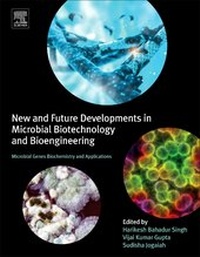
New and Future Developments in Microbial Biotechnology and Bioengineering
Microbial Genes Biochemistry and Applications
Published on 26. October 2018
Book
Hardback
254 pages
978-0-444-63503-7 (ISBN)
Description
New and Future Developments in Microbial Biotechnology and Bioengineering: Microbial Genes Biochemistry and Applications consolidates the most widely used genetic methods available, bringing together the fields of biochemistry, biotechnology, and microbiology. The chapters outlined give clear and concise direction on both standard and applied microbial genetic improvements, presenting undergraduates, postgraduates, and researchers with the latest developments in microbial gene technology. In addition, the book describes the background and usefulness of each experiment in question. All chapters covered in the book are derived from current peer-reviewed literature as accepted by the international scientific community.
More details
Language
English
Place of publication
Oxford
United Kingdom
Publishing group
Elsevier Science & Technology
Target group
Professional and scholarly
Bioengineers, Biochemical Engineers, Biochemist, Biotechnologists, food technologist, enzymologists, and related professionals/ researchers. Graduate and postgraduate students, researchers and microbiologists, mycologists.
Illustrations
Illustrated
Dimensions
Height: 276 mm
Width: 216 mm
Weight
910 gr
ISBN-13
978-0-444-63503-7 (9780444635037)
Copyright in bibliographic data and cover images is held by Nielsen Book Services Limited or by the publishers or by their respective licensors: all rights reserved.
Schweitzer Classification
Other editions
Additional editions
H. B. Singh | Vijai G. Gupta | Sudisha Jogaiah
New and Future Developments in Microbial Biotechnology and Bioengineering
Microbial Genes Biochemistry and Applications
E-Book
10/2018
Elsevier
€205.00
Available for download
Persons
Professor Harikesh Bahadur Singh is Head of the Department of Mycology and Plant Pathology, Banaras Hindu University, Varanasi, India. Over the past 35 years, Professor Singh has served at Central Universities and CSIR Institutes with his teaching and research. Based on his scientific contribution and leadership in the field of plant pathology, Professor Singh has been honoured with prestigious awards, such as the CSIR technology award, M.S. Swaminathan award, Mundkur Memorial award, and BRSI Industrial Medal. His research has resulted in more than 300 publications and 17 books. Dr Vijai G. Gupta is an Assistant Professor of Biotechnology at MITS University of India. Currently he is working as Research Scientist at National University of Ireland in Galway. Dr. Gupta's present work is focused on the development and optimization of novel Enzyme-based bioconversion systems for biorefining and bioenergy. He has been honored with several awards, including the prestigious Indian ICAR Senior Research Fellowship and Indian Young Scientist Award. He has submitted 33 new fungal nucleotide sequences and deposited 147 fungal strains in International databases. His work with Fusarium spp., Colletotrichum gloeosporioides, Penicillium spp. and Trichoderma spp. is augmented by contributions to biotechnological development, molecular diversity, secondary metabolites and industrial applications
Dr. Gupta is the editor-in-chief of the International Journal of Plant Pathology and a regional editorial board member of 8 other respected journals. He is the author of 40 journal articles and 27 book chapters. Gupta has also written and edited books and series from reputed publishers, including CRC Press, Taylor and Francis, USA; Springer, USA; Elsevier, USA; Nova Science Publisher, USA and LAP Lambert Academic Publishing, Germany. Dr. Sudisha Jogaiah is a Fellow of the National Academy of Sciences (FNASc), the Agricultural Sciences (FNAAS), and the National Academy of Biological Sciences (FNABS). He is also a Bridge Fellow, Government of Japan, and serves as a Visiting Professor at Yamaguchi University, Japan, and Nanjing Agricultural University, China. In 2022, he joined the Department of Environmental Science at the Central University of Kerala as an Associate Professor. He has been listed among the World's Top 2% of Scientists by Stanford University for 3 consecutive years. His research interests include plant pathology, plant-microbe interactions, plant defense signaling, biocontrol agents, biogenic nanoparticles for induced resistance in plants, and bioremediation. The technological quality and scientific rigor of his laboratory are evident from his extensive publication record and the prestigious national and international awards received.
Dr. Gupta is the editor-in-chief of the International Journal of Plant Pathology and a regional editorial board member of 8 other respected journals. He is the author of 40 journal articles and 27 book chapters. Gupta has also written and edited books and series from reputed publishers, including CRC Press, Taylor and Francis, USA; Springer, USA; Elsevier, USA; Nova Science Publisher, USA and LAP Lambert Academic Publishing, Germany. Dr. Sudisha Jogaiah is a Fellow of the National Academy of Sciences (FNASc), the Agricultural Sciences (FNAAS), and the National Academy of Biological Sciences (FNABS). He is also a Bridge Fellow, Government of Japan, and serves as a Visiting Professor at Yamaguchi University, Japan, and Nanjing Agricultural University, China. In 2022, he joined the Department of Environmental Science at the Central University of Kerala as an Associate Professor. He has been listed among the World's Top 2% of Scientists by Stanford University for 3 consecutive years. His research interests include plant pathology, plant-microbe interactions, plant defense signaling, biocontrol agents, biogenic nanoparticles for induced resistance in plants, and bioremediation. The technological quality and scientific rigor of his laboratory are evident from his extensive publication record and the prestigious national and international awards received.
Content
1. Gene Manipulation and Regulation of Catabolic Genes for Biodegradation of Biphenyl Compounds
2. Genetics and Molecular Biology of Genes Encoding Cephalosporin Biosynthesis in Microbes
3. Disruption of Protease Genes in Microbes for Production of Heterologous Proteins
4. Function profiling of microbial communities with three figures
5. Enhanced Resistance to Fungal Pathogens Through Selective Utilization of Useful Microbial Genes
6. Differential Expression of the Microbial ?-1,4-Xylanase, and ?-1,4-Endoglucanase Genes
7. Profile of Secondary Metabolite Gene Cluster in Microbe
8. Production of Recombinant Microbial Thermostable Lipases
9. Isolation of Cellulase Genes From Thermophilies: A Novel Approach Toward New Gene Discovery
10. Microbial Genes Involved in InteractionWith Plants
11. Virulence Factors and Their Associated Genes in Microbes
12. Modulation of Gene Expression by Microsatellites in Microbes
13. Polyketide and Its Derivatives
14. Synthetic Biology Strategy for Microbial Cellulases: An Overview
2. Genetics and Molecular Biology of Genes Encoding Cephalosporin Biosynthesis in Microbes
3. Disruption of Protease Genes in Microbes for Production of Heterologous Proteins
4. Function profiling of microbial communities with three figures
5. Enhanced Resistance to Fungal Pathogens Through Selective Utilization of Useful Microbial Genes
6. Differential Expression of the Microbial ?-1,4-Xylanase, and ?-1,4-Endoglucanase Genes
7. Profile of Secondary Metabolite Gene Cluster in Microbe
8. Production of Recombinant Microbial Thermostable Lipases
9. Isolation of Cellulase Genes From Thermophilies: A Novel Approach Toward New Gene Discovery
10. Microbial Genes Involved in InteractionWith Plants
11. Virulence Factors and Their Associated Genes in Microbes
12. Modulation of Gene Expression by Microsatellites in Microbes
13. Polyketide and Its Derivatives
14. Synthetic Biology Strategy for Microbial Cellulases: An Overview