

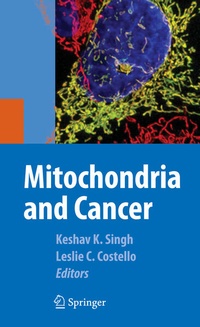
Mitochondria and Cancer
Published on 29. October 2010
Book
Paperback/Softback
XII, 289 pages
978-1-4419-2738-5 (ISBN)
Description
Nearly a century of scientific research has revealed that mitochondrial dysfunction is one of the most common and consistent phenotypes of cancer cells. A number of notable differences in the mitochondria of normal and cancer cells have been described. These include differences in mitochondrial metabolic activity, molecular composition of mitochondria and mtDNA sequence, as well as in alteration of nuclear genes encoding mitochondrial proteins. This book,
Mitochondria and Cancer
, edited by Keshav K. Singh and Leslie C. Costello, presents thorough analyses of mitochondrial dysfunction as one of the hallmarks of cancer, discusses the clinical implications of mitochondrial defects in cancer, and as unique cellular targets for novel and selective anti-cancer therapy.
More details
Edition
Softcover reprint of hardcover 1st ed. 2009
Language
English
Place of publication
New York
United States
Target group
Professional and scholarly
Research
Illustrations
39 s/w Abbildungen, 7 farbige Abbildungen
XII, 289 p. 46 illus., 7 illus. in color.
Dimensions
Height: 235 mm
Width: 155 mm
Thickness: 17 mm
Weight
464 gr
ISBN-13
978-1-4419-2738-5 (9781441927385)
DOI
10.1007/978-0-387-84835-8
Schweitzer Classification
Other editions
Additional editions
Keshav Singh | Leslie Costello
Mitochondria and Cancer
Book
12/2008
Springer
€149.99
Article exhausted; check different version
Content
Mitochondria and Cancer.- Warburg and his Legacy.- The Lipogenic Switch in Cancer.- Citrate Metabolism in Prostate and Other Cancers.- Integration of Genetic, Proteomic, and Metabolic Approaches in Tumor Cell Metabolism.- Mitochondrial Respiration and Differentiation.- Integration of Energy Metabolism and Control of Apoptosis in Tumor Cells.- Energy Generating Pathways and the Tumor Suppressor p53.- Mitochondrial Tumor Suppressors.- Mitochondria in Hematology.- Mitochondria and Oncocytomas.- Mitochondria as Targets for Cancer Therapy.- Reversing the Warburg Effect: Metabolic Modulation as a Novel Cancer Therapy.- Mitochondrial Nanotechnology for Cancer Therapy.