

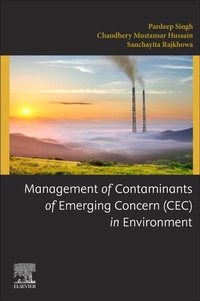
Management of Contaminants of Emerging Concern (CEC) in Environment
Published on 16. March 2021
Book
Paperback/Softback
490 pages
978-0-12-822263-8 (ISBN)
Description
Management of Contaminants of Emerging Concern (CEC) in Environment provides information about new concepts and latest developments in origin, reaction pathways, transportation, transformation products, identification, and adverse effects of CEC, as well as recent remediation technologies and tools for CEC. The book explores processes such as nanotechnology for the degradation of CEC by using various heterogeneous catalysts.
The chapters incorporate both theoretical and practical aspects and can serve as a baseline for future studies. So, Management of Contaminants of Emerging Concern (CEC) in Environment is an indispensable resource for university students, teachers, and researchers, especially those working in the area of remediation and management of contaminants of emerging concern.
The chapters incorporate both theoretical and practical aspects and can serve as a baseline for future studies. So, Management of Contaminants of Emerging Concern (CEC) in Environment is an indispensable resource for university students, teachers, and researchers, especially those working in the area of remediation and management of contaminants of emerging concern.
More details
Language
English
Place of publication
United States
Target group
Professional and scholarly
Chemical engineers, environmental engineers and scientist, scholars working on the management and remediation of hazardous waste; scientist working in fields of environmental management and remediation; civil engineers working on waste treatment
Dimensions
Height: 229 mm
Width: 152 mm
Weight
750 gr
ISBN-13
978-0-12-822263-8 (9780128222638)
Copyright in bibliographic data and cover images is held by Nielsen Book Services Limited or by the publishers or by their respective licensors: all rights reserved.
Schweitzer Classification
Other editions
Additional editions
Pardeep Singh | Sanchayita Rajkhowa | Chaudhery Mustansar Hussain
Management of Contaminants of Emerging Concern (CEC) in Environment
E-Book
03/2021
Elsevier
€200.00
Available for download
Persons
Dr. Pardeep Singh is an Assistant Professor at the Department of Environmental Science, PGDAV College, University of Delhi, in New Delhi, India. He obtained his PhD at the Indian Institute of Technology (Banaras Hindu University) Varanasi. Dr. Singh has published more than 65 papers in international journals in the fields of waste management, environmental pollution, and agricultural nanotechnology, and has co-edited 30 books. Dr. Sanchayita Rajkhowa, is currently working as Assistant Professor (Department of Chemistry, Jorhat Institute of Science & Technology, Jorhat, Assam, India) and has obtained her doctorate degree from North Eastern Hill University, Shillong in the year 2017. Her research is focused on surface chemistry, surfactants, carbohydrate chemistry and their impact on drug discovery and development. Dr. Rajkhowa has published several research papers in journals of both international and national repute as well as book chapters in her research areas with international publishers. Chaudhery Mustansar Hussain is an adjunct professor and lab director in the Department of Chemistry & Environmental Sciences at the New Jersey Institute of Technology (NJIT), United States. His research is focused on sustainability, nanotechnology & advanced materials, environmental management, analytical chemistry, and other various industries. Dr. Hussain is the author of numerous papers in peer-reviewed journals as well as a prolific author and editor of several books, including scientific monographs and handbooks in his research areas. He has published with ELSEVIER, American Chemical Society, Royal Society of Chemistry, John Wiley & Sons, CRC Press, and Springer.
Author
Assistant Professor, Department of Environmental Studies, PGDAV College, University of Delhi, New Delhi, India
Assistant Professor, Department of Chemistry, Jorhat Institute of Science and Technology, Assam, Jorhat, India
Adjunct Professor and Director of Chemistry & EVSC Labs, Department of Chemistry and Environmental Science, New Jersey Institute of Technology (NJIT), Newark, NJ, USA
Content
1. Impact and issues of Organic Pollutants
2. Pharmaceutical Ingredients
3. Personal Care Products
4. Veterinary Medicines
Section 2
5. Physical Treatment technologies
6. Bio-based Treatment technologies
Section 3
7. Removal of organic dyes from industrial waste using low cost adsorbants
8. Investigating the problem of Crop Residue Burning in an Indo-Gangetic Plain - A Risk to Air Quality
9. Fluoride contamination in underground water and its treatment
10. Occurrence, Distribution and Fate of Emerging Persistent Organic Pollutants in the Environment
11. Atmospheric Brown Carbon: Sources, Chemistry and Impact
12. Microplastics as an emerging contaminant in environment: Occurrence, distribution and management strategy
13. Appraisal of groundwater chemistry and Holocene aquifer for arsenic mobilization in groundwater from Bengal basin: A study for safe water supply option
14. Nanoscale Zero Valent Iron (nZVI): A promising nanoparticle for environmental contamination remediation
15. Occurrence of Steroidal Hormone in Environment
16. Persistent Organic Pollutants (POPs) and health Impact
2. Pharmaceutical Ingredients
3. Personal Care Products
4. Veterinary Medicines
Section 2
5. Physical Treatment technologies
6. Bio-based Treatment technologies
Section 3
7. Removal of organic dyes from industrial waste using low cost adsorbants
8. Investigating the problem of Crop Residue Burning in an Indo-Gangetic Plain - A Risk to Air Quality
9. Fluoride contamination in underground water and its treatment
10. Occurrence, Distribution and Fate of Emerging Persistent Organic Pollutants in the Environment
11. Atmospheric Brown Carbon: Sources, Chemistry and Impact
12. Microplastics as an emerging contaminant in environment: Occurrence, distribution and management strategy
13. Appraisal of groundwater chemistry and Holocene aquifer for arsenic mobilization in groundwater from Bengal basin: A study for safe water supply option
14. Nanoscale Zero Valent Iron (nZVI): A promising nanoparticle for environmental contamination remediation
15. Occurrence of Steroidal Hormone in Environment
16. Persistent Organic Pollutants (POPs) and health Impact