

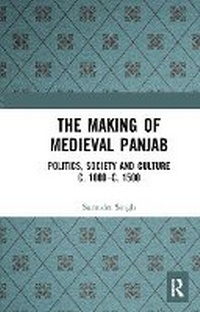
The Making of Medieval Panjab
Politics, Society and Culture c. 1000-c. 1500
1st Edition
Published on 25. June 2024
Book
Paperback/Softback
636 pages
978-1-032-65440-9 (ISBN)
Description
This book seeks to reconstruct the past of undivided Panjab during five medieval centuries. It opens with a narrative of the efforts of Turkish warlords to achieve control in the face of tribal resistance, internal dissensions and external invasions. It examines the linkages of the ruling class with Zamindars and Sufis, paving the way for canal irrigation and agrarian expansion, thus strengthening the roots of the state in the region. While focusing on the post-Timur phase, it tries to make sense of the new ways of acquiring political power.
This work uncovers the perpetual attempts of Zamindars to achieve local dominance, particularly in the context of declining presence of the state in the countryside. In this ambitious enterprise, they resorted to the support of their clans, adherence to hallowed customs and recurrent use of violence, all applied through a system of collective and participatory decision-making.
The volume traces the growth of Sufi lineages built on training disciples, writing books, composing poetry and claiming miraculous powers. Besides delving into the relations of the Sufis with the state and different sections of the society, it offers an account of the rituals at a prominent shrine. Paying equal attention to the southeastern region, it deals with engagement of the Sabiris, among other exemplars, with the Islamic spirituality. Inclusive in approach and lucid in expression, the work relies on a wide range of evidence from Persian chronicles, Sufi literature and folklore, some of which have been used for the first time.
Please note: Taylor & Francis does not sell or distribute the Hardback in India, Pakistan, Nepal, Bhutan, Bangladesh and Sri Lanka
This work uncovers the perpetual attempts of Zamindars to achieve local dominance, particularly in the context of declining presence of the state in the countryside. In this ambitious enterprise, they resorted to the support of their clans, adherence to hallowed customs and recurrent use of violence, all applied through a system of collective and participatory decision-making.
The volume traces the growth of Sufi lineages built on training disciples, writing books, composing poetry and claiming miraculous powers. Besides delving into the relations of the Sufis with the state and different sections of the society, it offers an account of the rituals at a prominent shrine. Paying equal attention to the southeastern region, it deals with engagement of the Sabiris, among other exemplars, with the Islamic spirituality. Inclusive in approach and lucid in expression, the work relies on a wide range of evidence from Persian chronicles, Sufi literature and folklore, some of which have been used for the first time.
Please note: Taylor & Francis does not sell or distribute the Hardback in India, Pakistan, Nepal, Bhutan, Bangladesh and Sri Lanka
More details
Language
English
Place of publication
London
United Kingdom
Publishing group
Taylor & Francis Ltd
Target group
College/higher education
Postgraduate
Dimensions
Height: 216 mm
Width: 138 mm
Weight
820 gr
ISBN-13
978-1-032-65440-9 (9781032654409)
Copyright in bibliographic data and cover images is held by Nielsen Book Services Limited or by the publishers or by their respective licensors: all rights reserved.
Schweitzer Classification
Other editions
Additional editions
Book
11/2019
1st Edition
Routledge
€233.60
Shipment within 15-20 days
E-Book
09/2019
1st Edition
Routledge
€59.49
Available for download
E-Book
09/2019
1st Edition
Routledge
€59.49
Available for download
Person
Surinder Singh has taught at the Department of History, Panjab University, Chandigarh. His main interest is Medieval India.
Content
1. Introduction 2. Warfare, Territory and Resistance 3. The Establishment of Sufi Orders 4. New Strategies of State Formation 5. Piety Submits to the State 6. Making and Breaking of Political Structures 7. Islamic Spirituality in Southeast Panjab 8. The World of the Zamindars 9. Conclusion