

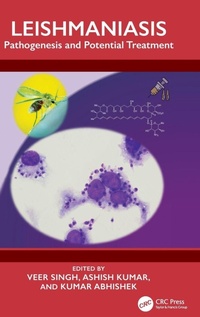
Leishmaniasis
Pathogenesis and Potential Treatment
1st Edition
Will be published approx. on 6. July 2026
Book
Hardback
316 pages
978-1-032-97975-5 (ISBN)
Description
his book covers the history, biology, pathogenesis, clinical manifestations, and the latest advancements in diagnosis, treatment, and control strategies against leishmaniasis. Chapter 1 presents the life cycle of Leishmania parasites, focusing on vector biology and transmission dynamics, while elucidating the mechanisms of infection and disease progression. The clinical manifestations of cutaneous, visceral, and mucocutaneous leishmaniasis are examined in detail, alongside the immune response of the host and the evasion strategies by the parasite. It also investigates the genetic and molecular diversity of Leishmania, highlighting their virulence mechanisms, and reviews diagnostic methods from traditional techniques to advanced molecular diagnostics. The chapter also covers the current therapeutic approaches, including potential drugs and combination therapies along with integrated vector management strategies for effective disease control. The book explores preventive measures, community interventions, and public health strategies, addressing challenges in leishmaniasis research and identifying knowledge gaps. It presents real-world applications and outcomes through case studies and clinical trials. This book is useful for researchers and students of infectious diseases, tropical medicine, and parasitology.
Key Features:
Explores the pathogenesis and epidemiology of leishmaniasis, providing a global perspective on its public health impact
Details the life cycle of Leishmania parasites, focusing on vector biology, transmission dynamics, and mechanisms of infection
Examines the clinical manifestations of cutaneous, visceral, and mucocutaneous leishmaniasis, including the host immune response and parasite evasion strategies
Reviews current therapeutic approaches, including potential drugs, combination therapies, and integrated vector management strategies for effective control
Presents preventive measures, community interventions, public health strategies, and the challenges in leishmaniasis research
Key Features:
Explores the pathogenesis and epidemiology of leishmaniasis, providing a global perspective on its public health impact
Details the life cycle of Leishmania parasites, focusing on vector biology, transmission dynamics, and mechanisms of infection
Examines the clinical manifestations of cutaneous, visceral, and mucocutaneous leishmaniasis, including the host immune response and parasite evasion strategies
Reviews current therapeutic approaches, including potential drugs, combination therapies, and integrated vector management strategies for effective control
Presents preventive measures, community interventions, public health strategies, and the challenges in leishmaniasis research
More details
Language
English
Place of publication
London
United Kingdom
Publishing group
Taylor & Francis Ltd
Target group
Professional and scholarly
College/higher education
Postgraduate and Professional Reference
Illustrations
1 s/w Abbildung, 54 farbige Abbildungen, 12 Farbfotos bzw. farbige Rasterbilder, 1 s/w Zeichnung, 42 farbige Zeichnungen, 29 s/w Tabellen
29 Tables, black and white; 42 Line drawings, color; 1 Line drawings, black and white; 12 Halftones, color; 54 Illustrations, color; 1 Illustrations, black and white
Dimensions
Height: 234 mm
Width: 156 mm
ISBN-13
978-1-032-97975-5 (9781032979755)
Copyright in bibliographic data and cover images is held by Nielsen Book Services Limited or by the publishers or by their respective licensors: all rights reserved.
Schweitzer Classification
Other editions
Additional editions
E-Book
approx. 07/2026
1st Edition
CRC Press
€151.99
Available for download
E-Book
approx. 07/2026
1st Edition
CRC Press
€151.99
Available for download
Persons
Veer Singh is currently working as Young Scientist (DHR) at the Department of Biochemistry, Rajendra Memorial Research Institute of Medical Sciences, Patna, India. He got PhD from the Indian Institute of Technology (Banaras Hindu University), Varanasi. He has more than 50 publications and his area of work involved Environmental contamination & toxicity, the role of drinking water heavy metals contamination in visceral leishmaniasis (VL) & post-kala-azar dermal leishmaniasis (PKDL) development. He has also published 6 books and 5 patents related to his research field.
Dr. Ashish Kumar is currently working as Scientist-C and Head of Department at the Department of Biochemistry, Rajendra Memorial Research Institute of Medical Sciences, and Patna, India. He has published more than 45 publications in International/national journals. He has received several awards and received several funding (sponsored projects) from many national and international agencies. Currently, 4 doctoral and 2 postdoctoral students are working under the supervision of Dr. Ashish Kumar. Dr. Kumar is working in the interdisciplinary area of life science. His work is mainly focused on visceral leishmaniasis (VL) and post kala-azar dermal leishmaniasis (PKDL). He is also working on VL and PKDL diagnosis, treatment and environmental impacts on disease development.
Kumar Abhishek is currently working as Scientist-C, Department of Health Research, Model Rural Health Research Unit (MRHRU), Kurhani, Muzaffarpur, under ICMR- Rajendra Memorial Research Institute of Medical Sciences, Patna, (Bihar) India. He got his Ph.D. from the Department of Microbiology, University of Calcutta, West Bengal. He has more than 26 publications in peer reviewed journals. He works in the field of visceral leishmaniasis (VL), post-kala-azar dermal leishmaniasis (PKDL), parasitic diseases and on the epidemiology of communicable and non-communicable diseases.
Dr. Ashish Kumar is currently working as Scientist-C and Head of Department at the Department of Biochemistry, Rajendra Memorial Research Institute of Medical Sciences, and Patna, India. He has published more than 45 publications in International/national journals. He has received several awards and received several funding (sponsored projects) from many national and international agencies. Currently, 4 doctoral and 2 postdoctoral students are working under the supervision of Dr. Ashish Kumar. Dr. Kumar is working in the interdisciplinary area of life science. His work is mainly focused on visceral leishmaniasis (VL) and post kala-azar dermal leishmaniasis (PKDL). He is also working on VL and PKDL diagnosis, treatment and environmental impacts on disease development.
Kumar Abhishek is currently working as Scientist-C, Department of Health Research, Model Rural Health Research Unit (MRHRU), Kurhani, Muzaffarpur, under ICMR- Rajendra Memorial Research Institute of Medical Sciences, Patna, (Bihar) India. He got his Ph.D. from the Department of Microbiology, University of Calcutta, West Bengal. He has more than 26 publications in peer reviewed journals. He works in the field of visceral leishmaniasis (VL), post-kala-azar dermal leishmaniasis (PKDL), parasitic diseases and on the epidemiology of communicable and non-communicable diseases.
Content
Chapter 1: Introduction to Leishmaniasis: History, Epidemiology, and Global Health Impact. Chapter 2: Leishmania Life Cycle: Vector Biology and Parasite Transmission Dynamics. Chapter 3: Pathogenesis of Leishmaniasis: Mechanisms of Infection and Disease Progression. Chapter 4: Clinical Manifestations: Cutaneous, Mucocutaneous and Visceral Leishmaniasis. Chapter 5: Genetic and Molecular Basis: Diversity and Virulence Mechanisms of Leishmania. Chapter 6: Diagnostic Methods for Leishmania: Traditional Techniques and Advances in Molecular Diagnosis. 7: Combination Therapy in Visceral Leishmaniasis (VL): A Step Toward Enhanced Efficacy. Chapter 8: Integrated Vector Management for Visceral Leishmaniasis Control in India. Chapter 9: Preventive Measures: Community Interventions and Public Health Strategies. Chapter 10: Therapeutic trials in visceral and dermal leishmaniasis: Real-world applications and outcomes. Chapter 11: Plant-Based Compounds for Treatment of Leishmaniasis. Chapter 12: Count Data Statistical Models for Predicting Visceral Leishmaniasis (VL). Chapter 13: An analysis of 2001-2017 time series data of kala-azar for Bihar, India and its prediction for the year 2018-2020. Chapter 14: In Silico resources and methods for the Discovery and Optimization of Treatments for Visceral Leishmaniasis and Post-Kala-Azar Dermal Leishmaniasis. Chapter 15: Preventive measures for PKDL and major challenges. Chapter 16: Conclusions and Future Perspectives: Research Priorities and Potential Solutions