

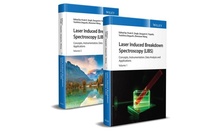
Laser Induced Breakdown Spectroscopy (LIBS): Conce pts, Instrumentation, Data Analysis and Applicatio ns 2V Set
Concepts, Instrumentation, Data Analysis and Applications 2 Volume Set
1st Edition
Published on 9. March 2023
Book
Hardback
992 pages
978-1-119-75840-2 (ISBN)
Description
Essential resource covering the field of LIBS, with respect to its fundamentals, established and novel applications, and future prospects
Laser Induced Breakdown Spectroscopy (LIBS), presents in two comprehensive volumes a thorough discussion of the basic principles of the method, including important recently available data which can lead to a better characterization of the LIBS plasma. This extensive work contains detailed discussions on the lasers, spectrometers, and detectors that can be used for LIBS apparatuses and describes various instrumentation, ranging from basic setups to more advanced configurations.
As a modern resource, the work includes the newest advances and capabilities of LIBS instruments, featuring the recent developments of Dual-Pulse LIBS, Femtosecond LIBS, and Micro-LIBS as well as their applications. Throughout, the contributions discuss the analytical capabilities of the method in terms of detection limits, accuracy, and precision of measurements for a variety of samples. Lastly, an extensive range of applications is presented, including food technology, environmental science, nuclear reactors, nanoscience and nanotechnology, and biological and biomedical developments.
Sample topics covered within the work include:
Diagnostics of laser induced plasma (LIP): LIBS plasma and its characteristics, factors affecting the LIBS plasma, methods of enhancing LIBS sensitivity, and LTE/non-LTE plasmas
Instrumental developments in LIBS: light collection system and spectral detection systems, handheld LIBS, deep sea LIBS, and industrial sorters and analyzers
Femtosecond laser ablation: laser-matter interaction, laser absorption, energy transport, ablation mechanisms and threshold, and plasma characterization
Micro-analysis and LIBS imaging: microjoule laser sources, scaling libs to microjoule energies, micrometer scaling, advanced applications, and future prospects
Spectroscopic and analytical scientists working with LIBS will find this wide-ranging reference immensely helpful in developing LIBS instrumentation and applications. Researchers and students in natural sciences and related programs of study will be able to use the work to acquire foundational knowledge on the method and learn about cutting-edge advancements being made in the field.
Laser Induced Breakdown Spectroscopy (LIBS), presents in two comprehensive volumes a thorough discussion of the basic principles of the method, including important recently available data which can lead to a better characterization of the LIBS plasma. This extensive work contains detailed discussions on the lasers, spectrometers, and detectors that can be used for LIBS apparatuses and describes various instrumentation, ranging from basic setups to more advanced configurations.
As a modern resource, the work includes the newest advances and capabilities of LIBS instruments, featuring the recent developments of Dual-Pulse LIBS, Femtosecond LIBS, and Micro-LIBS as well as their applications. Throughout, the contributions discuss the analytical capabilities of the method in terms of detection limits, accuracy, and precision of measurements for a variety of samples. Lastly, an extensive range of applications is presented, including food technology, environmental science, nuclear reactors, nanoscience and nanotechnology, and biological and biomedical developments.
Sample topics covered within the work include:
Diagnostics of laser induced plasma (LIP): LIBS plasma and its characteristics, factors affecting the LIBS plasma, methods of enhancing LIBS sensitivity, and LTE/non-LTE plasmas
Instrumental developments in LIBS: light collection system and spectral detection systems, handheld LIBS, deep sea LIBS, and industrial sorters and analyzers
Femtosecond laser ablation: laser-matter interaction, laser absorption, energy transport, ablation mechanisms and threshold, and plasma characterization
Micro-analysis and LIBS imaging: microjoule laser sources, scaling libs to microjoule energies, micrometer scaling, advanced applications, and future prospects
Spectroscopic and analytical scientists working with LIBS will find this wide-ranging reference immensely helpful in developing LIBS instrumentation and applications. Researchers and students in natural sciences and related programs of study will be able to use the work to acquire foundational knowledge on the method and learn about cutting-edge advancements being made in the field.
More details
Language
English
Place of publication
Hoboken
United States
Publishing group
John Wiley and Sons Ltd
Target group
Professional and scholarly
Dimensions
Height: 244 mm
Width: 170 mm
Thickness: 59 mm
Weight
2183 gr
ISBN-13
978-1-119-75840-2 (9781119758402)
Copyright in bibliographic data and cover images is held by Nielsen Book Services Limited or by the publishers or by their respective licensors: all rights reserved.
Schweitzer Classification
Other editions
Additional editions
Vivek K. Singh | Durgesh Kumar Tripathi | Yoshihiro Deguchi
Laser Induced Breakdown Spectroscopy (LIBS)
Concepts, Instrumentation, Data Analysis and Applications, 2 Volume Set
E-Book
03/2023
1st Edition
Wiley
€340.99
Available for download
Vivek K. Singh | Durgesh Kumar Tripathi | Yoshihiro Deguchi
Laser Induced Breakdown Spectroscopy (LIBS)
Concepts, Instrumentation, Data Analysis and Applications, 2 Volume Set
E-Book
03/2023
1st Edition
Wiley
€340.99
Available for download
Person
Vivek Kumar Singh is an Associate Professor in Department of Physics of Lucknow University, India. He has worked extensively on applications of XRF, LIBS, TOF-SIMS, and FTIR Spectroscopy for the study of numerous kinds of biological specimens such as gallstones, kidney stones, teeth, bones, plants, salts and others. Dr Singh is the recipient of the prestigious award of Raman Fellowship by UGC, Government of India.
Durgesh Kumar Tripathi, D.Phil., is Assistant Professor at Amity Institute of Organic Agriculture, Amity University, Uttar Pradesh, India. He has been the recipient of the prestigious UGC-DS-Kothari Post-Doctoral Fellowship from Centre of Advanced Study in Botany, BHU, India, and the Tony B. Academic Award, 2017, Washington DC, USA
Yoshihiro Deguchi began his career in laser diagnostics with BE, ME, and DE degrees from Toyohashi University of Technology in 1985, 1987, and 1990. He moved to Tokushima University as a full professor in 2010. Professor Deguchi has published research papers on the industrial applications of laser diagnostics and is one of the leading engineers to put laser diagnostics into practical use, especially in large scale plants.
Zhenzhen Wang is an Associate Professor at Xi'an Jiaotong University, in the Department of Thermal Power and Control Engineering in the School of Energy and Power Engineering. Her research interests are the laser diagnostics, measurement, and optimal control of thermal power plants, especially the developed applications of laser-induced breakdown spectroscopy (LIBS), laser breakdown time-of-flight mass spectrometry (LB-TOFMS), and tunable diode laser absorption spectroscopy (TDLAS).
Durgesh Kumar Tripathi, D.Phil., is Assistant Professor at Amity Institute of Organic Agriculture, Amity University, Uttar Pradesh, India. He has been the recipient of the prestigious UGC-DS-Kothari Post-Doctoral Fellowship from Centre of Advanced Study in Botany, BHU, India, and the Tony B. Academic Award, 2017, Washington DC, USA
Yoshihiro Deguchi began his career in laser diagnostics with BE, ME, and DE degrees from Toyohashi University of Technology in 1985, 1987, and 1990. He moved to Tokushima University as a full professor in 2010. Professor Deguchi has published research papers on the industrial applications of laser diagnostics and is one of the leading engineers to put laser diagnostics into practical use, especially in large scale plants.
Zhenzhen Wang is an Associate Professor at Xi'an Jiaotong University, in the Department of Thermal Power and Control Engineering in the School of Energy and Power Engineering. Her research interests are the laser diagnostics, measurement, and optimal control of thermal power plants, especially the developed applications of laser-induced breakdown spectroscopy (LIBS), laser breakdown time-of-flight mass spectrometry (LB-TOFMS), and tunable diode laser absorption spectroscopy (TDLAS).