

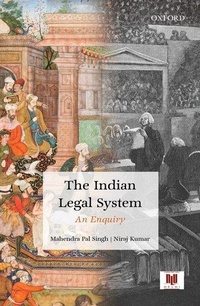
The Indian Legal System
An Enquiry
Published on 14. February 2019
Book
Hardback
240 pages
978-0-19-948987-9 (ISBN)
Description
Legal, anthropological, and historical literature acknowledges the undisputed presence of multiple legal traditions in India. However, the existence of uniform laws applicable to all citizens, questions plurality at some levels. The existence of multiple non-state legal traditions alongside a proclaimed formal state legal system certainly poses a challenge to the common law identity of the Indian legal system. It is historically acknowledged that colonialism and law share a reciprocal relationship, where law was used for the expansion of colonial rule, and was not an accurate reflection of the needs of society. When common law was introduced in India by the British to better integrate the Indian legal system, they did not refer to the prevailing legal practices of the time. Neither was it an exact appropriation of common law as understood in England. The book argues that this is the underlying cause for the gap between the state legal system and traditional community practices. This is arguably the reason behind preference for non-state legal practices among several communities in India, despite the existence of a formal state legal system. The central theme of the book is that legal systems cannot be seen or studied in isolation of the cultures of groups whose affairs they regulate.
More details
Language
English
Place of publication
New Delhi
India
Target group
Professional and scholarly
Product notice
sewn/stitched
Cloth over boards
Dimensions
Height: 221 mm
Width: 138 mm
Thickness: 23 mm
Weight
464 gr
ISBN-13
978-0-19-948987-9 (9780199489879)
Copyright in bibliographic data and cover images is held by Nielsen Book Services Limited or by the publishers or by their respective licensors: all rights reserved.
Schweitzer Classification
Persons
Mahendra Pal Singh is Chancellor, Central University of Haryana, India, and Chair Professor, Centre for Comparative Law, National Law University, Delhi, India
Niraj Kumar is Assistant Professor, National Law University, Delhi, India
Niraj Kumar is Assistant Professor, National Law University, Delhi, India
Content
Foreword by Upendra Baxi
Acknowledgements
Preface
List of Statutes (Chronological)
List of Cases (In order of appearance)
List of Tables (In order of appearance)
Summary of Arguments
Introduction
1. Tracing the History of Legal System in India
2. Historical & Contemporary Deviations from the State Legal System in India
3. Examples of Alternate Legal Systems in India
Conclusion
Appendix I
Appendix II
Appendix III: State Profiles Indicating Reliance on Traditional, Non-State Legal Systems
Bibliography
Index of Cases Illustrating Judicial Engagement with Customary Law in India
Index
Acknowledgements
Preface
List of Statutes (Chronological)
List of Cases (In order of appearance)
List of Tables (In order of appearance)
Summary of Arguments
Introduction
1. Tracing the History of Legal System in India
2. Historical & Contemporary Deviations from the State Legal System in India
3. Examples of Alternate Legal Systems in India
Conclusion
Appendix I
Appendix II
Appendix III: State Profiles Indicating Reliance on Traditional, Non-State Legal Systems
Bibliography
Index of Cases Illustrating Judicial Engagement with Customary Law in India
Index