

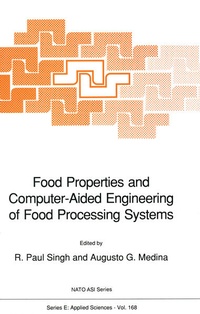
Food Properties and Computer-Aided Engineering of Food Processing Systems
Published on 21. April 2014
Book
Paperback/Softback
XVI, 593 pages
978-94-010-7567-1 (ISBN)
Description
Food properties, whether they concern the physical, thermodynamic, chemical, nutritional or sensory characteristics of foods, play an important role in food processing. In our quest to gain a mechanistic understanding of changes occurring during food processing, the knowledge of food properties is essential. Quantitative information on the food properties is necessary in the design and operation of food processing equipment. Foods, because of their biological nature and variability, vary in the magnitude of their properties. The variation in properties offer a challenge both in their measurement and use in the food processing applications. Often a high level of precision in measurement of properties is not possible as the measurement method may itself cause changes to the product, resulting in a variation in the obtained values. Recognizing the difficulties in measurement of food properties, and the lack of completeness of such information, several research programs have been in existence during the last two decades. In Europe, a multinational effort has been underway since 1978. The first project supported by COST (European Cooperation in the Field of Scientific and Technical Research), was titled COST 90 "The Effect of Processing on the Physical Properties of Foodstuffs". This and another project COST 90bis have considerably added to our knowledge of measurement methods and data on a number of physical properties. Two publications that summarize the work conducted under 1 2 these projects are Physical Properties of Foods and Physical Properties of Foods .
More details
Series
Edition
1989 ed.
Language
English
Place of publication
Dordrecht
Netherlands
Target group
Professional and scholarly
Research
Illustrations
XVI, 593 p.
Dimensions
Height: 235 mm
Width: 155 mm
Thickness: 33 mm
Weight
914 gr
ISBN-13
978-94-010-7567-1 (9789401075671)
DOI
10.1007/978-94-009-2370-6
Schweitzer Classification
Other editions
Additional editions
R.P. Singh | Augusto G. Medina
Food Properties and Computer-Aided Engineering of Food Processing Systems
E-Book
12/2012
Springer
€309.23
Available for download
R.P. Singh | Augusto G. Medina
Food Properties and Computer-Aided Engineering of Food Processing Systems
Book
04/1989
Kluwer Academic Publishers
€320.99
Shipment within 15-20 days
Content
1. Role of food properties in thermal processing of foods.- Measurement and prediction of thermal properties of foods.- Food properties, heat transfer conditions and sterilization considerations in retort processes.- Dielectric properties and microwave processing.- Heat penetration and bacteriological properties of foods for heat sterilization process design.- Non-isothermal kinetic data generation for food constituents.- Thermal conductivity of sucrose.- Local measurement of thermal diffusivity of foodstuffs.- Food properties and modeling approaches of importance in the continuous sterilization of liquid particle mixtures.- Dielectric properties and product variable.- Line chilling of beef carcasses: the selection of cooling regimes and the prediction of performance.- 2. Thermodynamic, sensory and nutritional properties in food processing and dehydration systems.- Role of water activity.- Thermodynamic properties for water removal processes in solid and liquid foods.- Nutritional and sensory properties of processed foods.- Thermodynamically interactive heat and mass transfer coupled with shrinkage and chemical reactions.- Determination of water content and moisture sorption isotherms of cellulose packaging material.- Combined freeze- and air drying.- Importance and feasibility of modeling and controlling hydration properties in fermentation processes.- 3. Rheological properties and food extrusion.- Flow properties of fluid food materials.- Food Extrusion.- Starch gelatinization.- Food engineering problems in rheology and non-Newtonian fluid mechanics.- Developments in measurement in rheological properties of food dispersions.- Non-oral texture evaluation of mixed gels. Selection of parameters.- Flow behavior of fruit jams at low shear rates. Calculation of yield stress.- Rheology of concentrated dispersions of deformable particles such as gelatinized starch granules.- Rheology of food materials in the extrusion cooker.- Statistical analysis of extrusion processes.- The mathematical modelling of single-screw extruders and its application in the prediction of a time dependent performance.- The use of an in-line viscometer for the continuous control of a fruit pulp dilution process.- Study of the influence of temperature on the rheological behavior of gluten by means of dynamic mechanical analysis.- 4. Role of food properties in separation and fermentation processes.- Membrane separations: mechanisms and models.- Critical property requirements for supercritical fluid processing of biomaterials.- Food property effects in evaporation.- Ultrafiltration of rapeseed meal extracts.- The application of membrane filtration to silage effluent.- Extraction of lupinus Sp.alkaloids leads to cheap high protein food/feed raw material.- Recovery of cellulases from a fermentation broth.- The mass transfer process of water, soluble solids and reducing sugars in carrot cortex tissue.- 5. Computer-aided engineering of food processing systems.- Computer aided engineering in the food industry.- Computer-aided inventory management using time-temperature indicators.- Computer simulation of thermal processing for canned food sterilization.- Mathematical modeling in meat processing.- Simulation of heat transfer processes using stochastic parameters.- Determination of ethanol in complex liquid media for continuous processing control.