

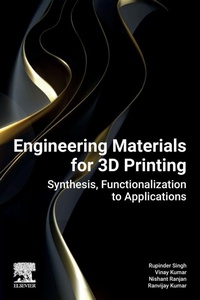
Engineering Materials for 3D Printing
Synthesis, Functionalization to Applications
Published on 27. February 2026
Book
Paperback/Softback
258 pages
978-0-443-33625-6 (ISBN)
Description
Engineering Materials for 3D Printing: Synthesis, Functionalization to Applications delves into the transformative world of additive manufacturing, covering the development and characterization of polymer-based materials crafted through processes such as extrusion, sol-gel, and pulverization. Over the past three decades, 3D printing has revolutionized the creation of functional prototypes, utilizing an array of materials like thermoplastics, resins, metals, and alloys. This book explores the advantages of 3D printing over conventional manufacturing, emphasizing its potential for structural and non-structural engineering applications. It stands out for its focus on meta-structure properties, offering insights into the fabrication of engineering prototypes.
While existing literature extensively covers manufacturing processes, this work bridges the gap by exploring 3D printable materials for diverse engineering uses.
While existing literature extensively covers manufacturing processes, this work bridges the gap by exploring 3D printable materials for diverse engineering uses.
More details
Language
English
Place of publication
Philadelphia
United States
Target group
Professional and scholarly
Product notice
Paperback (trade)
Dimensions
Height: 229 mm
Width: 152 mm
Thickness: 14 mm
Weight
354 gr
ISBN-13
978-0-443-33625-6 (9780443336256)
Copyright in bibliographic data and cover images is held by Nielsen Book Services Limited or by the publishers or by their respective licensors: all rights reserved.
Schweitzer Classification
Other editions
Additional editions
Rupinder Singh | Vinay Kumar | Nishant Ranjan
Engineering Materials for 3D Printing
Synthesis, Functionalization to Applications
E-Book
02/2026
Elsevier
€185.99
Available for download
Persons
Dr. Rupinder Singh is currently Professor and Head of the Department of Mechanical Engineering, National Institute of Technical Teacher Training and Research, Chandigarh. He received a Ph.D. in Mechanical Engineering from the Thapar Institute of Engineering and Technology Patiala. His research interests are additive manufacturing, composite filament processing, rapid tooling, metal casting and plastic solid waste management
Dr Vinay Kumar is an Assistant Professor at the University Centre for Research and Development, Chandigarh University. He has received Ph.D. in Mechanical Engineering from Punjabi University, Patiala. His area of research is additive manufacturing and the application of 3D printing for the development of new customizable solutions for structural and non-structural defects in heritage structures, and biomaterials for clinical applications. He has contributed extensively to additive manufacturing literature with publications appearing in Composite Part: B, Materials Letters, Journal of Manufacturing Processes, Journal of Thermoplastic composite Materials, Journal of Composite Materials, Journal of Materials Engineering and Performance, Sadhana, Materials Research Express, Advances in Materials Processing Technology, Proceedings of Institute of Mechanical Engineers Part-B, Part E, Part H, Part L, etc. He has authored 30 research papers and 25 book chapters
Dr Nishant Ranjan is an Assistant Professor at the University Centre for Research and Development of Chandigarh University, India. His research interests include: materials development for biomedical-based 3D printing applications, materials processing of thermoplastic polymers, reinforcement and the development of new composite thermoplastic polymers, and scaffold printing Dr. Ranvijay Kumar is an Associate Professor at the Marwadi University Research Center, Marwadi University, India. He received his Ph.D. in Mechanical Engineering from Punjabi University, Patiala. His expertise includes additive manufacturing, shape memory polymers, innovative materials, friction-based welding techniques, advanced materials processing, polymer matrix composites, reinforced polymer composites for 3D printing, 4D printing, plastic solid waste management, thermosetting recycling, and destructive testing of materials.
Dr. Kumar has published several articles and authored books and book chapters. He has also presented research at national and international conferences. He has been listed among the top 2% of world scientists by Stanford University in 2022, 2023, and 2024.
Dr Vinay Kumar is an Assistant Professor at the University Centre for Research and Development, Chandigarh University. He has received Ph.D. in Mechanical Engineering from Punjabi University, Patiala. His area of research is additive manufacturing and the application of 3D printing for the development of new customizable solutions for structural and non-structural defects in heritage structures, and biomaterials for clinical applications. He has contributed extensively to additive manufacturing literature with publications appearing in Composite Part: B, Materials Letters, Journal of Manufacturing Processes, Journal of Thermoplastic composite Materials, Journal of Composite Materials, Journal of Materials Engineering and Performance, Sadhana, Materials Research Express, Advances in Materials Processing Technology, Proceedings of Institute of Mechanical Engineers Part-B, Part E, Part H, Part L, etc. He has authored 30 research papers and 25 book chapters
Dr Nishant Ranjan is an Assistant Professor at the University Centre for Research and Development of Chandigarh University, India. His research interests include: materials development for biomedical-based 3D printing applications, materials processing of thermoplastic polymers, reinforcement and the development of new composite thermoplastic polymers, and scaffold printing Dr. Ranvijay Kumar is an Associate Professor at the Marwadi University Research Center, Marwadi University, India. He received his Ph.D. in Mechanical Engineering from Punjabi University, Patiala. His expertise includes additive manufacturing, shape memory polymers, innovative materials, friction-based welding techniques, advanced materials processing, polymer matrix composites, reinforced polymer composites for 3D printing, 4D printing, plastic solid waste management, thermosetting recycling, and destructive testing of materials.
Dr. Kumar has published several articles and authored books and book chapters. He has also presented research at national and international conferences. He has been listed among the top 2% of world scientists by Stanford University in 2022, 2023, and 2024.
Author
Professor and Head, Department of Mechanical Engineering, National Institute of Technical Teacher Training and Research, Chandigarh, India
Assistant Professor, University Centre for Research and Development, Chandigarh University, India
Assistant Professor, University Centre for Research and Development, Chandigarh University, India
Assistant Professor, Marwadi University Research Center, Marwadi University, Gujarat, India
Content
Section A: Polymer/ polymer composites-based 3D printable materials
1. In-house fabrication of extrusion-based polymer and composites for 3D printing
2. Sol-gel method for 3D printing of smart polymer materials
3. Pulverization as material processing for 3D printed thermoplastics
4. Meta-structure base 3D printing of polymers for structural applications
Section B: Metals-based 3D printable materials
5. Atomization and solid-state metal reduction for 3D printing
6. Electrolysis and chemical treated metal and alloys for structural engineering applications
7. Meta-structures-based metal 3D printing for non-structural applications
8. Hybridization of metal 3D printing for smart structures
Section C: Applications and case studies
9. Fabrication of smart orthopaedic implants for human and veterinary patients
10. Meta-structures based smart repair solutions for structural defects of heritage buildings
11. A case study on the fabrication of dental implants and tools for humans
12. Some comprehensive studies on compressive properties of metal 3D printed strategic canine tooth
13. Meta-structures inspired mesh based smart solutions for surgical practices of diaphragmatic hernia in bovines
1. In-house fabrication of extrusion-based polymer and composites for 3D printing
2. Sol-gel method for 3D printing of smart polymer materials
3. Pulverization as material processing for 3D printed thermoplastics
4. Meta-structure base 3D printing of polymers for structural applications
Section B: Metals-based 3D printable materials
5. Atomization and solid-state metal reduction for 3D printing
6. Electrolysis and chemical treated metal and alloys for structural engineering applications
7. Meta-structures-based metal 3D printing for non-structural applications
8. Hybridization of metal 3D printing for smart structures
Section C: Applications and case studies
9. Fabrication of smart orthopaedic implants for human and veterinary patients
10. Meta-structures based smart repair solutions for structural defects of heritage buildings
11. A case study on the fabrication of dental implants and tools for humans
12. Some comprehensive studies on compressive properties of metal 3D printed strategic canine tooth
13. Meta-structures inspired mesh based smart solutions for surgical practices of diaphragmatic hernia in bovines