

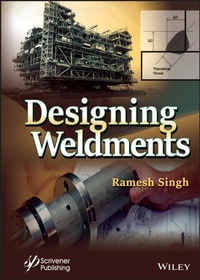
Designing Weldments
1st Edition
Published on 9. August 2022
Book
Hardback
500 pages
978-1-119-86515-5 (ISBN)
Description
In modern day construction welding is the primary methods to join various members of any structure. Welds are required to meet various types of load in tension, compression, torsion, and perform in static or cyclic loading conditions. The weld has to be at least as strong as the parent metal to meet the demands of various stress working on the structure. It should meet the structural requirement, add value to the integrity of the structure and prevent failures.
However, many design engineers lack even a fundamental insight or a basic understanding of essential welding processes and design requirements. Simply copying a few joint configurations in a drawing will not suffice. All-embracing and readable, Designing Weldments delivers a deeper understanding of number of design factors that play a critical role in the design. The book clarifies welding design principals and applications. With this reference in-hand, designers expert knowledge to consider very early on in the project implications of the choice of what type of weld to use for joining structural members and how the component is made. The author explains the many welding techniques developed over the years, as well as some of which are still evolving.
However, many design engineers lack even a fundamental insight or a basic understanding of essential welding processes and design requirements. Simply copying a few joint configurations in a drawing will not suffice. All-embracing and readable, Designing Weldments delivers a deeper understanding of number of design factors that play a critical role in the design. The book clarifies welding design principals and applications. With this reference in-hand, designers expert knowledge to consider very early on in the project implications of the choice of what type of weld to use for joining structural members and how the component is made. The author explains the many welding techniques developed over the years, as well as some of which are still evolving.
More details
Language
English
Place of publication
New York
United States
Target group
Professional and scholarly
Dimensions
Height: 254 mm
Width: 178 mm
Thickness: 14 mm
Weight
621 gr
ISBN-13
978-1-119-86515-5 (9781119865155)
Copyright in bibliographic data is held by Nielsen Book Services Limited or its licensors: all rights reserved.
Schweitzer Classification
Other editions
Additional editions
Person
Ramesh Singh, MS, IEng, MWeldI, is registered as Incorporated Engineer with British Engineering Council UK and a Member of The Welding Institute, UK. He worked as engineer for various operating and EPC organizations in Middle East, Canada and US. Most recently, he worked for 10 years with Gulf Interstate Engineering, Houston, TX. He is now consulting in the fields of welding, and corrosion engineering, and pipeline integrity and related materials and corrosion topics. Ramesh is a graduate from Indian Air Force Technical Academy, with diplomas in Structural Fabrication Engineering and Welding Technology. He has been member and officer of the Canadian Standard Association and NACE and serves on several technical committees. He has worked in industries spanning over aeronautical, alloy steel castings, fabrication, machining, welding engineering, petrochemical, and oil and gas. He has written several technical papers and published articles in leading industry magazines, addressing the practical aspects of welding, construction and corrosion issues relating to structures, equipment and pipelines.