

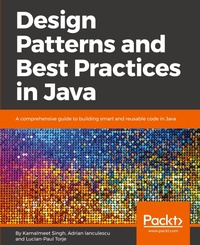
Design Patterns and Best Practices in Java
A comprehensive guide to building smart and reusable code in Java
Published on 27. June 2018
Book
Paperback/Softback
280 pages
978-1-78646-359-3 (ISBN)
Description
Create various design patterns to master the art of solving problems using Java
Key Features
[*] This book demonstrates the shift from OOP to functional programming and covers reactive and functional patterns in a clear and step-by-step manner
[*] All the design patterns come with a practical use case as part of the explanation, which will improve your productivity
[*] Tackle all kinds of performance-related issues and streamline your development
Book DescriptionHaving a knowledge of design patterns enables you, as a developer, to improve your code base, promote code reuse, and make the architecture more robust. As languages evolve, new features take time to fully understand before they are adopted en masse. The mission of this book is to ease the adoption of the latest trends and provide good practices for programmers.
We focus on showing you the practical aspects of smarter coding in Java. We'll start off by going over object-oriented (OOP) and functional programming (FP) paradigms, moving on to describe the most frequently used design patterns in their classical format and explain how Java's functional programming features are changing them.
You will learn to enhance implementations by mixing OOP and FP, and finally get to know about the reactive programming model, where FP and OOP are used in conjunction with a view to writing better code. Gradually, the book will show you the latest trends in architecture, moving from MVC to microservices and serverless architecture. We will finish off by highlighting the new Java features and best practices. By the end of the book, you will be able to efficiently address common problems faced while developing applications and be comfortable working on scalable and maintainable projects of any size.What you will learn
[*] Understand the OOP and FP paradigms
[*] Explore the traditional Java design patterns
[*] Get to know the new functional features of Java
[*] See how design patterns are changed and affected by the new features
[*] Discover what reactive programming is and why is it the natural augmentation of FP
[*] Work with reactive design patterns and find the best ways to solve common problems using them
[*] See the latest trends in architecture and the shift from MVC to serverless applications
[*] Use best practices when working with the new features
Who this book is forThis book is for those who are familiar with Java development and want to be in the driver's seat when it comes to modern development techniques. Basic OOP Java programming experience and elementary familiarity with Java is expected.
Key Features
[*] This book demonstrates the shift from OOP to functional programming and covers reactive and functional patterns in a clear and step-by-step manner
[*] All the design patterns come with a practical use case as part of the explanation, which will improve your productivity
[*] Tackle all kinds of performance-related issues and streamline your development
Book DescriptionHaving a knowledge of design patterns enables you, as a developer, to improve your code base, promote code reuse, and make the architecture more robust. As languages evolve, new features take time to fully understand before they are adopted en masse. The mission of this book is to ease the adoption of the latest trends and provide good practices for programmers.
We focus on showing you the practical aspects of smarter coding in Java. We'll start off by going over object-oriented (OOP) and functional programming (FP) paradigms, moving on to describe the most frequently used design patterns in their classical format and explain how Java's functional programming features are changing them.
You will learn to enhance implementations by mixing OOP and FP, and finally get to know about the reactive programming model, where FP and OOP are used in conjunction with a view to writing better code. Gradually, the book will show you the latest trends in architecture, moving from MVC to microservices and serverless architecture. We will finish off by highlighting the new Java features and best practices. By the end of the book, you will be able to efficiently address common problems faced while developing applications and be comfortable working on scalable and maintainable projects of any size.What you will learn
[*] Understand the OOP and FP paradigms
[*] Explore the traditional Java design patterns
[*] Get to know the new functional features of Java
[*] See how design patterns are changed and affected by the new features
[*] Discover what reactive programming is and why is it the natural augmentation of FP
[*] Work with reactive design patterns and find the best ways to solve common problems using them
[*] See the latest trends in architecture and the shift from MVC to serverless applications
[*] Use best practices when working with the new features
Who this book is forThis book is for those who are familiar with Java development and want to be in the driver's seat when it comes to modern development techniques. Basic OOP Java programming experience and elementary familiarity with Java is expected.
More details
Language
English
Place of publication
Birmingham
United Kingdom
Dimensions
Height: 235 mm
Width: 191 mm
Thickness: 16 mm
Weight
528 gr
ISBN-13
978-1-78646-359-3 (9781786463593)
Copyright in bibliographic data and cover images is held by Nielsen Book Services Limited or by the publishers or by their respective licensors: all rights reserved.
Schweitzer Classification
Other editions
Additional editions
Kamalmeet Singh | LUCIAN-PAUL TORJE | Adrian Ianculescu
Design Patterns and Best Practices in Java
A comprehensive guide to building smart and reusable code in Java
E-Book
09/2024
1st Edition
Packt Publishing Limited
€32.49
Available for download
Persons
Kamalmeet Singh got his first taste of programming at the age of 15, and he immediately fell in love with it. After spending over 14 years in the IT Industry, Kamal has matured into an ace developer and a technical architect. He is also the coauthor of a book on Design Patterns and Best Practices in Java. The technologies he works with range from cloud computing, machine learning, augmented reality, serverless applications to microservices and so on. Adrian Ianculescu is a software developer with 20 years programming experience, of which 12 years were in Java, starting with C++, then working with C#, and moving naturally to Java. Working in teams ranging from 2 to 40, he realized that making software is not only about writing code and became interested in software design and architecture, in different methodologies and frameworks. After living the corporate life for a while, he started to work as a freelancer and entrepreneur following his childhood passion to make games. Lucian-Paul Torje is an aspiring software craftsman working in software industry for almost 15 years. He is interested in almost anything that has to do with technology. This is why he has worked with everything from MS-DOS TSR to microservices, from Atmel microcontrollers to Android, iOS and Chromebooks, from C/C++ to Java, and from Oracle to MongoDB. Whenever someone is needed to use new and innovative approaches to solve a problem, he is keen to give it a go!
Content
Table of Contents
From Object Oriented to Functional Programming
Creational Patterns
Behavioral Patterns
Structural Patterns
Functional Design Patterns
Let
Reactive Design Patterns
Trends in Application Architecture
Best Practices in Java
From Object Oriented to Functional Programming
Creational Patterns
Behavioral Patterns
Structural Patterns
Functional Design Patterns
Let
Reactive Design Patterns
Trends in Application Architecture
Best Practices in Java