

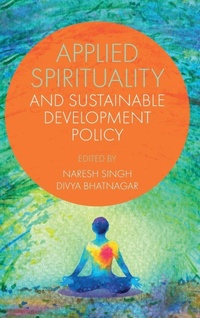
Applied Spirituality and Sustainable Development Policy
Published on 14. December 2023
Book
Hardback
296 pages
978-1-83753-381-7 (ISBN)
Description
The fundamental cause of many of the global challenges we are currently facing is our disconnection from ourselves, our fellow humans, other beings, and our planet. We have consistently failed to recognize the inner consciousness that dictates our relationships and decisions, an awareness that could be the first step toward humanity's quest to set civilization on a more sustainable trajectory.
Rooted in both secular spirituality and scientific evidence, Applied Spirituality and Sustainable Development Policy articulates a new model of sustainable development that is not just based on narrow definitions of GDP and economic growth, but that includes and even forefronts social and environmental development and inner transformation of human beings. Drawing on fields from physics to public policy, 18 pioneering authors discuss:
A distillation of the spiritual gems at the core of the world's major religions, including Indic and Buddhist philosophy
Root-cause analyses of major sustainable development policy challenges like climate change
Connections between spirituality and law, and how our legal frameworks can reflect these values
The need for leaders to understand their spiritual nature in order to be authentic and transformative in their leadership styles
Recognizing a global need for healing, this book rejuvenates how we think about development and nurture our innate spirituality, and challenges us to shift our collective mindset from one of having to one of being.
Rooted in both secular spirituality and scientific evidence, Applied Spirituality and Sustainable Development Policy articulates a new model of sustainable development that is not just based on narrow definitions of GDP and economic growth, but that includes and even forefronts social and environmental development and inner transformation of human beings. Drawing on fields from physics to public policy, 18 pioneering authors discuss:
A distillation of the spiritual gems at the core of the world's major religions, including Indic and Buddhist philosophy
Root-cause analyses of major sustainable development policy challenges like climate change
Connections between spirituality and law, and how our legal frameworks can reflect these values
The need for leaders to understand their spiritual nature in order to be authentic and transformative in their leadership styles
Recognizing a global need for healing, this book rejuvenates how we think about development and nurture our innate spirituality, and challenges us to shift our collective mindset from one of having to one of being.
Reviews / Votes
The book Applied Spirituality and Sustainable Development Policy is breathtaking in its scope and awe-inspiring for the depth of insight brought to bear on the current world crises. The editors have brought together contributions from a powerful team of academics, researchers and thinkers in the areas of spirituality, policy and sustainable development to create a truly outstanding text, sure to become a future classic. I will be using this text with my students! -- Lee Newitt, Founder MA Spirituality, Ecology & Mental Health at Buckinghamshire New University, UK Physicists define energy as the capacity of matter to do work, and have demonstrated that this capacity is in all things everywhere and can be neither created nor destroyed. Have we not just described the God of ancient man, and the essence of modern spirituality? Let us then leave mysticism behind. If energy created this planet, its systems, and the vast cosmos surrounding it, would it not have the capacity to solve what appear to be unsolvable human problems? Energy does not deny us its aid. Rather, we deny energy its existence and pretend to be separated from our own being. The laws of physics hold otherwise. This remarkable book on applied spirituality is nothing less than a manual for the application of the energy in all things everywhere to solve human problems. Of course, energy has no problems. If we apply the lessons of this book, we will soon realize that neither do we. -- James Kimmel, Jr., JD, Yale School of Medicine, author of Suing for Peace, The Trial of Fallen Angels, and The Science of Revenge Rather than outlining another neat, pre-determined framework, destined by definition to oversimplify the complexities of the real world, [this book] proposes a radically new approach -- one that neither rejects reason and rationalism, nor subjectivity and diversity; one that rather expands and enriches both.The Constitution of UNESCO reads 'Since wars begin in the minds of men, it is in the minds of men that the defences of peace must be constructed'. Similarly, this book posits that to achieve sustainable and equitable development in our world, we must cultivate the conditions for its flourishing within ourselves. It reminds us that we already hold the keys to this, both in the form of centuries' old spiritual wisdom passed down to us through the ages (spiritual, not religious), and in our own innate spirituality. Rather than engaging in exhausting ideological battles, it recommends opening the mind to applied spirituality, free of religious, political and ideological dogma. In this way, the buttresses of peace and wellbeing for all sentient beings can be constructed.
This approach will undoubtably elicit skepticism from various quarters, particularly from the rationalist orthodoxy camp. But reason and rationalism represent only one essential human faculty. Surely the complexities of our world with its multiple, intersecting, systemic challenges merit the full benefit of all our faculties and capabilities - our intuitive and ethical faculties, the faculties of the heart and our ability for love, empathy, and compassion, to name a few? Why would we willingly withhold the full scope of our faculties and abilities in the quest for a more sustainable future? This book calls for an integral, systems approach to our complex, interconnected global challenges, one that not only brings all our faculties to bear holistically, but that also stems from profound wisdom and applied spirituality. Methodological issues will certainly be open to debate, but the approach itself is deeply compelling. -- Renata Lok, Former Senior UN Official and Former Coordinator of the UN System in India Applied Spirituality and Sustainable Development Policy makes a much-needed contribution to our understanding of how spirituality, as distinct from religion, can inform and improve every aspect of our life. My own practice of Sahaja Yoga meditation over the last 35 years has revealed to me that inner transformation, which comes about as one seeks spiritual depth, enables us to make intuitively informed choices that enhance the quality of our family, professional and social interactions. The editors and contributors deserve our highest compliments and deepest gratitude for their courageous effort to explain that spirituality does not isolate us from society or nature. On the contrary, spirituality empowers us in the subtlest of ways, to live in consonance with nature and in harmony with mankind. -- Rajiv Kumar, Vice Chair (2017-22), NITI Aayog, Government of India This is a very stupendous work! Public policy and spirituality seem unconnected, but public policy is surely based on the quality of the key players and needs their internal transformation. Religion was created precisely to provide this support. Unfortunately institutionalised religion has created the opposite effect: of excluding others, rather than feeling the one-ness. It has led to destruction, wars and violence. If the theory of change proposed in this work has to materialise, it needs a lot of hard work of reformation, both within and without. But the time has come for it. -- R. Subrahmanyam, Former Secretary, Higher Education and Social Justice, Government of India
More details
Language
English
Place of publication
Bingley
United Kingdom
Target group
Professional and scholarly
Dimensions
Height: 235 mm
Width: 157 mm
Thickness: 21 mm
Weight
582 gr
ISBN-13
978-1-83753-381-7 (9781837533817)
Copyright in bibliographic data and cover images is held by Nielsen Book Services Limited or by the publishers or by their respective licensors: all rights reserved.
Schweitzer Classification
Other editions
Additional editions
Naresh Singh | Divya Bhatnagar
Applied Spirituality and Sustainable Development Policy
E-Book
12/2023
1st Edition
Emerald Publishing Limited
€98.49
Available for download
Persons
Naresh Singh is Professor and Executive Dean, Jindal School of Government and Public Policy, O.P. Jindal Global University, India, and Director of the Centre for Complexity Economics, Applied Spirituality and Public Policy (CEASP).
Divya Bhatnagar is Assistant Professor at the School of Humanities and Social Sciences, Shiv Nadar University, India. She works on education, childhood, sustainable development, and public policy.
Divya Bhatnagar is Assistant Professor at the School of Humanities and Social Sciences, Shiv Nadar University, India. She works on education, childhood, sustainable development, and public policy.
Content
Chapter 1. Introduction and Overview; Naresh Singh and Divya Bhatnagar
Chapter 2. Policy and Practice informed by the Ancient Science of Spirituality; Mihir Shah
Chapter 3. Politics of Being: Harnessing Spirituality and Science for a New Development Paradigm; Thomas Legrand
Chapter 4. Buddhist and Taoist Systems Thinking: Perennial Wisdom Applications and Implications to Sustainable Transformation; Josep M. Coll
Chapter 5. New Paradigm Politics and Governance for a Planetary Civilization; Anneloes Smitsman
Chapter 6. Spiritual Leadership For Sustainable Development Policy; Naresh Singh
Chapter 7. Law and Applied Spirituality; K. Parameswaran
Chapter 8. A Holistic View to Approach Sustainable Development: Spiritual Roots and Evidence from Quantum Physics; Divya Bhatnagar and Sudip Patra
Chapter 9. Spirituality, Wisdom, and Quantum Theory: Wisdom Has a Measurement Problem Too; David Rooney
Chapter 10. Public Policy for Sustainable Development: A Gandhian Paradigm; Pooja Sharma
Chapter 11. An Exploration of the Nonmaterial Dimension as the Sine Qua Non of "Sustainable Development"; Vern Neufeld Redekop
Chapter 12. Applied Spirituality and Mediation: Overcoming Challenges of Sustainability using Inter-relational Settlement Model; K. Parameswaran
Chapter 13. Compassionate Policies to Relieve Systemic Suffering: Visions, Obstacles, Strategies, Actions; Robertson Work
Chapter 2. Policy and Practice informed by the Ancient Science of Spirituality; Mihir Shah
Chapter 3. Politics of Being: Harnessing Spirituality and Science for a New Development Paradigm; Thomas Legrand
Chapter 4. Buddhist and Taoist Systems Thinking: Perennial Wisdom Applications and Implications to Sustainable Transformation; Josep M. Coll
Chapter 5. New Paradigm Politics and Governance for a Planetary Civilization; Anneloes Smitsman
Chapter 6. Spiritual Leadership For Sustainable Development Policy; Naresh Singh
Chapter 7. Law and Applied Spirituality; K. Parameswaran
Chapter 8. A Holistic View to Approach Sustainable Development: Spiritual Roots and Evidence from Quantum Physics; Divya Bhatnagar and Sudip Patra
Chapter 9. Spirituality, Wisdom, and Quantum Theory: Wisdom Has a Measurement Problem Too; David Rooney
Chapter 10. Public Policy for Sustainable Development: A Gandhian Paradigm; Pooja Sharma
Chapter 11. An Exploration of the Nonmaterial Dimension as the Sine Qua Non of "Sustainable Development"; Vern Neufeld Redekop
Chapter 12. Applied Spirituality and Mediation: Overcoming Challenges of Sustainability using Inter-relational Settlement Model; K. Parameswaran
Chapter 13. Compassionate Policies to Relieve Systemic Suffering: Visions, Obstacles, Strategies, Actions; Robertson Work