

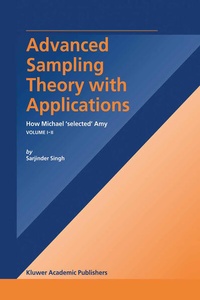
Advanced Sampling Theory with Applications
How Michael' selected' Amy Volume I
Published on 30. November 2003
Book
Hardback
LIV, 1219 pages
978-1-4020-1689-9 (ISBN)
Description
This book is a multi-purpose document. It can be used as a text by teachers, as a reference manual by researchers, and as a practical guide by statisticians. It covers 1165 references from different research journals through almost 1900 citations across 1194 pages, a large number of complete proofs of theorems, important results such as corollaries, and 324 unsolved exercises from several research papers. It includes 159 solved, data-based, real life numerical examples in disciplines such as Agriculture, Demography, Social Science, Applied Economics, Engineering, Medicine, and Survey Sampling. These solved examples are very useful for an understanding of the applications of advanced sampling theory in our daily life and in diverse fields of science. An additional 173 unsolved practical problems are given at the end of the chapters. University and college professors may find these useful when assigning exercises to students. Each exercise gives exposure to several complete research papers for researchers/students.
More details
Edition
2003 ed.
Language
English
Place of publication
Dordrecht
Netherlands
Target group
Professional and scholarly
Research
Product notice
sewn/stitched
Cloth over boards
Illustrations
LIV, 1219 p.
Dimensions
Height: 243 mm
Width: 171 mm
Thickness: 61 mm
Weight
2504 gr
ISBN-13
978-1-4020-1689-9 (9781402016899)
DOI
10.1007/978-94-007-0789-4
Schweitzer Classification
Other editions
Additional editions
E-Book
01/2013
1st Edition
Springer
€107.09
Available for download
Book
11/2012
Springer
€117.69
Shipment within 15-20 days
Content
Basic Concepts and Mathematical Notation.- Simple Random Sampling.- Use of Auxiliary Information: Simple Random Sampling.- Use of Auxiliary Information: Probability Proportional to Size and with Replacement (PPSWR) Sampling.- Use of Auxiliary Information: Probability Proportional to Size and Without Replacement (PPSWOR) Sampling.- Use of Auxiliary Information: Multi-Phase Sampling.- Systematic Sampling.- Stratified and Post-Stratified Sampling.- Non-Overlapping, Overlapping, Post, and Adaptive Cluster Sampling.- Multi-Stage, Successive, and Re-Sampling Strategies.- Randomized Response Sampling: Tools For Social Surveys.- Non-Response and Its Treatments.- Miscellaneous Topics.