

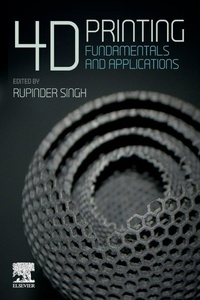
4D Printing
Fundamentals and Applications
Published on 19. January 2022
Book
Paperback/Softback
194 pages
978-0-12-823725-0 (ISBN)
Description
4D Printing: Fundamentals and Applications explores both autonomic and non-autonomic systems with different stimulus such as temperature, current, moisture, light and sound. In addition, the fifth dimensional aspect using more than one stimulus is outlined for additive manufacturing processes. The book presents both an introduction to the basic understanding of hybrid processes and explores the physics behind the process (in the form of derivation and numerical problems). For the field engineer, applicable codes and standards for each hybrid process are provided. Lastly, case studies are included in each section to provide the reader with a model to explore future research directions.
More details
Series
Language
English
Place of publication
United States
Target group
Professional and scholarly
Illustrations
Approx. 120 illustrations (35 in full color)
Dimensions
Height: 152 mm
Width: 229 mm
Thickness: 18 mm
Weight
326 gr
ISBN-13
978-0-12-823725-0 (9780128237250)
Copyright in bibliographic data and cover images is held by Nielsen Book Services Limited or by the publishers or by their respective licensors: all rights reserved.
Schweitzer Classification
Other editions
Additional editions
E-Book
01/2022
Elsevier
€130.00
Available for download
Person
Dr. Rupinder Singh is currently Professor and Head of the Department of Mechanical Engineering, National Institute of Technical Teacher Training and Research, Chandigarh. He received a Ph.D. in Mechanical Engineering from the Thapar Institute of Engineering and Technology Patiala. His research interests are additive manufacturing, composite filament processing, rapid tooling, metal casting and plastic solid waste management
Content
1. Introduction to Additive Manufacturing (Basic process for beginners)
2. Physics behind various additive manufacturing processes
3. Case studies for process hybridization (For analysis)
4. Case studies for hybrid process with smart materials
5. Case studies for 4D/5D printing (For researchers)
6. Commercial standards in additive manufacturing (for field practices)
2. Physics behind various additive manufacturing processes
3. Case studies for process hybridization (For analysis)
4. Case studies for hybrid process with smart materials
5. Case studies for 4D/5D printing (For researchers)
6. Commercial standards in additive manufacturing (for field practices)