

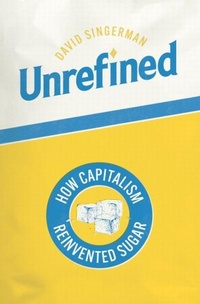
Unrefined
How Capitalism Reinvented Sugar
Published on 4. September 2025
Book
Hardback
352 pages
978-0-226-83737-6 (ISBN)
Description
A surprising look at how modern capitalism changed sugar from a natural food to a scientific commodity.
Sugar is everywhere in the western diet, blamed for epidemics of obesity, diabetes, and other modern maladies. Our addiction to sweetness has a long and unsavory history. Over the past five hundred years, sugar has shaped empires, made fortunes for a few, and brought misery for millions of workers both enslaved and free. How did sugar become a defining modern food and an essential global commodity?
In Unrefined, David Singerman recasts our thinking about this crucial substance in the history of capitalism. Before the nineteenth century, sugar's value depended on natural qualities: its color, its taste, where it was grown, and who had made it. But beginning around 1850, a combination of plantation owners, industrialists, and scientists set out to redefine sugar itself. Deploying the tools and rhetoric of science, they transformed not just how sugar was produced or traded but even how people thought about it. By changing sugar into a pure chemical object, these forces stripped power from workers and enabled-and obscured-new kinds of fraud, corruption, and monopoly.
Taking us to unexplored spaces in the world of sugar, from laboratories and docks to refineries and the halls of Congress, Singerman illuminates dark intersections of the histories of corruption, science, and capitalism.
Sugar is everywhere in the western diet, blamed for epidemics of obesity, diabetes, and other modern maladies. Our addiction to sweetness has a long and unsavory history. Over the past five hundred years, sugar has shaped empires, made fortunes for a few, and brought misery for millions of workers both enslaved and free. How did sugar become a defining modern food and an essential global commodity?
In Unrefined, David Singerman recasts our thinking about this crucial substance in the history of capitalism. Before the nineteenth century, sugar's value depended on natural qualities: its color, its taste, where it was grown, and who had made it. But beginning around 1850, a combination of plantation owners, industrialists, and scientists set out to redefine sugar itself. Deploying the tools and rhetoric of science, they transformed not just how sugar was produced or traded but even how people thought about it. By changing sugar into a pure chemical object, these forces stripped power from workers and enabled-and obscured-new kinds of fraud, corruption, and monopoly.
Taking us to unexplored spaces in the world of sugar, from laboratories and docks to refineries and the halls of Congress, Singerman illuminates dark intersections of the histories of corruption, science, and capitalism.
Reviews / Votes
"This robust and perceptive book traces the startling pathways through which sugar was turned into a standardized commodity. Using powerful stories and striking imagery, from beet fields and cane plantations to factories and commodity markets, Singerman demonstrates the artful combinations, violent collisions, and unlikely schemes that made sugar seem the most uniform of all goods, even while it exhibited an astonishing range of subtle distinctions. This book will be indispensable for anyone concerned with the history and politics of food, science, and how capital shaped the world of goods."-- Simon Schaffer, emeritus professor of the history of science, University of Cambridge "Singerman has written an astonishing history of the making of sugar. With a keen eye for telling and absurd detail, he scrutinizes all the forms of knowledge, labor, and power crystallized in a substance so complex that it often appears irreducibly natural. Unrefined is pure brilliance." -- Augustine Sedgewick, author of 'Coffeeland: One Man's Dark Empire and the Making of Our Favorite Drug' "This is an important new work on the relationship between science, measurement, capital-ism, and commerce. It will be of value to anyone interested in the history of food, science and technology, commodities, trade, and economics." * Ambix *
More details
Series
Language
English
Place of publication
Chicago
United States
Publishing group
The University of Chicago Press
Target group
Professional and scholarly
Illustrations
49 halftones
Dimensions
Height: 236 mm
Width: 163 mm
Thickness: 27 mm
Weight
580 gr
ISBN-13
978-0-226-83737-6 (9780226837376)
Copyright in bibliographic data and cover images is held by Nielsen Book Services Limited or by the publishers or by their respective licensors: all rights reserved.
Schweitzer Classification
Person
David Singerman is assistant professor of history and American studies at the University of Virginia.
Content
Prologue: Outrageous Conduct in the Sugar House
1. The Journey of Purification
Part One
2. Freedom from the New World
3. A Lever That Squeezes
4. There My Responsibility Begins
Part Two
5. Acarus sacchari
6. The Unpracticed Eye
7. The Electric Apartment
Part Three
8. Instructions Relative to the Use of the Polariscope
9. The Sum of the Errors
10. Ups and Downs
11. Final Receipt
Acknowledgments
Notes
Selected Bibliography
Index
1. The Journey of Purification
Part One
2. Freedom from the New World
3. A Lever That Squeezes
4. There My Responsibility Begins
Part Two
5. Acarus sacchari
6. The Unpracticed Eye
7. The Electric Apartment
Part Three
8. Instructions Relative to the Use of the Polariscope
9. The Sum of the Errors
10. Ups and Downs
11. Final Receipt
Acknowledgments
Notes
Selected Bibliography
Index