

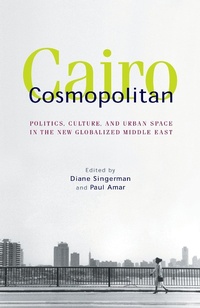
Cairo Cosmopolitan
Politics, Culture, and Urban Space in the New Middle East
Published on 25. August 2009
Book
Paperback/Softback
564 pages
978-977-416-289-3 (ISBN)
Description
A new paperback edition of the first collected volume from the Cairo School of Urban Studies
Bringing together a distinguished interdisciplinary group of scholars, this volume explores what happens when new forms of privatization meet collectivist pasts, public space is sold off to satisfy investor needs and tourist gazes, and the state plans for Egypt's future in desert cities while stigmatizing and neglecting Cairo's popular neighborhoods. These dynamics produce surprising contradictions and juxtapositions that are coming to define today's Middle East.
The original publication of this volume launched the Cairo School of Urban Studies, committed to fusing political-economy and ethnographic methods and sensitive to ambivalence and contingency, to reveal the new contours and patterns of modern power emerging in the urban frame.
Contributors: Mona Abaza, Nezar AlSayyad, Paul Amar, Walter Armbrust, Vincent Battesti, Fanny Colonna, Eric Denis, Dalila ElKerdany, Yasser Elsheshtawy, Farha Ghannam, Galila El Kadi, Anouk de Koning, Petra Kuppinger, Anna Madoeuf, Catherine Miller, Nicolas Puig, Said Sadek, Omnia El Shakry, Diane Singerman, Elizabeth A. Smith, Leila Vignal, Caroline Williams.
Bringing together a distinguished interdisciplinary group of scholars, this volume explores what happens when new forms of privatization meet collectivist pasts, public space is sold off to satisfy investor needs and tourist gazes, and the state plans for Egypt's future in desert cities while stigmatizing and neglecting Cairo's popular neighborhoods. These dynamics produce surprising contradictions and juxtapositions that are coming to define today's Middle East.
The original publication of this volume launched the Cairo School of Urban Studies, committed to fusing political-economy and ethnographic methods and sensitive to ambivalence and contingency, to reveal the new contours and patterns of modern power emerging in the urban frame.
Contributors: Mona Abaza, Nezar AlSayyad, Paul Amar, Walter Armbrust, Vincent Battesti, Fanny Colonna, Eric Denis, Dalila ElKerdany, Yasser Elsheshtawy, Farha Ghannam, Galila El Kadi, Anouk de Koning, Petra Kuppinger, Anna Madoeuf, Catherine Miller, Nicolas Puig, Said Sadek, Omnia El Shakry, Diane Singerman, Elizabeth A. Smith, Leila Vignal, Caroline Williams.
More details
Language
English
Place of publication
Cairo
Egypt
Target group
College/higher education
Professional and scholarly
Product notice
Paperback (trade)
Dimensions
Height: 232 mm
Width: 151 mm
Thickness: 37 mm
Weight
921 gr
ISBN-13
978-977-416-289-3 (9789774162893)
Copyright in bibliographic data and cover images is held by Nielsen Book Services Limited or by the publishers or by their respective licensors: all rights reserved.
Schweitzer Classification
Other editions
Additional editions
Diane Singerman
Cairo Cosmopolitan
Politics, Culture, and Urban Space in the New Globalized Middle East
E-Book
08/2009
I.B.Tauris
€14.49
Available for download
Diane Singerman
Cairo Cosmopolitan
Politics, Culture, and Urban Space in the New Globalized Middle East
E-Book
08/2009
I.B.Tauris
€14.49
Available for download
Persons
Diane Singerman is associate professor in the Department of Government at the School of Public Affairs of American University. She is the author of Avenues of Participation: Family, Politics, and Networks in Urban Quarters of Cairo, and editor of Cairo Contested (AUC Press, 2009).
Paul Amar is assistant professor of law and society at the University of California, Santa Barbara. He is co-editor of The Middle East in Brazil: South-South Relations, Migrations and Recognitions and Police Planet: The Global/Local Origins of Authoritarian Security.
Paul Amar is assistant professor of law and society at the University of California, Santa Barbara. He is co-editor of The Middle East in Brazil: South-South Relations, Migrations and Recognitions and Police Planet: The Global/Local Origins of Authoritarian Security.