

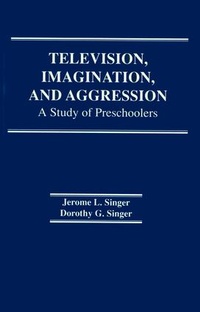
Television, Imagination, and Aggression
A Study of Preschoolers
1st Edition
Published on 15. August 2017
Book
Hardback
224 pages
978-1-138-46738-5 (ISBN)
Description
First Published in 1981. This book presents a detailed account of a two-year study relating preschool children's home television-viewing patterns to their spontaneous behavior, play, aggression, and language use in nursery school settings. It also describes an attempt to modify children's viewing patterns and behavior through interventions with parents and special training procedures. This book will be of special interest to behavioral scientists and graduate students in the fields of child development and communication research.
More details
Language
English
Place of publication
London
United Kingdom
Publishing group
Taylor & Francis Ltd
Target group
Professional and scholarly
Professional
Dimensions
Height: 216 mm
Width: 138 mm
Weight
453 gr
ISBN-13
978-1-138-46738-5 (9781138467385)
Copyright in bibliographic data and cover images is held by Nielsen Book Services Limited or by the publishers or by their respective licensors: all rights reserved.
Schweitzer Classification
Other editions
Additional editions
E-Book
06/2014
1st Edition
Routledge
€68.49
Available for download
E-Book
06/2014
1st Edition
Routledge
€68.49
Available for download
Book
03/1981
Lawrence Erlbaum Associates Inc
€80.65
Shipment within 3-4 weeks
Persons
Content
Chapter 1 Television: Its Potential Role in the Cognitive and Emotional Development of the Child; Chapter 2 The Developmental Study: Participants, Variables, and Procedures; Chapter 3 A Year to Grow: Patterns of TV-Viewing, Behavior, and Language; Chapter 4 Dimensions of Spontaneous Play; Chapter 5 Imaginary Playmates; Chapter 6 Television-Viewing and Aggression Play Observations; Chapter 7 Family Interviews: Home Life Style, TV-Viewing, and Aggression; Chapter 8 Parent-Intervention Study: Rationale, Method, Results; Chapter 9 Television and Imagination: What We Have Learned and What Still Lies Ahead;