

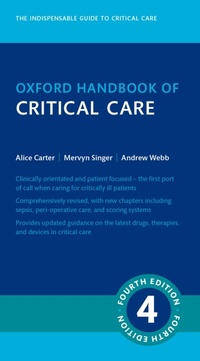
Oxford Handbook of Critical Care
4th Edition
Published on 9. April 2025
Book
752 pages
978-0-19-968887-6 (ISBN)
Description
The fully revised, fourth edition of this bestselling Oxford Handbook describes best practice of critical care in a succinct, concise and clinically-orientated way. Covering the principles of general management, it includes therapeutic and monitoring devices, specific disorders of organ systems, as well as detailed information on drugs and fluids. New material has been added on key areas such as airway maintenance, dressing techniques, infection control, echocardiography, tissue perfusion monitoring, coma and more. With up-to-date references and invaluable clinical advice, there is also plenty of space to add notes or amend sections to suit local protocols.
Patient-centred and practical, it will serve the consultant, trainee, nurse, or other allied health professionals as both a reference and aide memoir. This is the indispensable Oxford Handbook for all those working within critical care.
Patient-centred and practical, it will serve the consultant, trainee, nurse, or other allied health professionals as both a reference and aide memoir. This is the indispensable Oxford Handbook for all those working within critical care.
Reviews / Votes
Review from previous edition "Every ICU should have at least one copy. I think all junior doctors who work on ICU will benefit from owning a copy." * British Journal of Anaesthesia * "It covers all the main, and many of the minor areas involved in intensive care, and will be a valuable aid to nurses and doctors alike... an excellent publication * Critical Care UK * "The information is presented in a concise, and clinically oriented fashion. Sections are well organized... it could serve as a good starting point for individuals who are less familiar with the complex problems often faced in critical care " * Annals of the Royal College of Physicians and Surgeons of Canada * "A dandy little book for those caring for severely or moderately ill adult patients. It covers most bases, fits in your pocket, has thoughtful bookmark ribbons... it is an excellent reference and does deliver on its promise to provide immediate guidance and practical information for any situation likely to be encountered... If you are caring for critically ill patients in your hospital, this is one of the books to have " * Canadian Journal of Rural Medicine * "Singer and Webb's book is an excellent handbook for those working on critical care... Its patient-centred, practical and fully referenced... " * Doody's Journal * "Must have - Professor Singer is an authority in the field and having his teachings in a format of quick consultation and easy learning as an Oxford Handbook for me is the ultimate. It is a very technical book that explains the key aspects of the management of the critical patient I recommend it to anyone who works in the intensive care unit, particularly to the anesthetic and resuscitation specialists." * Amazon UK * This edition of this highly respected handbook remains a go- to reference for all critical care clinicians. It is particularly well suited for Advanced Critical care Practitioners working in clinical practice as an on-shift reference manual for concise reinforcement of current best practice written by clinical experts. Easy to navigate and trust to complement and reinforce clinical decision making. The Oxford Handbook remains my favourite daily resource for at the bedside up to date, effective guidance. * Carole Boulanger, Consultant Advanced Critical Care Practitioner *More details
Series
Edition
4th Revised edition
Language
English
Place of publication
Oxford
United Kingdom
Target group
Professional and scholarly
Edition type
Revised edition
Dimensions
Height: 182 mm
Width: 101 mm
Thickness: 28 mm
Weight
372 gr
ISBN-13
978-0-19-968887-6 (9780199688876)
Copyright in bibliographic data and cover images is held by Nielsen Book Services Limited or by the publishers or by their respective licensors: all rights reserved.
Schweitzer Classification
Persons
Mervyn Singer, Professor of Intensive Care Medicine, Director; NIHR Emeritus Senior Investigator, Bloomsbury Institute of Intensive Care Medicine; University College London, UK, Andrew Webb, Retired Critical Care Physician and Senior Executive; Retired Senior Healthcare Executive, University College London Hospitals, London, UK; Surrey, BC, Canada and Sault Ste Marie, ON, Canada, Alice Carter, Consultant in Anaesthesia and Critical Care; Associate Dean and Director, University College London Hospitals; London Foundation School, NHS England, London, UK
Author
Professor of Intensive Care Medicine, Director ; NIHR Emeritus Senior InvestigatorProfessor of Intensive Care Medicine, Director ; NIHR Emeritus Senior Investigator, Bloomsbury Institute of Intensive Care Medicine; University College London, UK
Retired Critical Care Physician and Senior Executive; Retired Senior Healthcare ExecutiveRetired Critical Care Physician and Senior Executive; Retired Senior Healthcare Executive, University College London Hospitals, London, UK; Surrey, BC, Canada and Sault Ste Marie, ON, Canada
Consultant in Anaesthesia and Critical Care; Associate Dean and DirectorConsultant in Anaesthesia and Critical Care; Associate Dean and Director, University College London Hospitals; London Foundation School, NHS England, London, UK
Content
1: Organisation & management 2: Critical care scoring systems 3: Respiratory therapy techniques 4: Cardiovascular therapy techniques 5: Renal & blood therapy techniques 6: Gastrointestinal therapy techniques 7: Nutrition 8: Wound and pressure area management 9: Respiratory monitoring 10: Cardiovascular monitoring 11: Neurological monitoring 12: Laboratory & point of care monitoring 13: Fluids 14: Respiratory drugs 15: Cardiovascular drugs 16: Gastrointestinal drugs 17: Neurological drugs 18: Haematological drugs 19: Antimicrobial drugs 20: Immunological drugs 21: Resuscitation 22: Respiratory disorders 23: Cardiovascular disorders 24: Renal disorders 25: Gastrointestinal disorders 26: Hepatopancreatobiliary disorders 27: Neurological disorders 28: Haematological disorders 29: Metabolic and endocrine disorders 30: Poisoning 31: Infection, sepsis & inflammation 32: Trauma and burns 33: Disorders of temperature 34: Pain & peri-operative critical care 35: Oncological critical care 36: Obstetric emergencies 37: Transport of the critically ill 38: End of life care