

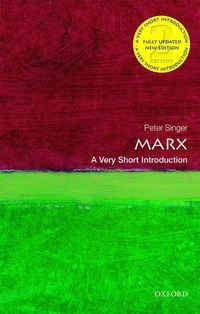
Marx
A Very Short Introduction
2nd Edition
Published on 22. March 2018
Book
Paperback/Softback
160 pages
978-0-19-882107-6 (ISBN)
Description
Karl Marx is one of the most influential philosophers of all time, whose theories have shaped and directed political, economic, and social thought for 150 years. Considering Marx's life and impact, renowned philosopher Peter Singer identifies the central vision that unifies Marx's thought, enabling us to grasp Marx's views as a whole. Presenting Marx as a philosopher primarily concerned with human freedom, rather than as an economist or a social scientist, Singer explains Marx's key ideas on alienation, historical materialism, and the economic theory of Capital, in plain English.
In this new edition, Singer explores whether Marx remains relevant to the twenty first century, and if so, how. Does the fact that eight billionaires now own as much as the bottom half of the world's population give support to Marxist thinking? Does the ease with which conservative politicians can win over working class voters by appealing to nationalism undermines Marx's view of class struggle and the inevitability of victory for the proletariat? Singer ponders key questions such as these, and also discusses the place of the internet as a 'productive force' when analysed in Marxist theory. He concludes with an assessment of Marx's legacy, asking if there is any realistic prospect of replacing capitalism with a better system of production and distribution in the twenty first century.
ABOUT THE SERIES: The Very Short Introductions series from Oxford University Press contains hundreds of titles in almost every subject area. These pocket-sized books are the perfect way to get ahead in a new subject quickly. Our expert authors combine facts, analysis, perspective, new ideas, and enthusiasm to make interesting and challenging topics highly readable.
In this new edition, Singer explores whether Marx remains relevant to the twenty first century, and if so, how. Does the fact that eight billionaires now own as much as the bottom half of the world's population give support to Marxist thinking? Does the ease with which conservative politicians can win over working class voters by appealing to nationalism undermines Marx's view of class struggle and the inevitability of victory for the proletariat? Singer ponders key questions such as these, and also discusses the place of the internet as a 'productive force' when analysed in Marxist theory. He concludes with an assessment of Marx's legacy, asking if there is any realistic prospect of replacing capitalism with a better system of production and distribution in the twenty first century.
ABOUT THE SERIES: The Very Short Introductions series from Oxford University Press contains hundreds of titles in almost every subject area. These pocket-sized books are the perfect way to get ahead in a new subject quickly. Our expert authors combine facts, analysis, perspective, new ideas, and enthusiasm to make interesting and challenging topics highly readable.
Reviews / Votes
An admirably balanced portrait of the man and his achievement. * The Observer *More details
Series
Edition
2nd Revised edition
Language
English
Place of publication
Oxford
United Kingdom
Edition type
Revised edition
Illustrations
12 black and white images
Dimensions
Height: 175 mm
Width: 113 mm
Thickness: 15 mm
Weight
119 gr
ISBN-13
978-0-19-882107-6 (9780198821076)
Copyright in bibliographic data and cover images is held by Nielsen Book Services Limited or by the publishers or by their respective licensors: all rights reserved.
Schweitzer Classification
Other editions
Additional editions
E-Book
03/2018
2nd Edition
OUP eBook
€5.49
Available for download
E-Book
02/2018
2nd Edition
OUP eBook
€5.49
Available for download
Previous edition
Book
10/2000
Oxford University Press
€9.89
Article exhausted; check for reprint
Person
Peter Singer is Ira W. DeCamp Professor of Bioethics in the University Center for Human Values at Princeton University, a position that he now combines with the position of Laureate Professor at the University of Melbourne. An Australian, in 2012 he was made a Companion to the Order of Australia, his country's highest civilian honour. His books include Animal Liberation (1975; Bodley Head, 2015) Practical Ethics (1979; CUP, 2011), The Life You Can Save (Picador, 2010), and The Most Good You Can Do (Yale University Press, 2015).
Content
1: A life and its legacy 2: The young Hegelian 3: From God to money 4: Enter the proletariat 5: The first Marxism 6: Tracing the development of the Materialist theory of history 7: The goal of history 8: Economics 9: Communism and revolution 10: Was Marx right? 11: Is Marx still relevant?Further ReadingIndex