

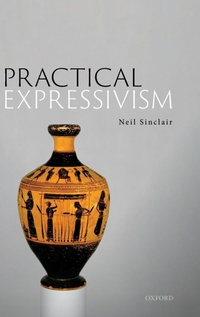
Practical Expressivism
Published on 4. February 2021
Book
Hardback
320 pages
978-0-19-886610-7 (ISBN)
Description
What is morality? In Practical Expressivism, Neil Sinclair argues that morality is a purely natural interpersonal co-ordination device, whereby human beings express their attitudes in order to influence the attitudes and actions of others.
The ultimate goal of these expressions is to find acceptable ways of living together. This 'expressivist' model for understanding morality faces well-known challenges concerning 'saving the appearances' of morality, because morality presents itself to us as a practice of objective discovery, not pure expression.
This book demonstrates how a properly developed expressivist view can overcome this objection, by showing that even if moral practice is fundamentally expressive, it can still come to possess those features that make it appear objective (features such as talk and thought of moral disagreement, truth and belief, and the applicability of logical notions to moral sentences). The key to this development is to emphasise the unique and intricate practical role that morality plays in our lives. Practical expressivism is also practical in the further sense that it provides repeatable patterns that expressivists can deploy in coming to understand the apparently objective features of morality.
The ultimate goal of these expressions is to find acceptable ways of living together. This 'expressivist' model for understanding morality faces well-known challenges concerning 'saving the appearances' of morality, because morality presents itself to us as a practice of objective discovery, not pure expression.
This book demonstrates how a properly developed expressivist view can overcome this objection, by showing that even if moral practice is fundamentally expressive, it can still come to possess those features that make it appear objective (features such as talk and thought of moral disagreement, truth and belief, and the applicability of logical notions to moral sentences). The key to this development is to emphasise the unique and intricate practical role that morality plays in our lives. Practical expressivism is also practical in the further sense that it provides repeatable patterns that expressivists can deploy in coming to understand the apparently objective features of morality.
Reviews / Votes
The accommodation project that Sinclair articulates seems mightily laudable, and his attempt to execute significant chunks of it contains a lot that is helpful and of interest with regard to the prospects of expressivist views in metaethics. * Teemu Toppinen, Tampere University, Ethics * While explaining and defending practical expressivism, Sinclair discusses many key controversies in metaethics. Valuable for students and scholars of moral philosophy, ethical theory, and metaethics. * J. R. Shook, CHOICE * Anyone interested in metaethics can find a lot to learn and think about in this superb book, and I am sure it only marks the starting point in systematic thinking about the view it champions. * S. Kohler, Philosophical Review *More details
Language
English
Place of publication
Oxford
United Kingdom
Target group
Professional and scholarly
Dimensions
Height: 240 mm
Width: 161 mm
Thickness: 21 mm
Weight
637 gr
ISBN-13
978-0-19-886610-7 (9780198866107)
Copyright in bibliographic data and cover images is held by Nielsen Book Services Limited or by the publishers or by their respective licensors: all rights reserved.
Schweitzer Classification
Other editions
Additional editions
Person
Neil Sinclair studied Philosophy at Cambridge and Oxford, culminating in a PhD from Cambridge in 2006. Subsequently he has taught philosophy at several UK Universities, including Bristol, Oxford, St. Andrews, and Nottingham. He was awarded a University of Nottingham Lord Dearing Award for Teaching in Learning in 2014 and the Marc Sanders Metaethics Prize in 2016. He has published more than 25 papers on metaethics including for journals such as Analysis, Biology and Philosophy, and Philosophical Studies. He is the editor of The Naturalistic Fallacy (Cambridge University Press 2018) and Explanation in Ethics and Mathematics (with Uri D. Leibowitz, Oxford University Press 2016) and an area editor for Ergo: An Open Access Journal of Philosophy.
Content
Preface
1: The Subject Matter of Metaethics
2: Practical Expressivism, Morality's Function, and Moral Attitudes
3: Practical Expressivism, Expression, and Quasi-Realism
4: Moral Disagreement and Reason-Giving
5: The Frege-Geach Problem
6: Subsentential Metasemantics
7: Truth, Truth-aptness, and Belief
8: Mind-Independent Moral Truths and Categorical Moral Reasons
9: Practical Expressivist Strategies and Presumptive Arguments for Realism
10: Conclusion
Appendix A: Comparison with Other Versions of Expressivism
Bibliography
1: The Subject Matter of Metaethics
2: Practical Expressivism, Morality's Function, and Moral Attitudes
3: Practical Expressivism, Expression, and Quasi-Realism
4: Moral Disagreement and Reason-Giving
5: The Frege-Geach Problem
6: Subsentential Metasemantics
7: Truth, Truth-aptness, and Belief
8: Mind-Independent Moral Truths and Categorical Moral Reasons
9: Practical Expressivist Strategies and Presumptive Arguments for Realism
10: Conclusion
Appendix A: Comparison with Other Versions of Expressivism
Bibliography