

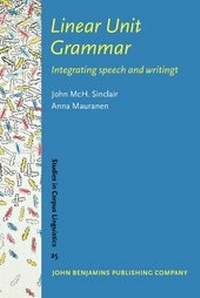
Linear Unit Grammar
Integrating speech and writing
Published on 29. November 2006
Book
Hardback
185 pages
978-90-272-2298-5 (ISBN)
Description
People have a natural propensity to understand language text as a succession of smallish chunks, whether they are reading, writing, speaking or listening. Linguists have found that this propensity can shed light on the nature and structure of language, and there are many studies which attempt to harness the potential of natural chunking.This book explores the role of chunking in the description of discourse, especially spoken discourse. It appears that chunking offers a sound but flexible platform on which can be built a descriptive model which is more open and comprehensive than more familiar approaches to structural description. The model remains linear, in that it avoids hierarchies, and it concentrates on the combinatorial patterns of text.
The linear approach turns out to have many advantages, bringing together under one descriptive method a wide variety of different styles of speech and writing. It is complementary to established grammars, but it raises pertinent questions about many of their assumptions.
The linear approach turns out to have many advantages, bringing together under one descriptive method a wide variety of different styles of speech and writing. It is complementary to established grammars, but it raises pertinent questions about many of their assumptions.
More details
Series
Language
English
Place of publication
Amsterdam
Netherlands
Target group
College/higher education
Professional and scholarly
Dimensions
Height: 245 mm
Width: 164 mm
Weight
505 gr
ISBN-13
978-90-272-2298-5 (9789027222985)
Copyright in bibliographic data and cover images is held by Nielsen Book Services Limited or by the publishers or by their respective licensors: all rights reserved.
Schweitzer Classification
Other editions
Additional editions
E-Book
11/2006
1st Edition
John Benjamins Publishing Company
€118.99
Available for download
Persons
Content
1. Dedication; 2. Acknowledgements; 3. Preamble; 4. Introduction; 5. Section A: Preliminaries; 6. Setting the scene; 7. Background; 8. Data description; 9. Section B: Analysis; 10. System of analysis; 11. Provisional Unit Boundaries; 12. Types of chunks; 13. Types of organisational elements; 14. Types of increments to shared experience; 15. Synthesis; 16. Section C: Theory and follow-up; 17. The example texts analysed; 18. Theoretical synopsis; 19. Looking ahead; 20. Appendix; 21. Bibliography; 22. Index of names; 23. Index of subjects