

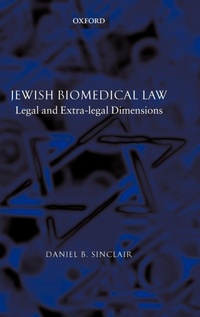
Jewish Biomedical Law
Legal and Extra-Legal Dimensions
Published on 2. October 2003
Book
Hardback
304 pages
978-0-19-826827-7 (ISBN)
Description
Jewish Biomedical Law deals with the controversial issues of abortion, assisted reproduction, genetics, the obligation to heal, patient autonomy, treatment of the terminally ill, the definition of death, organ donations, and the allocation of scarce medical resources in Jewish Law.
The volume focuses upon the complex interplay between legal and moral elements in the decision-making process, particularly when questions of life and death (such as abortion and treatment of the terminally ill) are involved. Sinclair argues that the moral element in Jewish biomedical law is of a universal, rational nature, and its theoretical basis may be located in a weak form of Natural law theory regarding the value of human life in the Jewish legal tradition.
The concept of patient autonomy in Jewish biomedical law is more limited than in contemporary liberal jurisprudence, and is based upon theological as well as strictly legal elements. The influence of scientific thinking upon the decision-making process in Jewish biomedical law is illustrated in a discussion of the contemporary debate concerning the permissibility of heart transplants.
In most chapters, Jewish law is compared and contrasted with Canon and Common Law, and the volume also discusses the role played by Jewish biomedical law in modern, secular Israeli law. In this context, it addresses the thorny issue of combining religious law with democratic principles within the framework of a secular legal system.
The volume focuses upon the complex interplay between legal and moral elements in the decision-making process, particularly when questions of life and death (such as abortion and treatment of the terminally ill) are involved. Sinclair argues that the moral element in Jewish biomedical law is of a universal, rational nature, and its theoretical basis may be located in a weak form of Natural law theory regarding the value of human life in the Jewish legal tradition.
The concept of patient autonomy in Jewish biomedical law is more limited than in contemporary liberal jurisprudence, and is based upon theological as well as strictly legal elements. The influence of scientific thinking upon the decision-making process in Jewish biomedical law is illustrated in a discussion of the contemporary debate concerning the permissibility of heart transplants.
In most chapters, Jewish law is compared and contrasted with Canon and Common Law, and the volume also discusses the role played by Jewish biomedical law in modern, secular Israeli law. In this context, it addresses the thorny issue of combining religious law with democratic principles within the framework of a secular legal system.
Reviews / Votes
This excellent new book makes an important contribution to the English-language literature on Jewish medical ethics. ... Daniel Sinclair's book will help us navigate today's challenges, preserving the Jewish moral tradition without enslavement to a mistakenly inflexible interpretation of the halakhah * The Israel Medical Association Journal, November 2004 *More details
Language
English
Place of publication
Oxford
United Kingdom
Target group
Professional and scholarly
Dimensions
Height: 240 mm
Width: 161 mm
Thickness: 21 mm
Weight
622 gr
ISBN-13
978-0-19-826827-7 (9780198268277)
Copyright in bibliographic data and cover images is held by Nielsen Book Services Limited or by the publishers or by their respective licensors: all rights reserved.
Schweitzer Classification
Person
Rabbi Daniel Sinclair is Professor of Jewish Comparative Biomedical Law at the College of Management Academic Studies in Tel-Aviv.
Content
Introduction ; Abortion ; Assisted Reproduction ; Genetics ; The Obligation to Heal and Patient Autonomy ; The Terminally Ill Patient ; Science, Halakhah, and Public Health Policy: The Definition of Death, heart transplants, Organ Donations, and the Allocation of Scarce Medical Resources ; Conclusion