

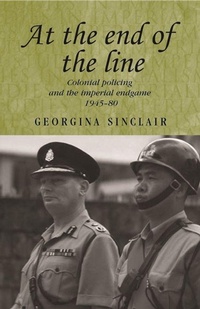
At the End of the Line
Colonial Policing and the Imperial Endgame 1945-80
Published on 30. November 2006
Book
Hardback
264 pages
978-0-7190-7138-6 (ISBN)
Description
Colonial policing and the imperial endgame is the first comprehensive study of the colonial police and their complex role within Britain's long and turbulent process of decolonisation, a time characterised by political upheaval and colonial conflict.
The Colonial Police Service was created in 1936 in order to standardise all imperial police forces and mould colonial policing to the British model. From the British Caribbean to the Middle East, the Mediterranean to British Colonial Africa and on to Southeast Asia, colonial police forces struggled with the unrest and conflict that stemmed from Britain's withdrawal from its empire. As the shadow of decolonisation grew ever longer, so colonial police forces reverted back to their traditional role as a colony's first line of defence. At the same time, as tensions increased throughout the empire, so too did the power of the police through the development of police intelligence systems and counter-insurgency units. Colonial policing and the imperial endgame controversially asserts that it was coercion rather than consent which was more commonly associated with the work of police forces during this period of political dislocation.
Georgina Sinclair's focussed study of colonial policing during this period facilitates a greater understanding of the processes of decolonisation. -- .
The Colonial Police Service was created in 1936 in order to standardise all imperial police forces and mould colonial policing to the British model. From the British Caribbean to the Middle East, the Mediterranean to British Colonial Africa and on to Southeast Asia, colonial police forces struggled with the unrest and conflict that stemmed from Britain's withdrawal from its empire. As the shadow of decolonisation grew ever longer, so colonial police forces reverted back to their traditional role as a colony's first line of defence. At the same time, as tensions increased throughout the empire, so too did the power of the police through the development of police intelligence systems and counter-insurgency units. Colonial policing and the imperial endgame controversially asserts that it was coercion rather than consent which was more commonly associated with the work of police forces during this period of political dislocation.
Georgina Sinclair's focussed study of colonial policing during this period facilitates a greater understanding of the processes of decolonisation. -- .
More details
Series
Language
English
Place of publication
Manchester
United Kingdom
Target group
College/higher education
Product notice
Unsewn / adhesive bound
Cloth over boards
With dust jacket
Illustrations
Illustrations, black & white|Tables
Dimensions
Height: 240 mm
Width: 167 mm
Thickness: 26 mm
Weight
553 gr
ISBN-13
978-0-7190-7138-6 (9780719071386)
Copyright in bibliographic data and cover images is held by Nielsen Book Services Limited or by the publishers or by their respective licensors: all rights reserved.
Schweitzer Classification
Other editions
Additional editions
E-Book
03/2017
1st Edition
Manchester University Press
€27.49
Available for download
Person
Georgina Sinclair is Lecturer in Decolonisation in the School of History at the University of Leeds -- .
Content
Acknowledgements
PReface
Chapter 1
Chapter 2
Chapter 3
Chapter 4
Chapter 5
Chapter 6
Chapter 7
Chapter 8
Chapter 9
Afterword
Select Bibliography
Appendices -- .
PReface
Chapter 1
Chapter 2
Chapter 3
Chapter 4
Chapter 5
Chapter 6
Chapter 7
Chapter 8
Chapter 9
Afterword
Select Bibliography
Appendices -- .